

How Much Is a Gold Bar Worth?
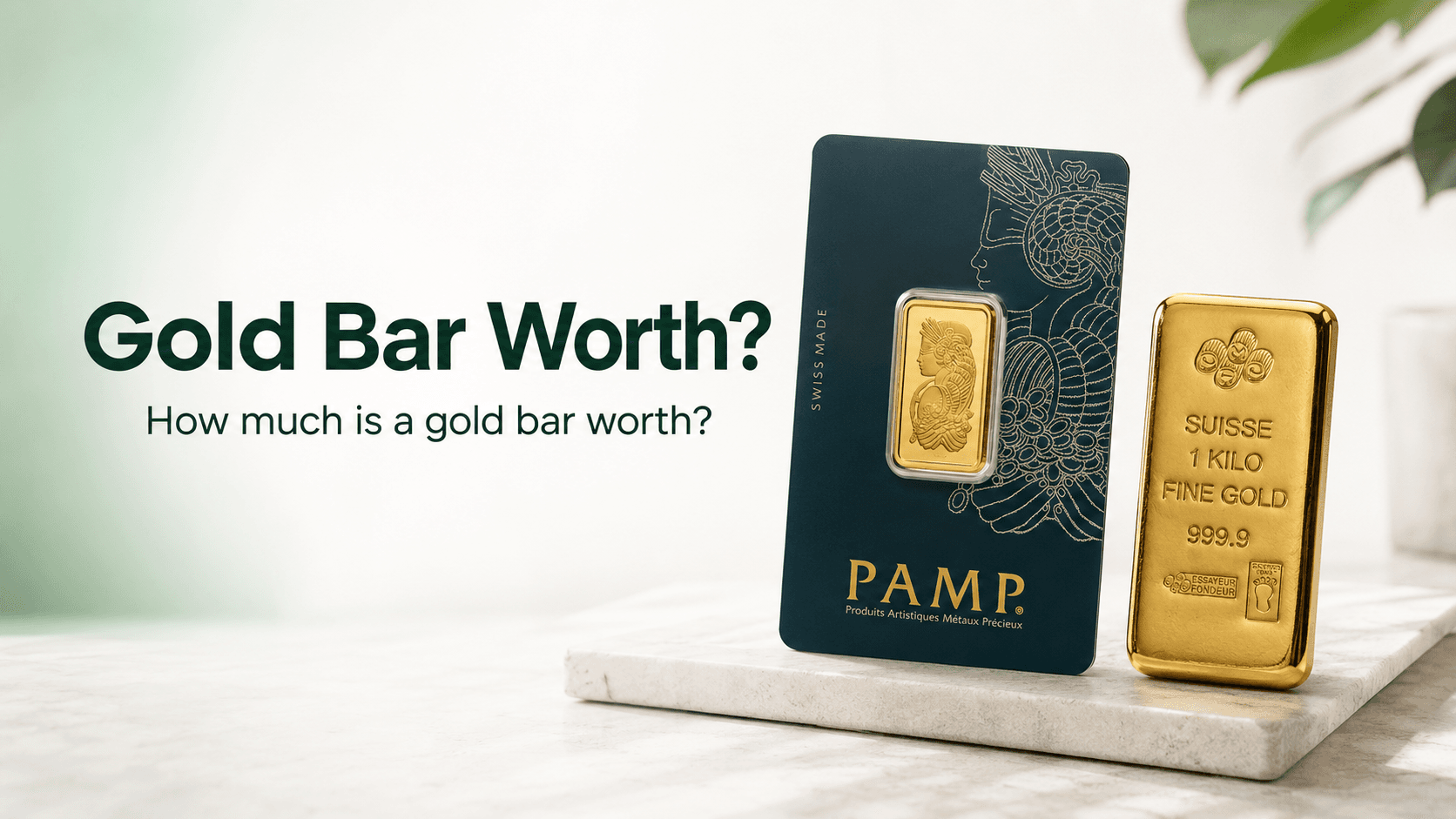

A gold bar is worth its weight in pure gold, measured in troy ounces, times whatever gold's spot price happens to be at that moment. Scale it up and the math holds: a 400 ounce bar is 400 times the 1 ounce number. That's the underlying value. What you'd actually pay to buy a bar, and what you'd get handed if you sold one today, are two different prices entirely. Most explainers on this topic stop at spot and never get to the gap.
Gold bar value by size
Bar sizes span a huge range, and the value scales in a straight line with weight. The figures below use a spot price of $4,165.30 per troy ounce, the rate implied by Pure's live order book on July 6, 2026 at 2:29 PM PT. Gold moves throughout the day, sometimes by a lot, so treat this table as a worked example, not a current quote.
Bar size | Approx. gold content | Value at $4,165.30/oz spot |
|---|---|---|
1 gram | 0.0322 troy oz | $134 |
1 troy ounce | 1 troy oz | $4,165 |
100 grams | 3.215 troy oz | $13,392 |
10 troy ounces | 10 troy oz | $41,653 |
1 pound (avoirdupois) | 14.58 troy oz | $60,744 |
1 kilogram | 32.15 troy oz | $133,917 |
100 troy ounces | 100 troy oz | $416,530 |
400 troy ounces ("good delivery" bar) | 400 troy oz | $1,666,120 |
*Dollar values are rounded to the nearest whole dollar.*
The 400 ounce bar is the standard institutional size, known in the market as an LBMA Good Delivery bar, and it's the one sitting in central bank and LBMA vaults.
Almost nobody buys one directly.
Everything below 100 ounces is what actually shows up on a retail or marketplace listing.
How a gold bar's value is calculated
Weight times purity times spot. Multiply those three and you have the whole formula, though each piece is doing more work than it looks like on paper.
Start with weight. It's measured in troy ounces, not the ounces on a kitchen scale, and a troy ounce runs about 10% heavier than a standard avoirdupois ounce, 31.1 grams against 28.35. The whole precious metals market still prices against a unit that traces back to medieval bullion fairs. We've written a full explainer on what a troy ounce actually is if that's the part that's confusing you.
Purity works the same way but gets less attention. It's stated as fineness, and most investment-grade bars run .9999 fine, 99.99% pure gold. Drop to .999 or lower and there's slightly less actual gold per unit of weight, so the math shifts. Nobody at a real counter rounds this away.
Spot is different from both. It's the wholesale, unfabricated price of gold at that instant, set continuously through global trading and benchmarked twice daily by the LBMA auction, and it's the number every dealer, refiner, and marketplace starts their own pricing from. On its own, spot isn't what you'll pay.
Spot value vs. what you actually pay
Spot tells you what the metal is worth. It doesn't tell you what a dealer will charge you for a physical bar, because turning raw gold into a stamped, assayed, verified bar costs money, and that cost gets passed to the buyer as a premium.
On a 1 oz PAMP Suisse "Good Luck Koi Fish" gold bar, Pure's live order book showed a lowest ask of $4,290.26 against that $4,165.30 spot on July 6, 2026. That's $124.96 over spot, a 3.00% premium. On a plainer 1 oz bar from the same refiner, the premium at that same moment was closer to 0.8%. Design and rarity move the premium; the underlying gold content doesn't change at all.
Smaller bars carry higher premiums per ounce than larger ones. A lot of first-time buyers get surprised by this. A refiner's fixed costs, stamping a serial number, running the assay, sealing the card, barely shrink when the bar does. Spread those costs over one gram instead of a hundred ounces and the markup per ounce climbs, even though the 1 gram bar is by far the cheaper thing to buy outright. We break down premium mechanics in more depth here.
Pure's typical premiums run roughly 3-5% over spot, against an industry range that commonly runs 10-30% at retail dealers and coin shops, and the entire gap comes down to fee structure rather than anything different about the metal itself.
What a gold bar is worth when you sell it
Selling flips the question. You're not asking what you'd pay; you're asking what a buyer will pay you, and that's a separate number entirely.
On an order-book marketplace, every listing shows a highest bid and lowest ask side by side, the bid being the most any buyer is currently offering and the ask the least any seller will part with the bar for. On that same Koi Fish bar, the highest bid was $4,212.58 on July 6, 2026, which works out to $51.28 over spot, or 1.23%. That's what a seller would have gotten right then, before any marketplace fee took its cut.
The bid and the ask move independently; they don't have to sit an equal distance from spot. Some listings show an ask barely above spot, next to no markup for the buyer. Others climb a lot further out, and that's worth checking before writing off a bar as a bad deal just because the headline price looks high. Reading a live order book takes about two minutes once you know what you're looking at.
None of this signals where gold is headed next, just how a two-sided market happened to price one physical bar at one moment on July 6, 2026.
Gold bar weights and units
Bars get sold in a mix of metric and imperial units depending on where the refiner is based, which is why the same "1 kilo bar" and "100 ounce bar" show up in the same catalog without much explanation.
Unit | Troy ounces | Grams |
|---|---|---|
1 gram | 0.0322 | 1 |
1 pennyweight | 0.08 | 1.555 |
1 troy ounce | 1 | 31.1035 |
1 avoirdupois ounce (standard) | 0.911 | 28.35 |
1 avoirdupois pound | 14.58 | 453.592 |
1 kilogram | 32.15 | 1,000 |
A retail "pound" of gold almost always means 14.58 troy ounces, the standard avoirdupois pound, not the 12-ounce troy pound some buyers expect walking in. That mismatch trips up more people than any other unit on this page, and it's why you'll see both numbers floating around for the same bar. Full unit-by-unit detail, including where each convention came from, is in our troy ounce guide. For weight specifically rather than value, there's also our piece on how much a gold bar weighs.
Who makes gold bars, and how their value gets verified
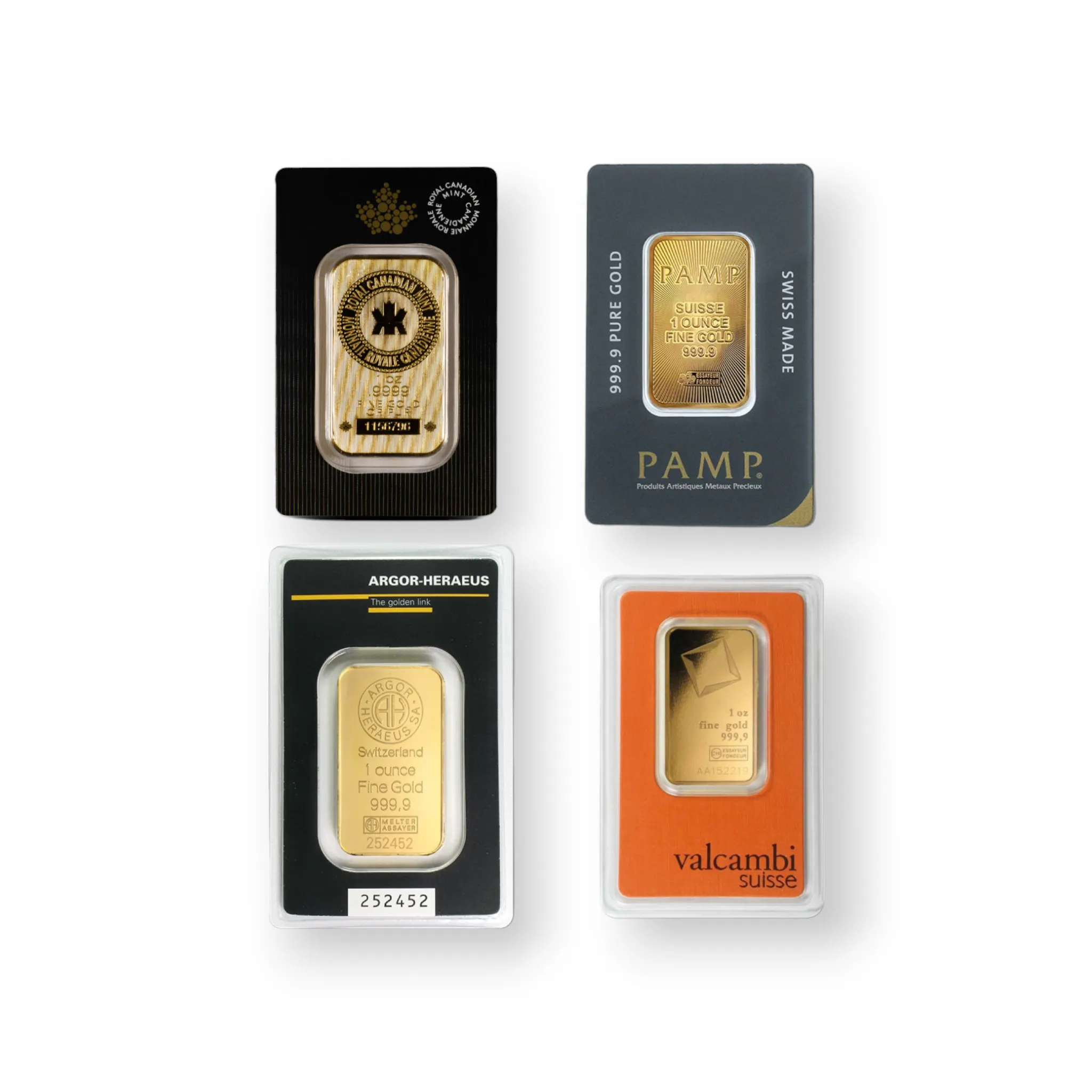
A short list of refiners produces most of the investment-grade gold bars in circulation: PAMP Suisse, Argor-Heraeus, and Valcambi out of Switzerland, plus national mints like the Royal Canadian Mint and the Perth Mint. Each stamps its bars with a serial number, weight, and fineness, and most ship sealed in an assay card that certifies the contents without opening the seal.
A sealed assay card is why a bar can trade sight-unseen at all. Break the seal, and a buyer has no way to confirm what's inside without re-testing it. On Pure, every bar that comes back into the marketplace through a sell order goes through XRF and Sigma testing before it's relisted, the same verification a bar gets before it's marked Pure Qualified. A bar's stated value only holds up after it's left the refiner's hands if something like that keeps checking it.
Where to check a gold bar's value right now
Spot price sites give you the wholesale number. To see what a specific bar is actually trading for, bid and ask included, you need a live market, not a static chart.
Pure's gold under-spot page shows current listings where the ask sits at or below spot, along with the full order book for each one. It's the fastest way to see a real bid/ask spread on a specific bar size instead of doing the spot-times-weight math yourself. You can also browse all gold listings if you're looking at something other than an under-spot deal.
FAQ
How much is a 1 oz gold bar worth?
A 1 oz bar's gold content is worth spot times one, no more and no less. On July 6, 2026, that was $4,165.30. What you'd pay to buy one runs higher once the premium is added, typically a few percent over that on Pure, and often 10% or more at a retail dealer. Check a live order book for the current number, since spot moves daily.
How much is a 10 oz gold bar worth?
Ten times the 1 oz figure, since the content scales linearly with weight. Using the same July 6, 2026 spot of $4,165.30/oz, that's $41,653 in gold content before any premium.
What's the actual difference between a gold bar's spot value and its price?
Spot value only counts the wholesale gold content, nothing else. Whatever a seller lists a bar for adds the cost of turning that raw metal into a finished, assay-verified bar, plus their margin. Two bars carrying identical gold content can list at very different prices if their premiums aren't the same.
What would I actually get if I sold a gold bar?
Whatever the highest bid on that exact bar is at that moment, minus any marketplace or dealer fee. Not spot, and usually not the ask price either. Check the bid side of the order book, not the headline "value," if you're trying to estimate a real payout.