

What Is a Troy Ounce? Grams, Weight, and Why It Matters
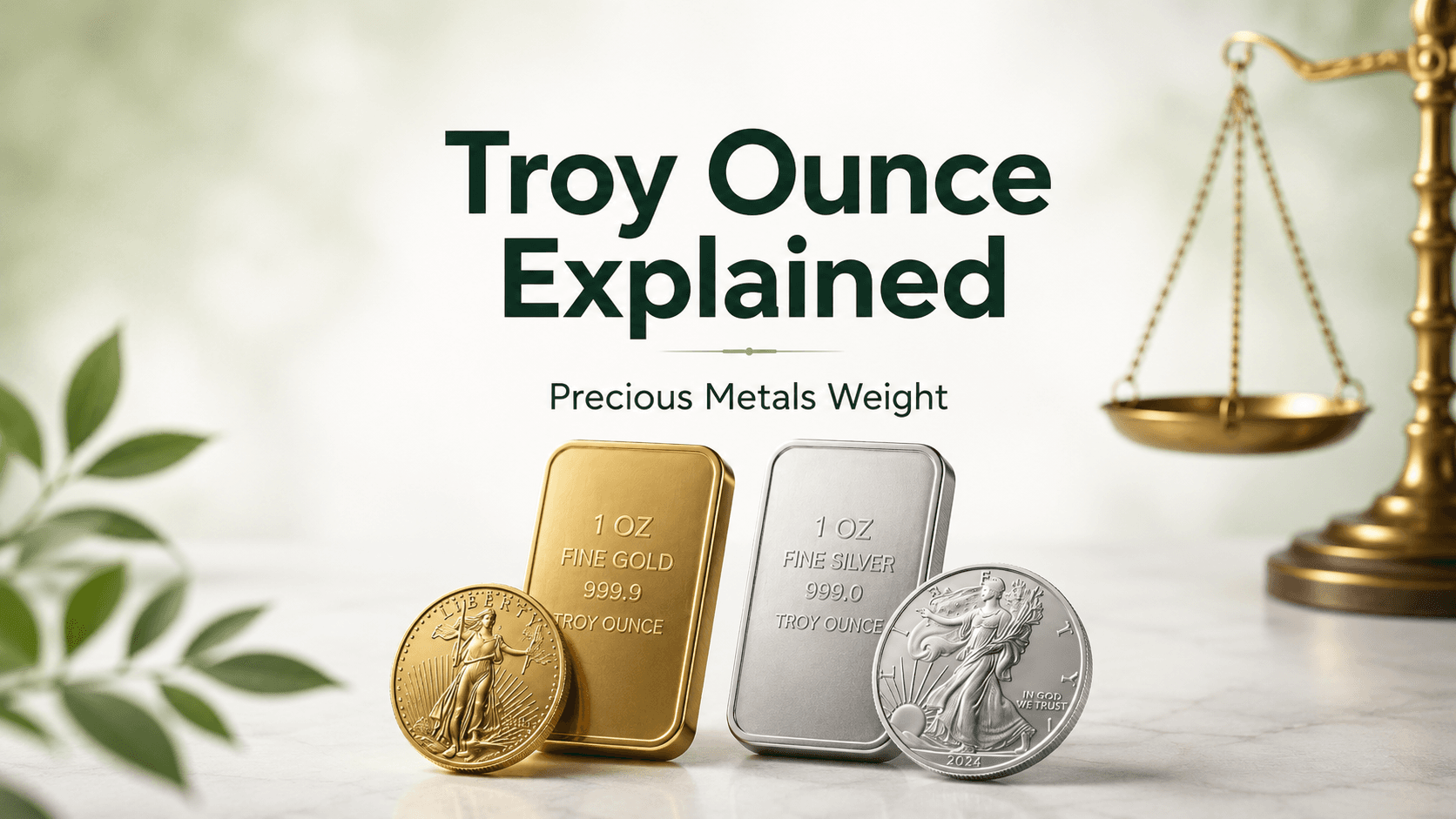

Buy a one ounce gold coin, set it on a kitchen scale, and it reads heavier than an ounce. The scale is not broken. Precious metals are weighed in a different unit called the troy ounce, and it is not the ounce you use for food or postage.
Gold, silver, platinum, palladium: all of them get weighed this way. The number you want is 31.1034768 grams. That is one troy ounce. The ounce printed on a food label is a different animal, the avoirdupois ounce, and it comes in at 28.35 grams. Heavier by roughly 2.75 grams. Call it 10%. Anytime the metals world says "ounce," troy is what it means, whether the word shows up on a coin, a bar, or a price quote.
The 10% sounds trivial. On one coin it nearly is. Stack a few hundred ounces and it stops being trivial, which is the whole reason to get it straight before money changes hands.
How to read it on a coin or bar
The weight gets abbreviated a handful of ways, and they all mean the same thing:
ozt is the proper symbol. A piece stamped "1 ozt" holds a full troy ounce.
oz t, with a space, turns up on some mint markings.
Plain oz on bullion is troy too, not the kitchen kind, even though nothing on the coin says so.
31.1 g is the same weight written in grams, which is how a lot of international and metric-market product is marked.
Troy ounce vs the standard ounce
The two ounces come from different weight systems. The kitchen scale runs on avoirdupois, which the US leans on for almost everything you weigh in daily life. Precious metals never made the switch and stayed on the older troy system.
Now the genuinely confusing part. A troy ounce outweighs a standard ounce, yet a troy pound weighs less than a standard pound. How? A troy pound is only 12 troy ounces, 373.24 grams. A standard pound packs 16 avoirdupois ounces, 453.59 grams. So a pound of gold and a pound of sugar are not the same weight at all, and it is the gold that comes up short. Jewelers and refiners live in troy every day. The rest of us go a lifetime without touching it.
Why gold and silver are weighed in troy ounces
It is an old system. The name most likely traces back to Troyes, a French market town whose medieval trade fairs pulled in merchants who needed one weight they could all agree on for precious goods. England ran with troy for gold and silver. The US Mint has weighed coinage in it since the country wrote its first coinage laws back in the 1790s.
Why did it last? Trade only works if everyone means the identical thing by "an ounce." The big benchmarks all settled on troy and never moved off it. The LBMA price out of London, the COMEX futures contracts: priced per troy ounce, every one. So when you pull up a gold spot price, you are looking at the cost of exactly one troy ounce.
How the troy ounce shows up when you buy or sell
Once you are actually buying, the unit does real work. A few things fall right out of it.
A "1 oz" gold or silver coin carries one troy ounce of metal, full stop. The American Gold Eagle is a good example with a wrinkle: it holds a full troy ounce of gold, but the coin itself tips the scale a touch higher, because it is alloyed with copper and silver so it can survive being handled. The Canadian Gold Maple Leaf skips the alloy and runs one troy ounce at .9999 fineness. Fractional pieces just split the same unit. A 1/10 oz gold coin is 3.11 grams of gold.
And spot is quoted per troy ounce, so any coin or bar sells for its metal content plus a premium. That premium is what sits on top of spot to cover minting, distribution, and the seller's margin. Pricing by the troy ounce is the thing that lets you pull those two numbers apart, the gold itself on one side, the product cost on the other.
On Collect Pure, gold and silver trade by the troy ounce on an order book. Rather than one dealer posting a single take-it-or-leave-it number, you place your order against the live buy and sell orders already on the book. The premium over spot shows up right on the order. You see what you are paying above the metal before you commit to anything.
"Most people don't realize the 'ounce' on a gold coin isn't the one on their kitchen scale. Once you do, you start asking the better question: what am I actually paying over the metal? That's exactly what we show you on the order." Aidan Schwartz, Collect Pure
Troy weight units you will see
For bullion you can mostly get by on grams and troy ounces. The rest of the troy ladder still turns up though, on jewelry, on scrap, and on the troy pound that caused all the trouble two sections back.
Unit | Equals | Grams |
Grain | the shared base unit | 0.0648 g |
Pennyweight (dwt) | 24 grains, 1/20 troy ounce | 1.555 g |
Troy ounce (ozt) | 20 pennyweights, 480 grains | 31.1035 g |
Troy pound | 12 troy ounces | 373.24 g |
Notice the grain at the bottom. Both the troy and avoirdupois systems are built up from it, which is why a grain weighs the same 0.0648 g in either one. The pennyweight, dwt for short, is the one a jeweler reaches for, and it is still how a lot of scrap gold gets priced by weight.
Frequently asked questions
How many grams are in a troy ounce?
31.1034768, rounded to 31.1 nearly everywhere. Every per-ounce gold and silver spot price you have ever seen is built on that number.
Is a troy ounce heavier than a regular ounce?
Yes. About 10% heavier, 31.1 grams against the kitchen scale's 28.35. Do not swap one for the other when metal is involved.
How many troy ounces are in a pound of gold?
Depends which pound you mean. Gold gets measured in troy pounds, and a troy pound is 12 troy ounces. Plug in a regular avoirdupois pound instead and you land at roughly 14.58 troy ounces.
What does "ozt" mean on a coin or bar?
Troy, not the avoirdupois ounce off your kitchen scale. So "1 ozt" of gold is a full troy ounce of gold, 31.1 grams of it.
Browse gold priced by the troy ounce
Every gold listing on Collect Pure shows its live premium over spot, so the metal cost and the product cost sit side by side instead of buried in one figure. Browse gold on the marketplace and compare.