

Dimes Worth Money: What Years, Errors and Silver to Look For
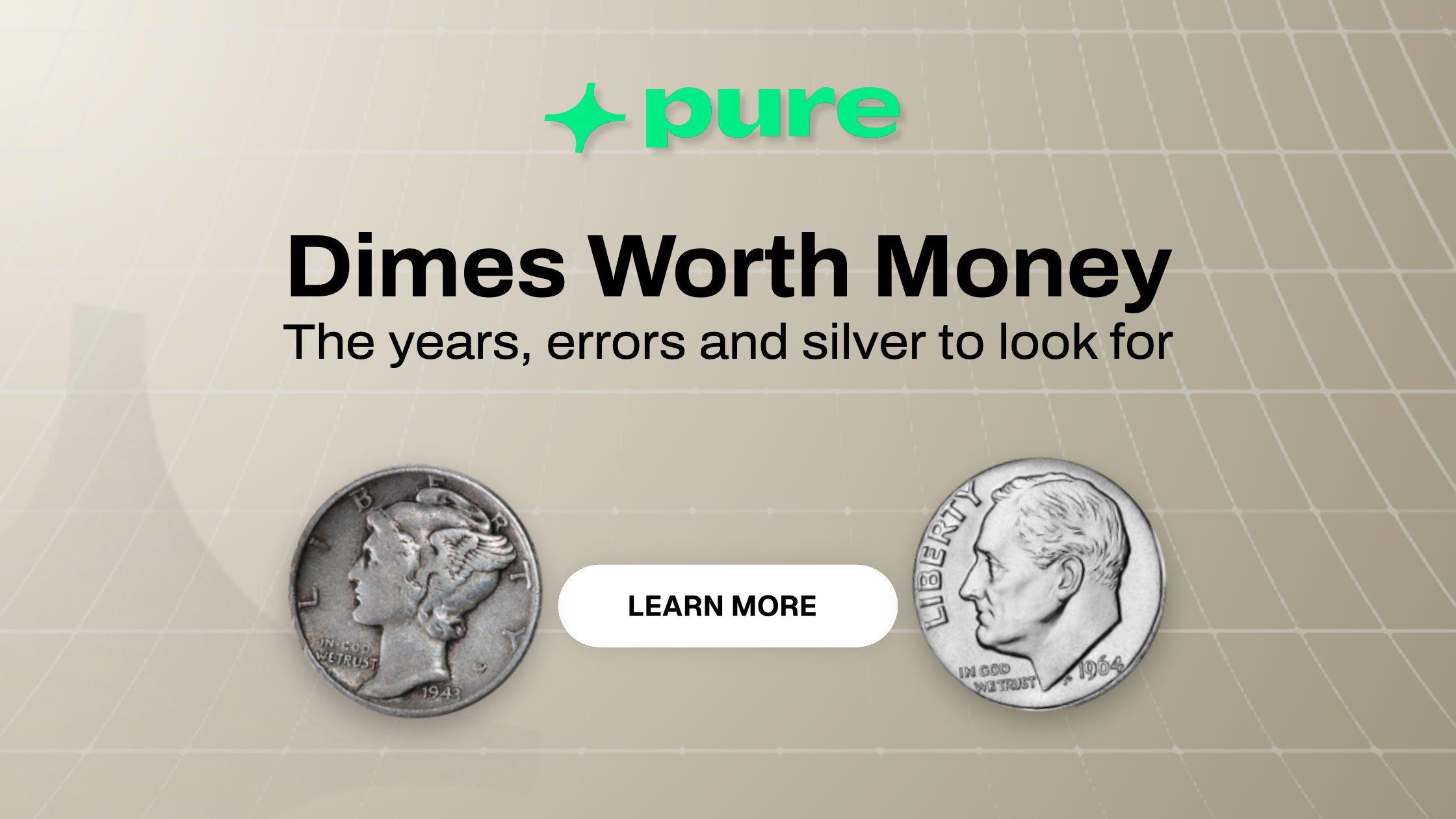

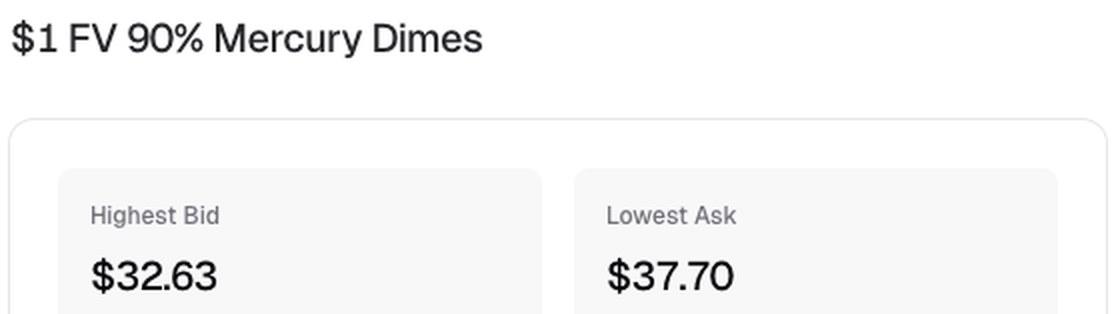
The dimes worth money are any dated 1964 or earlier, which are 90% silver, plus a short list of key dates and errors: the 1916-D Mercury, the 1942/1 overdates, the 1968, 1970, 1975 and 1983 no-S proofs, and the 1982 No P. Ten silver dimes ($1 face of 90% Mercury dimes) had a top bid of $32.63 on Pure at 3:31 pm Pacific on November 17, 2026; it's moved since. The 1916-D is guided at $1,750 even in Good-4. Most other dimes in your change are worth ten cents.
Guide figures in this post are the PCGS price guide as of November 2026. Everything else is a single auction sale, and none of it is a quote for your coin.
What year dimes are worth money
Oldest first, with the thing to check on each:
1873-CC: Seated Liberty, the No Arrows variety. One is known.
1894-S: Barber dime with an S under the bow on the back. 24 were struck.
1895-O: Barber dime, O under the bow.
1916-D: Mercury dime with a D on the back, lower left of the fasces (the big design in the middle).
1921 and 1921-D: Mercury dimes. The date is the whole check.
1942/1 and 1942/1-D: Mercury overdates, a faint 1 hiding under the last 2.
1964 and earlier: silver, any mint, any condition.
1965: only if it weighs 2.50 g instead of 2.268 g (struck on a leftover silver blank).
1968, 1970, 1975, 1983: proof dimes with no S above the date (proofs only; a regular 1975 is ten cents).
1982: a regular circulation dime with no P above the date.
1996-W: a W above the date. Only came in that year's mint set.
Outside the silver and the 1921s, a year by itself won't do it. You need the mintmark or the error too. After that it's condition.
Silver dimes: what a 1964 dime is worth, and every year before
This is the one you'll really find. Roosevelt dimes from 1946 through 1964 are silver, same as the Mercury and Barber dimes before them: 2.50 grams, 90% silver, the rest copper, so there's 0.0723 troy oz of silver in each. That number holds for 1892 through 1964. Older Seated dimes are their own thing (the 1873-CC further down weighs 2.48 g).
Then the Coinage Act of 1965 made the dime copper-nickel clad at 2.268 grams, starting with coins dated 1965. So 1964 is the last silver year.
Melt math is easy. Silver read $47.38 on Pure's ticker in that same 3:31 pm capture; at that price a 90% dime had about $3.43 of silver in it. Do the multiplication yourself on whatever day you're reading this; the 0.0723 doesn't change.
Most of these turn up in old rolls and inherited coffee cans, not in change. A roll of dimes is 50 coins, $5 face (the full rundown is in how many coins are in a roll), so a full silver roll works out to a little over 3.6 troy oz. Worn common dates are just silver. They get bought and sold by face value, not coin by coin: mixed 90% dimes go by the dollar of face, same as the Mercury listing up top. If you're on the buying side there's a page of silver listed under spot. Sellers with a pile to get rid of, the longer walkthrough is how to sell junk silver.
Mercury dime value: the 1916-D, 1921 and 1942/1
Most Mercury dimes are worth their silver, the same 0.0723 troy oz as any 90% dime. The money is in three dates. Check the back first. The mintmark's on the reverse, lower left of the fasces. On a 1916 that one little letter is everything.
The 1916-D had a mintage of 264,000, by far the lowest in the series. PCGS's guide had it at $1,750 in Good-4 and $4,500 in Fine-12 in November 2026 (both low grades). The top one, a PCGS MS67+ with Full Bands, brought $300,000 at Stack's Bowers in March 2020. It's also one of the most faked coins in the country. The usual trick is a D added to an ordinary 1916 Philadelphia dime, so a raw "1916-D" at a flea market should make you nervous.
1921 and 1921-D have the next lowest mintages (1,230,000 and 1,080,000). Nowhere near the 1916-D in price: $85 and $110 in Good-4 on PCGS's guide. Top sales are a different world. $32,200 for a 1921 in PCGS MS67 (Heritage, August 2010); $50,400 for a 1921-D in MS66+ Full Bands, Heritage again, January 2019.
Then the overdates. In 1942 one die got pressed by both a 1941 hub and a 1942 hub. The dimes it struck show a faint 1 under the last 2 of the date, plus a doubled 4 with a notch at the top. There's a Denver one too, with a D on the back; the underlying date is fainter on it and it's the slightly scarcer of the pair. People call the 1942/1 rare, but in worn grades there are plenty around; they run $350 in Fine-12 up to $700 in XF45. Mint State is where it gets hard. A PCGS MS66 Full Bands went for $120,000 in a January 2018 Heritage sale. The Denver record is $73,437.50 (PCGS MS66+ Full Bands, Legend, May 2019).
Full Bands, since it keeps coming up: the middle pair of bands on the fasces has to be split all the way across. On a 1916-D in MS65 the guide showed $38,500 without it and $75,000 with it (PCGS, November 2026). People cut the bands with a knife to fake it. Don't pay for Full Bands on a coin that isn't in a holder.
Roosevelt dimes worth money
Short section. Silver Roosevelts are silver and that's most of it. The two dates collectors bring up are the 1949-S (13,510,000 struck) and the 1955, the lowest-mintage circulation Roosevelt at 12,450,181; worn, both go for melt or a hair over. The mintmark on these is on the reverse, left of the torch. From 1968 on it moved to the front, over the date.
Three later ones you should know.
1965 on a silver planchet. A few 1965 dimes got struck on leftover silver blanks. A PCGS AU58 example made $12,600 (Heritage, March 2024). Look at the edge first (a clad dime shows a copper stripe), then weigh it.
1982 No P. A Philadelphia die went into service without its mintmark and the dimes went out into circulation; estimates run as high as 10,000 released. There's a Strong and a Weak version. Strong is nearly fully struck and it's the one people want, where the Weak has flat outer details and a 2 that sits close to the rim. An ungraded XF usually finds a buyer at $60, the guide showed $275 for a Strong in MS65 (PCGS, November 2026). Top sale: $2,185 for an MS68, Heritage, back in May 2004. Not thousands, whatever the listing titles say.
1996-W. 1,457,000 struck, sold only inside the 1996 mint set, the first base-metal coin with a W on it. Low mintage, sure, but nearly all of them survived uncirculated since they were sold only in sets. The best price PCGS has logged is $411.25, an NGC MS69 in December 2014. And there's no 2019-W dime to look for. The W coins in 2019 were quarters.
The no-S proof dimes: 1968, 1970, 1975 and 1983
Proof dimes come in collector sets and they're supposed to carry an S for San Francisco. Four times a die went out without one. In 1968 the proof die was prepared in Philadelphia and shipped to San Francisco with the mintmark left off.
Of the other three the 1968 is the scarce one, a few dozen known at most; a PCGS PR68 brought $48,875 (Heritage, September 2006). 1970 and 1983 are easier, something like 500 known of each. Records there are $6,038 (PCGS PR69, Heritage, May 2004) for the 1970 and $10,560 for a 1983 in PCGS PR70 at GreatCollections, November 2014.
1975 is the monster. Two known, both found in proof sets. The PCGS PR67 coin sold for $506,250 at GreatCollections on October 27, 2024. The other brought $349,600 in August 2011 and $456,000 (PCGS PR68, Heritage) in September 2019.
A 1975 dime out of your change with no mintmark is not this coin. Philadelphia struck 585,673,900 dimes that year with no mintmark on purpose. A circulated one is face value. The rare one is a proof.
The rarest dimes: the 1873-CC and the 1894-S
These are the rare dimes people mean, and nobody finds them in a jar. They're here because they settle the "most valuable dime" argument, which a lot of pages still get wrong.
The most expensive dime ever sold at auction is the 1873-CC No Arrows Seated Liberty. Mintage 12,400, one known. That one coin, in PCGS MS65, sold for $3.6 million at Heritage's FUN sale in January 2023; the same coin made $1.84 million back in August 2012.
The famous one is the 1894-S Barber. San Francisco struck 24 (apparently to balance a bullion account), all proofs. No more than nine are known now. Older write-ups say 12; that count doesn't hold up. A PCGS PR66 sold for $2.16 million in a Heritage sale in January 2025. Same coin, January 2016: $1,997,500.
The Barber a regular collector can chase is the 1895-O: 440,000 struck at New Orleans, the lowest of any business-strike Barber dime. The PCGS guide showed $625 in Good-4 in November 2026; the record is $58,755.88 for a PCGS MS67 (Heritage, January 2017). Barber mintmarks (O, S or D) are on the reverse, under the knot of the ribbon bow.
Dimes that aren't worth money, despite the listings
A lot of online listings price ordinary dimes like key dates, so here's the other side of the list.
There's no 2019-W dime. The W coins that year were quarters. A regular 1975 dime with no mintmark is a Philadelphia coin, one of 585,673,900, and it's worth ten cents; only the two proofs matter. Worn 1949-S and 1955 dimes go for melt or close to it even though they're the low-mintage Roosevelts. A 1996-W is a nice set coin, but the best price PCGS has logged is $411.25 for an NGC MS69. And the 1942/1 overdate in worn grades is a few hundred dollars, not the five figures you'll see attached to it, which come from top Mint State coins.
Dimes worth money: the checklist
Dime | What to look for | Sold for / guided at |
|---|---|---|
Any 1892-1964 dime | The date | About $3.43 of silver at $47.38 spot (Nov 17, 2026) |
1916-D Mercury | D on the back, lower left of the fasces | $1,750 G4 guide; $300,000 MS67+FB, 2020 |
1921 and 1921-D Mercury | Date, plus the D | $85 and $110 G4 guide |
1942/1 and 1942/1-D | Faint 1 under the last 2 | $350 F12 to $700 XF45; $120,000 MS66FB, 2018 |
1965 on silver | Weighs 2.50 g | $12,600 AU58, 2024 |
1982 No P | No mintmark over the date | $275 MS65 Strong guide; $2,185 MS68, 2004 |
1996-W | W above the date, mint sets only | $411.25 NGC MS69, 2014 |
1968 No S proof | Proof, no S | $48,875 PR68, 2006 |
1970 No S proof | Proof, no S | $6,038 PR69, 2004 |
1975 No S proof | Proof, no S, from a proof set | $506,250 PR67, 2024 |
1983 No S proof | Proof, no S | $10,560 PR70, 2014 |
1895-O Barber | O under the bow | $625 G4 guide; $58,755.88 MS67, 2017 |
1894-S Barber | S under the bow | $2.16 million PR66, 2025 |
1873-CC No Arrows | CC, no arrows | $3.6 million MS65, 2023 |
Guide figures are the PCGS price guide, November 2026; the rest are single auction sales.
If you think you've found a valuable dime
Don't clean it. That's first, before anything else.
Silver you can settle by the date. For everything else, hold the coin next to the feature in the list above and be honest with yourself about whether it's really there. A 1965 goes on a gram scale: 2.50 g is silver, 2.268 g is clad. The scale only gets you to maybe, though.
For a real key date the next step is a grading service. PCGS and NGC are the two main third-party graders. With a 1916-D, send it in even if the coin's beat up, because of all the added-D fakes.
If what you've got is plain silver dimes, the Mercury and mixed-dime listings on Pure show the highest live bid, so you can see what buyers are offering today. Graded coins and key dates are over on the numismatic coins page. Other denominations are covered in what nickels are worth money, rare quarters worth money and the long list of pennies worth money.
FAQ
What year is the $2 million dime?
An 1894-S Barber dime sold for $1,997,500 in January 2016 (Heritage); the same coin, graded PCGS PR66, went for $2.16 million in January 2025 (Heritage). It isn't the priciest dime, though. The one known 1873-CC No Arrows Seated dime sold for $3.6 million in January 2023.
Why is a 1975 dime so valuable?
Almost none of them are. The valuable one is a 1975 proof missing its S: two are known. The PCGS PR67 coin sold for $506,250 in October 2024. Ordinary 1975 dimes with no mintmark came from Philadelphia, 585,673,900 of them. A circulated one is face value.
What makes a 1982 dime rare?
A missing P. One Philadelphia die never got its mintmark; by some estimates as many as 10,000 of the dimes it struck were released. Look right over the date; if there's no letter there, that's the one. The Strong strike is the better version, guided at $135 in MS60 and $275 in MS65 (PCGS price guide, November 2026).
How much is a 1964 dime worth?
A worn one holds 0.0723 troy oz of silver, about $3.43 with silver at $47.38 on November 17, 2026. Buyers can pay above or below that, so the number to check is the live bid for 90% dimes on Pure, where buyers and sellers post their own prices.