

What Nickels Are Worth Money? A Checklist for Your Change
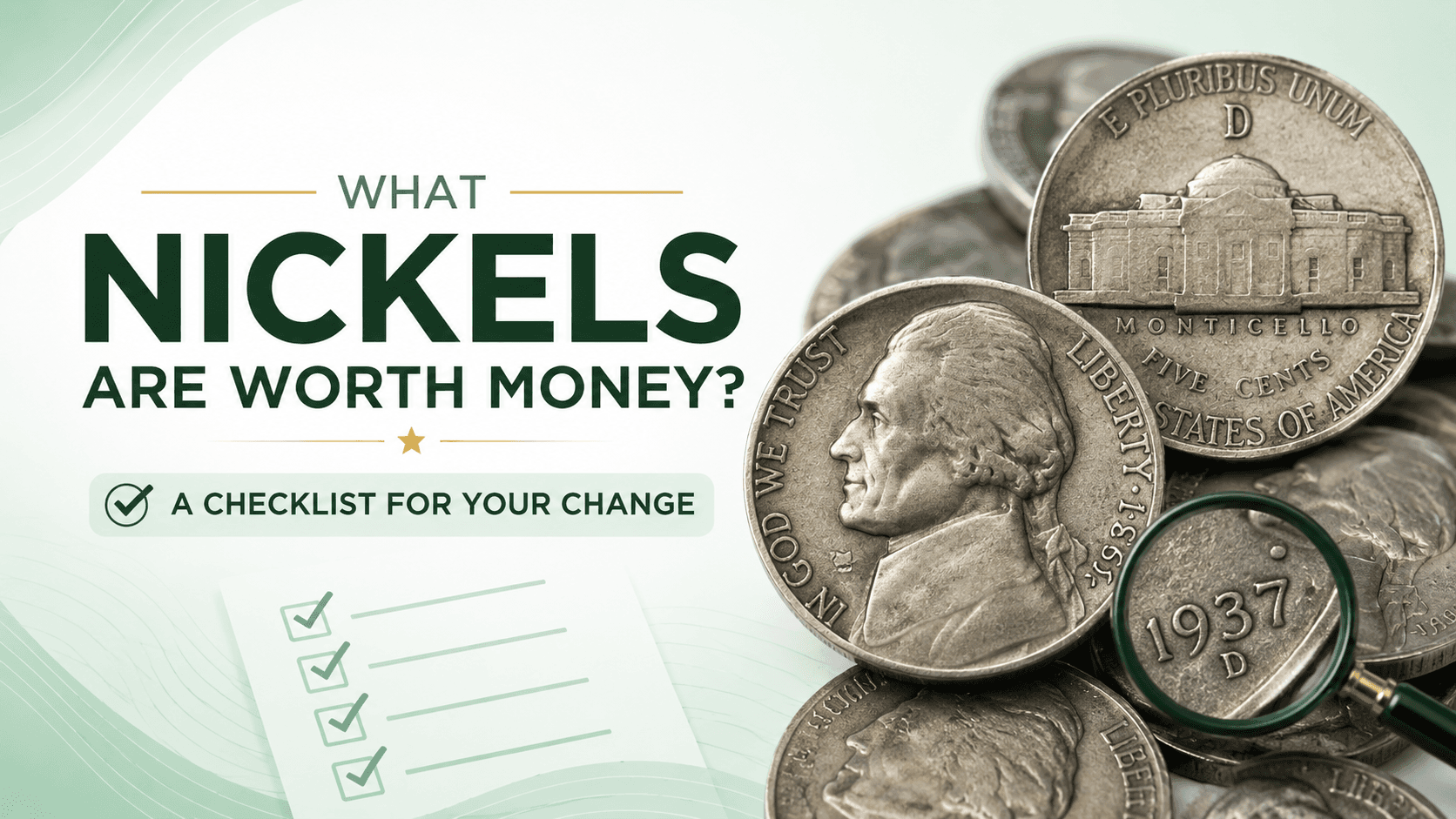

The nickels worth pulling out of circulation come down to a short list: war nickels from 1942 to 1945, which are 35% silver and worth around $3 each in metal alone at mid-2026 silver prices, the 1950-D Jefferson (the lowest-mintage coin in the whole series), and a few famous mint errors, like the 1937-D Buffalo nickel that lost a leg to an over-polished die. Everything else you find in change is almost certainly worth five cents. The good news is that the valuable nickels are easy to check for once you know where to look on the coin.
Silver war nickels: flip it over and check above Monticello
Start with the reverse. From late 1942 through 1945, the Mint pulled nickel out of the five-cent coin because the metal was needed for armor plating, and replaced it with an alloy of 56% copper, 35% silver, and 9% manganese. To mark the change, these wartime coins carry a large mint mark centered above Monticello's dome. It's the only place a "P" mint mark appeared on any US coin until 1979, and it's visible at arm's length once you know it's there.
That composition is why war nickels are the most realistic find on this list. Millions survive, they pass for ordinary nickels at a glance, and each one contains 0.05626 troy ounces of silver. Worn examples trade close to their melt value: those 0.05626 ounces multiplied by whatever spot silver is doing that day.
Here's what that looks like on a live market. On Pure's marketplace, the 35% Silver War-Time Nickel had a highest bid of $2.41 and a lowest ask of $3.19 on July 27, 2026, with that ask sitting about 3.5% below the coin's silver melt value that day. A coin you can still find in a roll of nickels, trading on Pure at more than sixty times face value. If you want the full date-by-date breakdown of which nickels contain silver, we cover it in what year nickels are silver.
One date needs a second look: 1942. The Mint struck both regular and silver nickels that year. No large mint mark above the dome means no silver.
The rare Buffalo nickels that bring serious money
Buffalo nickels (1913 to 1938) hold most of the series' heavyweights, and two of them are errors you can spot with a loupe.
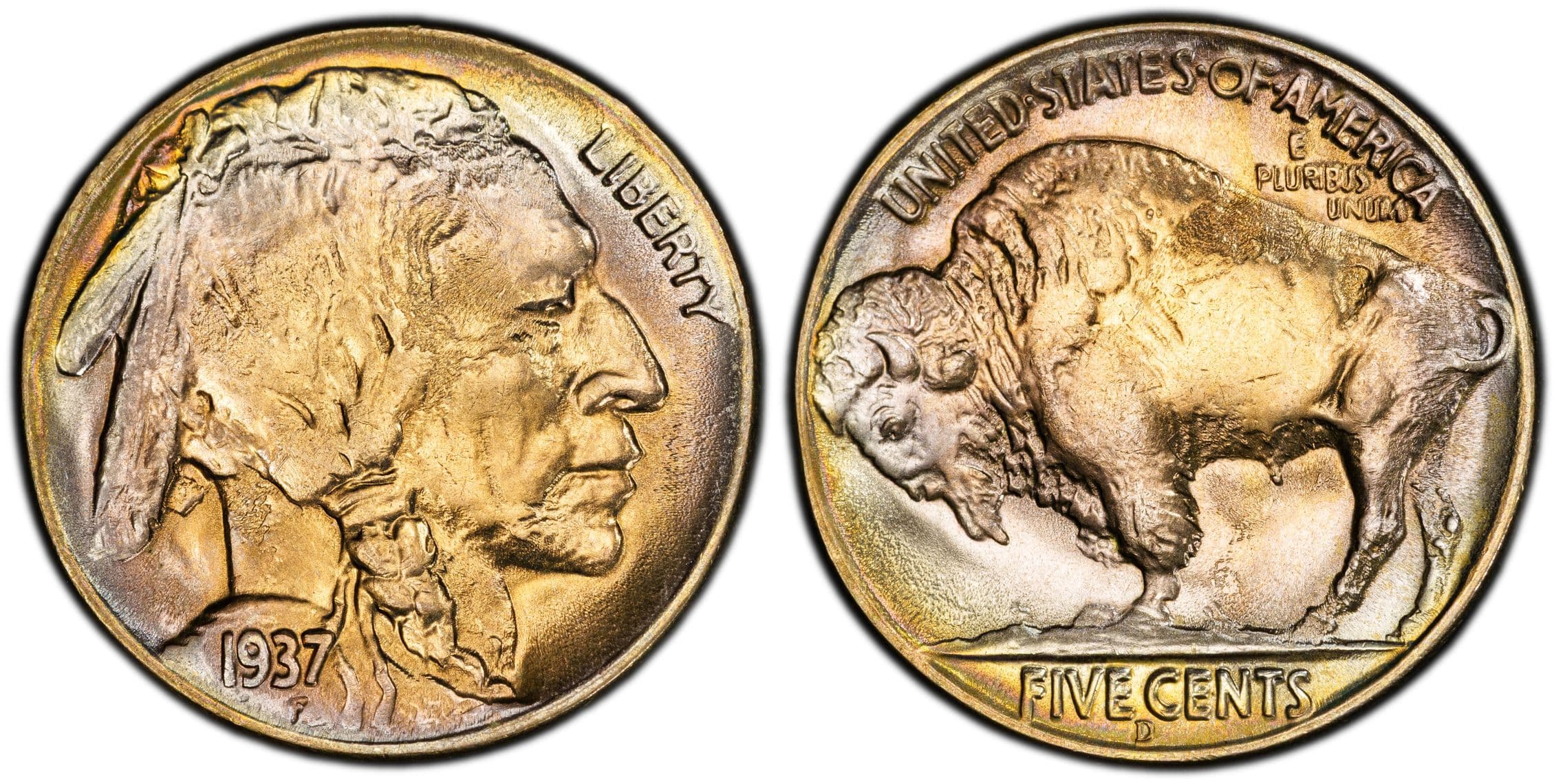
The 1937-D "three-legged" Buffalo is the famous one. A Denver mint worker polished a damaged reverse die so aggressively that the bison's front leg disappeared, leaving a hoof floating under its chest. Well-worn examples bring a few hundred dollars and near-uncirculated pieces close to $2,000; the auction record is $99,875, paid for an MS66+ in 2021. Check any 1937 nickel with a D mint mark. The missing leg is obvious once you look for it.
The 1918/7-D overdate is scarcer and worth more. In 1918, a die originally dated 1917 was re-punched with an 8, and the 7 still shows underneath. Circulated examples turn up at auction regularly and stay expensive in every grade, and a gem uncirculated piece set a record at $511,875 in 2024.
Then there's the 1913 Liberty Head nickel, which you will not find in change, but it explains why nickel collectors check dates obsessively. The Liberty Head design officially ended in 1912. Five examples dated 1913 were struck under circumstances the Mint never sanctioned, and the finest of them sold for $4.56 million in 2018. Five coins. That's the entire supply.
Other Buffalo keys like the 1916 doubled die obverse and the low-mintage 1926-S bring strong money too, but you will not find them in change.
Jefferson nickels: one key date and two errors
Jefferson nickels get dismissed because most of them really are worth five cents. Three exceptions.
The 1950-D is the key to the series. Denver struck just 2,630,030 that year, the lowest mintage of any Jefferson nickel, and collectors hoarded them from the start. Because so many were saved uncirculated, prices are modest for a key date: a certified gem typically brings $30 to $40. The odd result of all that hoarding is that worn 1950-Ds are actually harder to find than uncirculated ones, and still worth less.
The 1939 Doubled Monticello is a doubled die: "MONTICELLO" and "FIVE CENTS" show clear doubling on the reverse. Circulated examples bring around $75, and uncirculated pieces run from the low hundreds into four figures.
The 2005-D Speared Bison is the modern one worth knowing. A die gouge left a raised line running through the bison's back on some of that year's Westward Journey nickels, and it reads like a spear. Circulated finds bring $20 to $50, and MS65 examples top $475. This one still turns up in circulation because 2005 nickels are everywhere and almost nobody flips them over.
Condition does more work than you'd think
Every price above spans a range, and grade is the reason. The same 1939 Doubled Monticello is a $73 coin worn and a four-figure coin in gem uncirculated. On Jefferson nickels, graders also look for "Full Steps," meaning the steps on Monticello show complete horizontal lines, and that designation alone can multiply a common date's price.
Two practical rules follow from this. Handle a promising coin by its edges, and never clean it. Cleaning leaves hairline scratches that graders catch immediately, and a cleaned coin loses most of its collector premium. A dark, ugly, original coin is worth more than a shiny scrubbed one.
Nickels worth money: the checklist
Nickel | What to look for | What they bring |
|---|---|---|
War nickel, 1942-1945 | Large mint mark above Monticello | ~$2.40 to $3.20 silver melt |
1950-D Jefferson | D mint mark, right of Monticello | ~$30 to $40 certified gem |
1939 Doubled Monticello | Doubled "MONTICELLO" / "FIVE CENTS" | ~$75 circulated, hundreds+ uncirculated |
2005-D Speared Bison | Raised line through the bison's back | $20-$50 circulated, $475+ in MS65 |
1937-D three-legged Buffalo | Bison missing its front leg | A few hundred to ~$2,000 circulated |
1918/7-D Buffalo | 7 visible under the 8 in the date | Valuable in any grade; record $511,875 |
1913 Liberty Head | Liberty Head design dated 1913 | Five known; record $4.56M |
Auction records and guide ranges shift, and the war nickel figures are Pure's order book as of July 27, 2026, so treat the table as a snapshot, not a quote.
If you think you've found a valuable nickel
For the war nickel, you don't need anyone's opinion. The mint mark placement is the diagnosis, and the coin is worth its silver.
For the errors and key dates, authentication matters, because all of them have been faked (the three-legged Buffalo attracts tooled fakes where someone shaves the leg off a normal coin). Third-party grading through PCGS or NGC settles both authenticity and grade, and for a coin potentially worth hundreds the fee makes sense. We walked through how the two services compare in our PCGS vs. NGC piece.
When you're ready to sell a certified coin, or want to see what verified examples actually trade for, Pure's marketplace lists rare coins alongside bullion, every item tested and verified in our own facility before it reaches a buyer. The order book on each Pure listing shows live bids and asks, so you can see real demand instead of guessing from a price guide. And if checking change is your thing, we did the same exercise for rare quarters worth money.
FAQ
Are any nickels after 2005 worth money?
Almost no nickels struck after 2005 are worth more than face value in circulation. Modern errors exist and occasionally sell for real money, but there's no post-2005 date or variety common enough to be worth systematically checking for.
What is the most valuable nickel?
The 1913 Liberty Head, and it isn't close: the finest of the five known examples sold for $4.56 million, and two of the five sit in museums (the Smithsonian and the ANA Money Museum). Among nickels a collector could realistically buy, the 1918/7-D overdate leads.
How much silver is in a war nickel?
A silver war nickel (1942-1945) contains 0.05626 troy ounces of silver, about 1.75 grams. A full $2 roll of 40 war nickels holds roughly 2.25 troy ounces. Which years and mint marks qualify is covered here.
Do buffalo nickels without a readable date have value?
Not much. The date is what carries the value on a Buffalo nickel, so a dateless one can't be attributed to a scarce year. Some people restore dates with acid, but the treatment is visible and graded coins it produces are labeled as damaged.