

Should You Grade Your Liberty Bell Coin? PCGS vs. NGC
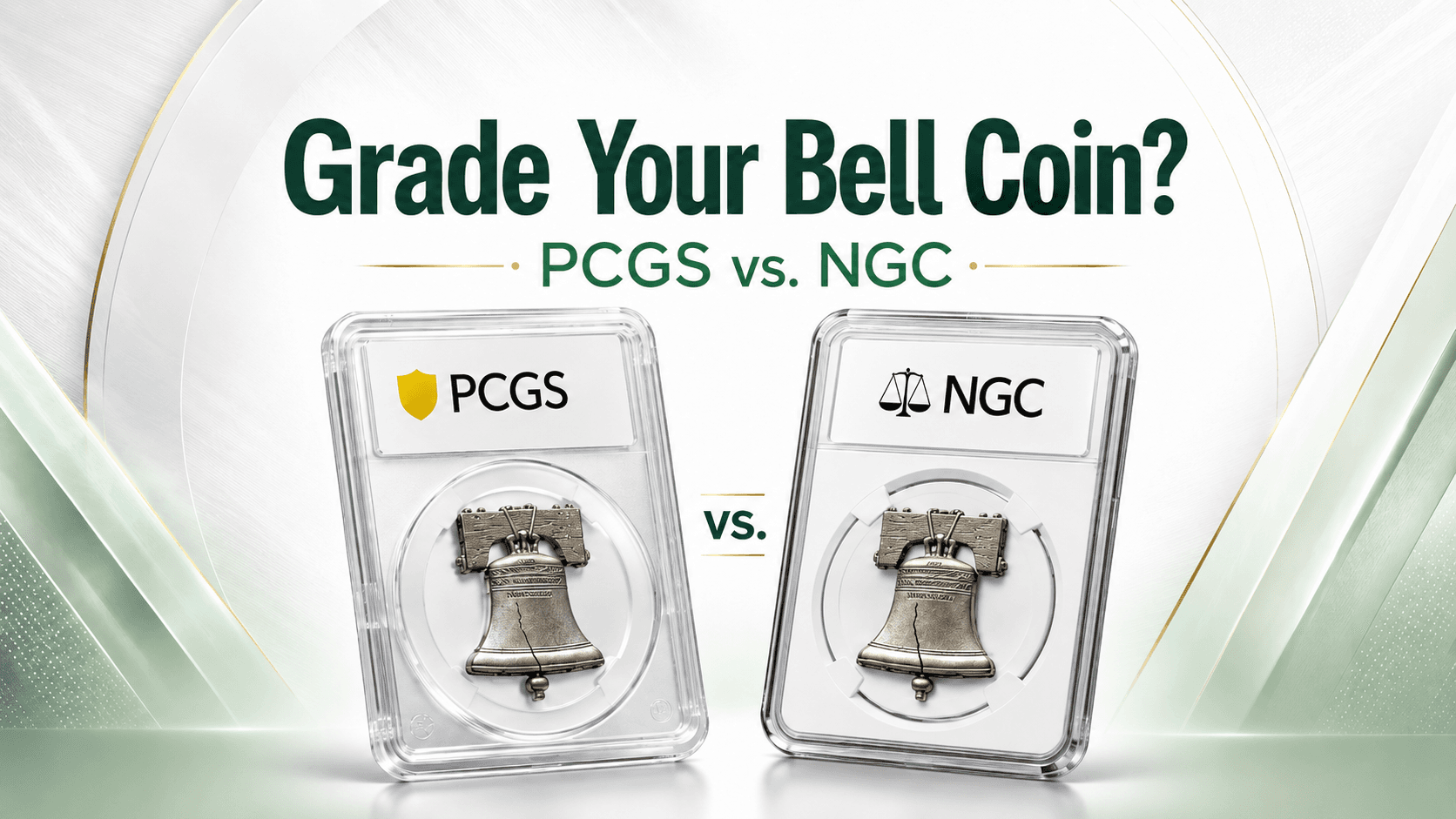

Your Freedom Ringing Liberty Bell coin arrives in a red presentation case with a U.S. Mint certificate inside, and that's exactly why a lot of buyers assume grading is optional busywork on a coin the Mint already vouched for. The Mint's certificate says where the coin came from. It says nothing about the coin's condition, which is the actual question grading answers.
Only 2,026 of each piece exist, one per household. Send the wrong coin to a grading service or miss a submission deadline, and there's no second one coming from the Mint to try again with.
What a grading service actually does to your coin
Two companies dominate U.S. coin grading. PCGS, short for Professional Coin Grading Service, has been grading coins since 1986. NGC, the Numismatic Guaranty Company (renamed from Numismatic Guaranty Corporation in 2021), started a year later. Send either one a coin and you get roughly the same treatment: authentication, a number on the Sheldon scale (1 to 70, where 60 and up means uncirculated or proof and 70 means nothing wrong even under magnification), and a seal into a tamper-evident holder collectors call a slab, with that grade printed right on the label.
That's a different job than what Pure does at intake, where an XRF scanner and a Sigma Metalytics tester confirm a coin or bar is genuinely what it claims to be made of, in about 24 hours. PCGS and NGC assess something else entirely, the coin's condition, and for pieces like these, whether it qualifies for a special label. A raw Liberty Bell coin straight from the Mint has never been touched by either process. The case and certificate are real. They're the Mint vouching for where the coin came from, not a third party judging its surface for wear or strike quality.
PCGS First Strike, NGC Early Releases, and the deadline that's actually real
The label most people ask about is tied to timing, not condition.
PCGS | NGC | |
|---|---|---|
Full name | Professional Coin Grading Service | Numismatic Guaranty Company |
Founded | 1985 (grading since 1986) | 1987 |
Release-timing label | First Strike | Early Releases (also offered as First Releases, same window) |
Submission window | 30 days from the coin's official release date | 30 days from the coin's official release date |
Tighter release label | None offered | First Day of Issue, about one week |
Grading scale | Sheldon scale, 1 to 70 | Sheldon scale, 1 to 70 |
Both run on the same math: a coin has to reach the grading service, or an approved depository, within 30 days of its official release date. For the Liberty Bell coins, that clock starts July 16, 2026. Neither company posts the exact cutoff date until a release is underway, since it has to account for weekends and shipping schedules. Check PCGS's First Strike page or NGC's Early Releases and First Releases page once the date's posted, rather than counting 30 days yourself and guessing wrong.
Neither label means the coin was struck first.
The Mint doesn't track which coins come off the press before others, and shipping dates don't reveal manufacturing order either, so both labels are really just measuring how fast a coin got mailed.
That gap between the marketing and the mechanics ended up in court. In 2006, a Miami attorney sued both companies for $10 million, alleging the First Strike label was deceptive. NGC settled the year after: money to collectors and their attorneys, another $447,500 toward consumer education, and the label renamed from First Strike to Early Release. PCGS kept First Strike.
NGC also has a tighter designation, First Day of Issue, for coins that reach NGC within about a week of release instead of 30 days, aimed at buyers who source a coin on release day itself. PCGS doesn't offer anything equivalent.
What a grade actually changes
A Liberty Bell coin already starts scarce, 2,026 pieces per product, proof finish, one per household, and grading doesn't move that number in either direction. It adds a third-party opinion on the coin's condition, printed as a number, and possibly a First Strike or Early Releases label if the timing works out.
Some buyers and sellers use that number as a shorthand instead of comparing photos or trusting a description alone. Pure's own marketplace listings note whether a coin has been graded and which service certified it, and buyers can filter for certified pieces if that's what they're shopping for, the same filter we've pointed readers to when explaining how third-party grading interacts with a coin's edge. Whether a graded example beats a raw one, or a First Strike label beats a plain one, is personal taste. Reasonable collectors land on both sides.
Grading also costs money on top of the coin's price, takes time you don't have the coin in hand, and adds shipping risk to something the Mint only made 2,026 of. PCGS and NGC both publish current fees and turnaround times by declared value on their own sites, since both change often enough that a number printed here would go stale.
A shape neither company has certified before
There's a wrinkle specific to this release. The Liberty Bell pieces aren't round, and the only other non-round U.S. coin, the 1915-S Panama-Pacific octagonal $50 gold piece, is the one precedent either company has. Both PCGS and NGC have graded and slabbed examples of that coin for decades; their finest known octagonal $50s sit in the mid-60s on the Sheldon scale. So both services already know how to fit a non-round U.S. coin into a standard holder.
How each company's current holder line handles the Freedom Ringing bell shape specifically isn't published anywhere. Call PCGS or NGC directly before you mail in a piece this scarce, rather than assume they'll figure it out.
If you decide to submit one
The mechanics are the same as grading any modern coin. You can mail a coin to PCGS or NGC directly, or go through an authorized dealer or show that submits on your behalf. You pick a service tier based on the coin's declared value, which sets both the fee and how long grading takes; higher declared values and faster turnaround both cost more. If you want a First Strike or Early Releases label, you request it at submission, and it only applies if the coin arrives within that service's published window for this release.
Keep the Mint's original box and certificate regardless of what you decide. Neither is required for the grading process itself, but they document where the coin came from, and you can't get a second one from the Mint once your household's allocation is gone.
Frequently asked questions
What is PCGS First Strike?
A label PCGS adds to a coin's holder when the coin reaches PCGS within 30 days of its official Mint release date. It says nothing about whether that particular coin came off the press before others; the Mint doesn't track strike order, so no grading service can verify that.
What is NGC Early Releases?
NGC's version of the same idea. A coin received by NGC, or an approved depository, within 30 days of release qualifies. NGC also offers the identical designation under the name First Releases if you request it specifically, plus a stricter First Day of Issue label for coins that arrive within about a week.
Is a First Strike or Early Releases label worth paying for?
Collectors are split on it. NGC's own history with the label, the lawsuit, the settlement, the rename, is part of why some skip paying extra for either version and just grade for the number itself.
Does Pure grade coins?
No. PCGS and NGC are the third-party grading services. Pure verifies metal authenticity on intake with XRF and Sigma Metalytics testing, which checks what a coin or bar is made of rather than assigning it a numeric condition grade. Pure's marketplace lists both graded and raw coins, and listings note the grading service and grade where one exists.
---
If you're deciding whether to buy or sell a Liberty Bell coin in the first place, our buyer and seller guide covers pricing, mintage, and how the secondary market works once the Mint sells out. To see what's already listed, certified and raw, browse the Pure marketplace.