

Freedom Ringing Liberty Bell Coin: 2026 Buyer & Seller Guide
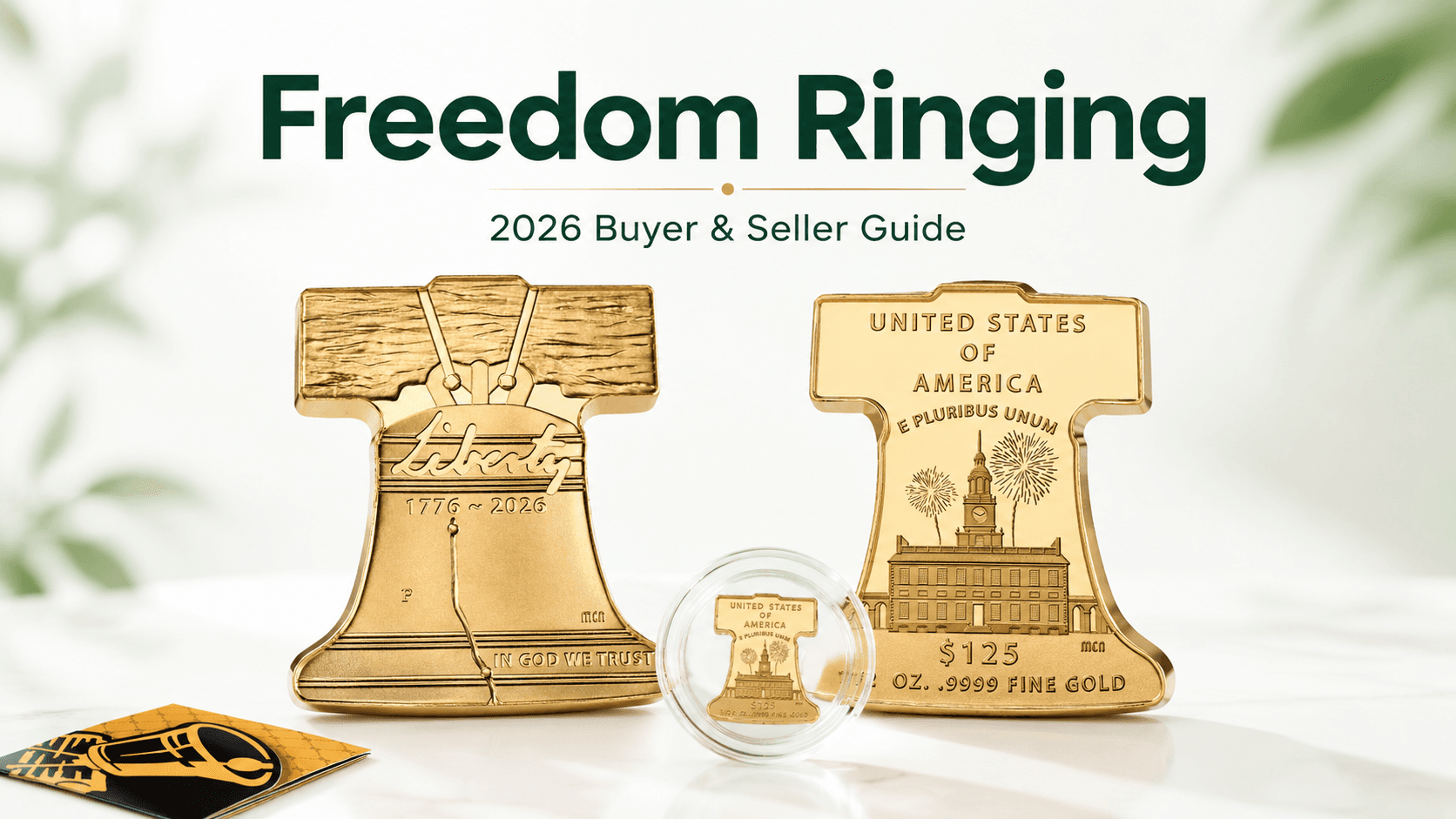

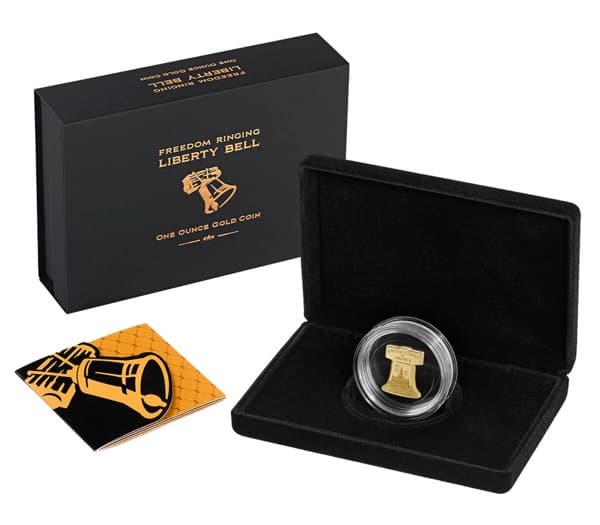
The Freedom Ringing Liberty Bell coin is not round. The U.S. Mint struck it in the actual silhouette of the Liberty Bell, crack and all, and it goes on sale Thursday, July 16, 2026, at noon Eastern. There are three pieces in the release: a one-ounce gold coin, a half-ounce gold coin, and a half-ounce silver medal. Each is capped at a mintage of 2,026, one per household.
That low cap, paired with a shape no modern U.S. coin has used, is why collectors are already circling the date. Most people who want one won't get it from the Mint, so what happens after the sell-out matters as much as release day, whether you're buying or selling.
The three Liberty Bell products: specs and prices
Product | Metal | Fineness | Face value | Mintage | Mint price |
|---|---|---|---|---|---|
1 oz Liberty Bell gold coin (26LB) | 1 troy oz gold | .9999 | $250 | 2,026 | $19,600 |
½ oz Liberty Bell gold coin (26LC) | ½ troy oz gold | .9999 | $125 | 2,026 | $10,050 |
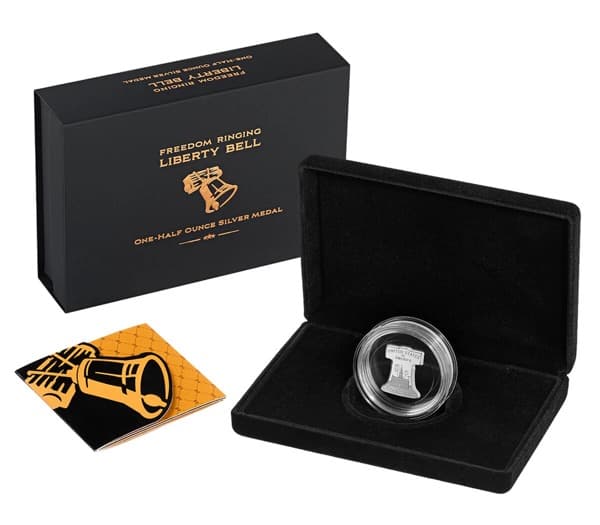
½ oz Liberty Bell silver medal (26LD) | ½ troy oz silver | .999 | none (medal) | 2,026 | $750 |
All three are proof finish, struck at the Philadelphia Mint with the P mint mark, and carry a smooth edge. The bell shape means they're rectangular rather than circular: the one-ounce gold coin measures roughly 0.888 by 1.024 inches, the half-ounce gold coin 0.883 by 1.024 inches, and the silver medal 0.888 by 1.024 inches (dimensions per CoinNews).
Liberty Bell coin release date and where to buy
Sales open at noon ET on July 16, 2026, directly from the Mint at usmint.gov. The product pages are already live so you can review the one-ounce gold coin, the half-ounce gold coin, and the silver medal before the clock starts.
After the Mint sells out, the only way to buy is the secondary market, from collectors and dealers who got their allocation. More on that below.
Liberty Bell coins vs. the silver medal
The two gold pieces are coins. They carry legal-tender face values, $250 on the one-ounce and $125 on the half-ounce, stamped on the metal. Those numbers are symbolic. Nobody spends a $19,600 gold coin for $250 of groceries, and the face value has nothing to do with what you pay.
The silver piece is a medal, not a coin. It has no denomination and no legal-tender status. The Mint issues medals for commemorative pieces it doesn't authorize as money, which is the practical difference and about the only one. The silver medal is still .999 fine silver, still struck by the U.S. Mint, still a genuine government product. For something headed into a display case rather than a cash register, the coin-versus-medal label changes very little.
The gap between face value and price catches first-time buyers every release. A $250 face value on a one-ounce gold coin doesn't mean you can buy it for $250, and it doesn't mean it's worth $250. The Mint prices these as low-mintage proof collectibles, well above the metal's melt value, because that's what they are.
Design of the Liberty Bell coins and medal
The obverse carries the Liberty Bell, including the famous crack, with LIBERTY across the top and the dual date 1776 ~ 2026 marking 250 years of American independence. IN GOD WE TRUST sits on the bell.
The reverse shows Independence Hall, the Philadelphia building where the bell hung and the Declaration was signed, with fireworks behind it. UNITED STATES OF AMERICA runs across the yoke, E PLURIBUS UNUM below, and the weight and fineness are tucked onto the sound bow at the base of the bell.
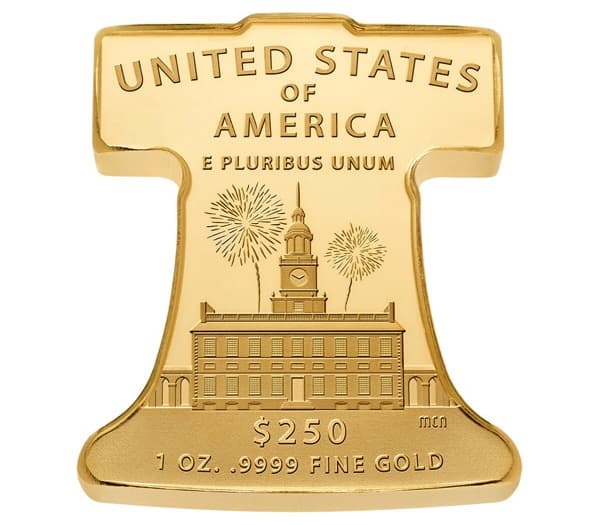
It's the centerpiece of the Mint's Semiquincentennial program, the multi-year run of coins and medals marking the 250th anniversary. The Mint describes the gold pieces as the first non-round coins it has made in recent U.S. history, and the silver piece as its first recent non-round medal. The shape is the reason this issue stands apart from the rest of the anniversary lineup. For the full design story, how the bell shape was made, and the one non-round coin that came before it, see our Liberty Bell shaped coin guide.
Liberty Bell coin mintage and household limits
Each of the three products has a mintage and product limit of 2,026, a number chosen to match the anniversary year. Household orders are capped at one of each. Those figures are confirmed by the U.S. Mint on the product listings, not estimates.
A 2,026-piece cap is small. For comparison, the U.S. Mint's 2024 proof Gold Eagles drew 25,280 orders across all sizes in their first four days (CoinNews), more than ten times the entire Liberty Bell mintage. The one-per-household rule also means no single buyer can corner the supply, so the pieces spread across thousands of separate orders.
How to buy Liberty Bell coins from the U.S. Mint
The Mint's release-day process is straightforward, but it rewards preparation:
Set up your usmint.gov account before July 16. Confirm your shipping address and payment method in advance. Doing this during the rush costs you minutes you won't have.
Be on the product page at noon ET. Sell-outs on low-cap issues can happen in minutes. Have the page loaded and refresh as the sale opens.
Add to cart and check out quickly. Items can show as available, then sell out before you finish checkout. Speed matters.
Mind the one-per-household limit. You can order one of each product, but a second order to the same household can be canceled.
Watch the return window. The Mint allows returns within a set window after delivery, which is worth knowing before you commit at these prices.
If the page shows sold out before you check out, the secondary market is where you can still find one.
How to buy or sell a Liberty Bell coin after it sells out
A sold-out, one-per-household release is exactly the situation where a single dealer's posted price tells you very little. Supply is scattered across thousands of original buyers, and the real price is whatever buyers and sellers agree on once the Mint is out.
Collect Pure runs an order book for precisely this. Every product shows live buy and sell orders, so you can see what people are actually bidding and asking, place your own bid instead of accepting one shop's markup, and watch the premium over the Mint's price move as the market settles.
For sellers, the same mechanics work in reverse. If you secured a Liberty Bell coin or the silver medal from the Mint, you can list it against live demand rather than negotiating one buyer at a time or eating a marketplace's flat fee. You set your ask, you see the resting bids, and you decide when the number is right.
I've watched plenty of modern sell-outs play out, and the order book is where the guessing stops: with a 2,026 mintage and a one-per-household cap, almost all the volume is secondary, and seeing real resting bids and asks beats wondering whether a markup is fair. First time chasing a sold-out issue? The concierge team will walk you through it.
This is an explainer, not investment advice. What any of these pieces sells for later depends on demand we can't predict.
FAQ for buyers
When do the Freedom Ringing Liberty Bell coins go on sale?
Noon Eastern on Thursday, July 16, 2026, directly from usmint.gov. Sold-out inventory then moves to the secondary market.
How much does the Freedom Ringing Liberty Bell coin cost?
$19,600 for the one-ounce gold coin, $10,050 for the half-ounce gold coin, and $750 for the half-ounce silver medal. Secondary-market prices after a sell-out can be higher or lower.
Are the Liberty Bell gold coins real gold?
Both contain .9999 fine gold, one a full troy ounce and the other a half ounce. The silver medal is .999 fine silver.
Why is the Liberty Bell silver piece a medal and not a coin?
It has no face value and isn't legal tender, so the Mint classifies it as a medal. It's still a genuine .999 silver product struck by the U.S. Mint.
What happens if the Liberty Bell coin sells out before I check out?
That's common on a 2,026-mintage issue. Buyers who miss the Mint sale buy on the secondary market, where collectors and dealers resell their allocations. You can place a bid on the Collect Pure order book and see live asking prices.
FAQ for sellers
How do I sell a Freedom Ringing Liberty Bell coin?
You list it on the secondary market. On the Collect Pure order book you can post an ask against live buyer demand, see the resting bids before you price it, and sell without negotiating one buyer at a time.
What is a Freedom Ringing Liberty Bell coin worth?
For a sold-out modern issue, the live order book is the clearest signal: it shows the actual bids and asks rather than one dealer's quote, so you can price against real demand instead of a guess.
Is the Liberty Bell silver medal worth selling?
The $750 silver medal is the lowest-priced of the three, which makes it the most accessible entry point. What any of these sells for later depends on demand we can't predict. The order book shows the live bids on each, which is the clearest read on what buyers are actually offering.
Ready to buy or sell a Liberty Bell coin?
Track the release on Collect Pure: see the live order book for the one-ounce gold coin, the half-ounce gold coin, and the silver medal, set your own bid, or list one you secured from the Mint. If it's your first sold-out issue, the concierge team can help you find a fair price on either side.