

Why Do Coins Have Ridges? Reeded Edges Explained
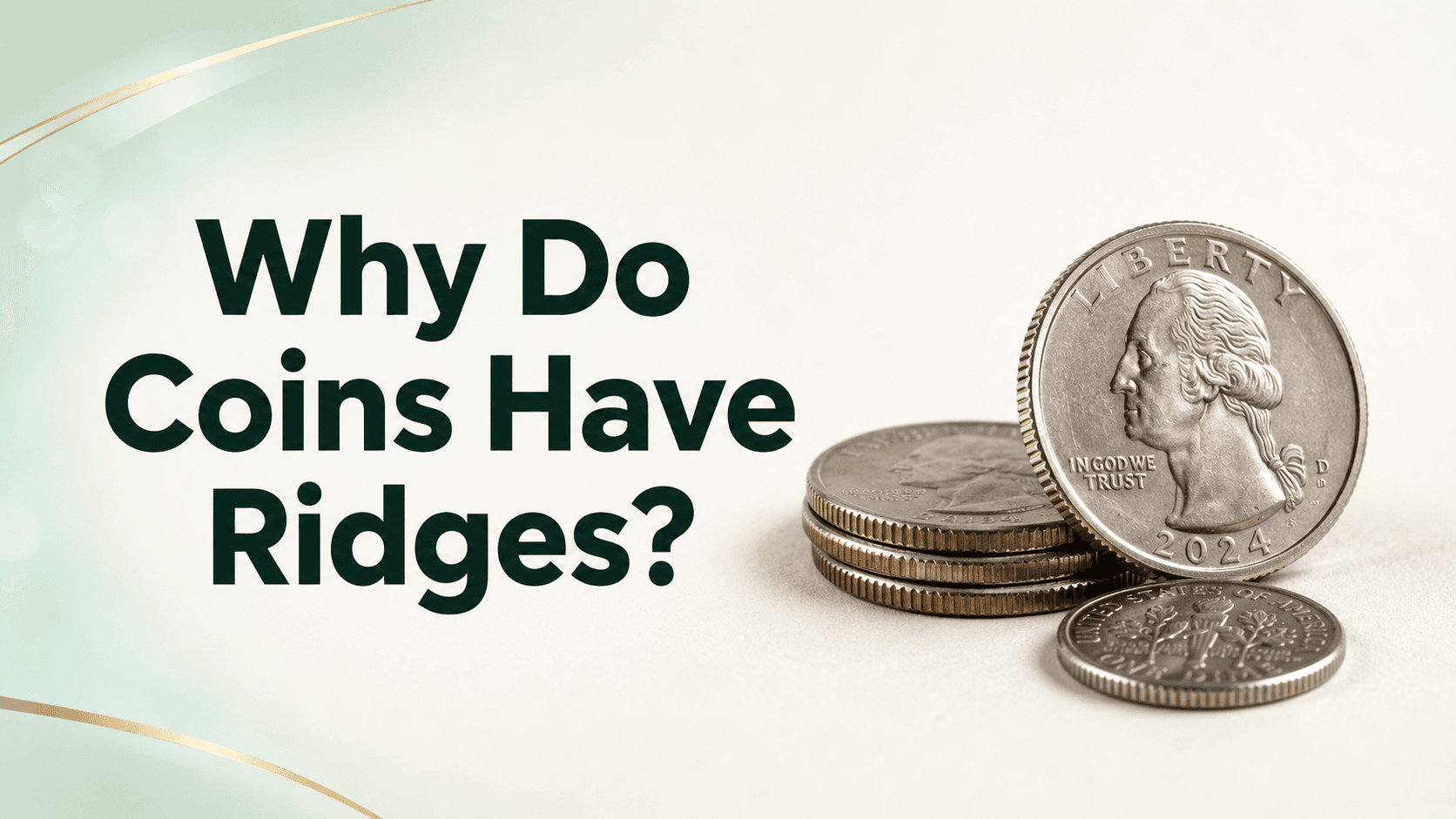

Look at the edge of a quarter and you'll see dozens of tiny grooves running all the way around it. A penny's edge is smooth. Those ridges are there because of an old scam: people used to shave thin slivers of metal off the edges of gold and silver coins, spend the coins at full value, and sell the shavings for melt. Grooving the edge gave the scam away, since a shaved coin came up short on grooves. The crime was called clipping, and mints have been grooving edges to stop it for more than three hundred years.
What the grooves are called
The ridges are called reeding, and an edge that has them is a reeded edge. A flat one is a plain edge. You'll see both terms on grading labels and in coin specs. (A few coins skip both and carry lettering around the rim instead, but for everyday US coins it's reeded or plain.)
Reeding goes on at the moment of striking. The blank sits inside a collar with a grooved inner wall, and when the dies come down and squeeze the coin, the metal flows out against that wall. The edge and the two faces all form in the same instant, straight from the press.
Why the ridges started
The story runs through the Royal Mint in London. By the 1690s English silver coins were in bad shape: something like one in ten was counterfeit, and clippers had been shaving the hand-struck coins for years, because their rough, uneven edges made a missing sliver almost impossible to spot. The government launched a huge recoinage in 1696 to replace the lot, and the man running it was Isaac Newton, Warden and then Master of the Mint, who went after clippers and counterfeiters himself. Newton enforced milled, grooved edges as part of the recoinage, which made a shaved coin obvious and clipping more trouble than it was worth. Other mints picked up the idea over the following decades.
Why we still have them after the silver left
US dimes and quarters stopped containing silver in 1965, when the Coinage Act switched them to a copper-nickel clad mix. A modern quarter is worth its face value, not its metal, so there is nothing to clip.
The grooves stayed anyway.
Part of that is inertia, but they still pull their weight. A cast counterfeit tends to come out with soft or uneven edges, so clean reeding is one more detail a faker has to nail. And the grooves help anyone who can't easily see the coin, since a dime and a penny are close in size and you can tell them apart by running a thumb around the edge.
Which coins have ridges, and which don't
In your pocket right now:
Reeded edge: dime, quarter, half dollar
Plain edge: penny, nickel
There's a reason behind the split. The dime, quarter, and half dollar were all silver once, so they got the protective edge. The penny and nickel were always cheap base metal (today's cent is mostly zinc under a thin copper coat, and the nickel is a copper-nickel mix), never worth the bother of clipping, so they were left smooth.
What the edge tells a collector
If you collect coins rather than spend them, the edge is worth a close look.
Reed counts were never set by law. Each mint cut its own collars, so how many grooves a coin carries, and how tightly they sit, depends on where and when it was struck. Collectors lean on this. Philadelphia dimes from the early 1870s have 113 narrow, closely spaced reeds; Carson City dimes from the same years have 89 broad ones. When a coin's edge doesn't match what its date and mint mark should produce, that mismatch is usually where a problem first turns up.
The edge is also a fast read on old silver. Every pre-1965 dime, quarter, and half dollar (the 90% silver coins stackers call junk silver) is reeded. On a raw silver coin I look at the edge before almost anything else, because a bad cast fake tends to fall apart there first: the grooves come out soft, doubled, or just slightly off.
Checking an edge when you buy on Collect Pure
An edge only helps if someone actually looks at it. On Collect Pure, listings show the grade and how the coin was verified, and a lot of the silver and gold here is third-party graded, where the edge has already been checked by the grading service (you can filter by grading service if that matters to you). If you're new to this and not sure what you're looking at, the concierge team will go through a coin with you before you buy.
Pricing works differently from a typical dealer, too. Most shops post one price and that's that. Pure runs an order book, so every product shows live buy and sell orders. You set your own bid and watch the premium over spot move in real time instead of taking whatever's printed.
Common questions
What are the ridges on a coin called?
Reeding. The edge is a reeded edge; a smooth one is a plain edge.
Why don't pennies and nickels have ridges?
They were never worth shaving. The silver coins got a protected edge; the cent and nickel have always been cheap base metal.
Do coins still need ridges now that they aren't silver?
Not for clipping, that ended with the silver in 1965. They stay because they make fakes harder and let you tell similar coins apart by feel.
Does a reeded edge mean a coin is silver?
No. Plenty of modern clad coins are reeded and some silver coins aren't. Treat the edge as a clue, then check the date, denomination, and certification.