

How Many Coins Are in a Roll? Every US Denomination, Plus Bullion Tubes

A roll of quarters holds 40 coins and is worth $10. The rest follow one rule, a roll is however many coins it takes to reach a round dollar figure: pennies come 50 to a roll (50 cents), nickels 40 ($2), dimes 50 ($5), half dollars 20 ($10), and dollar coins 25 ($25). Five of the six counts are the ones the US Mint uses for its own wrapped rolls; the dime count is the bank wrapper standard. Either way they are what a teller expects when you hand a roll across the counter.
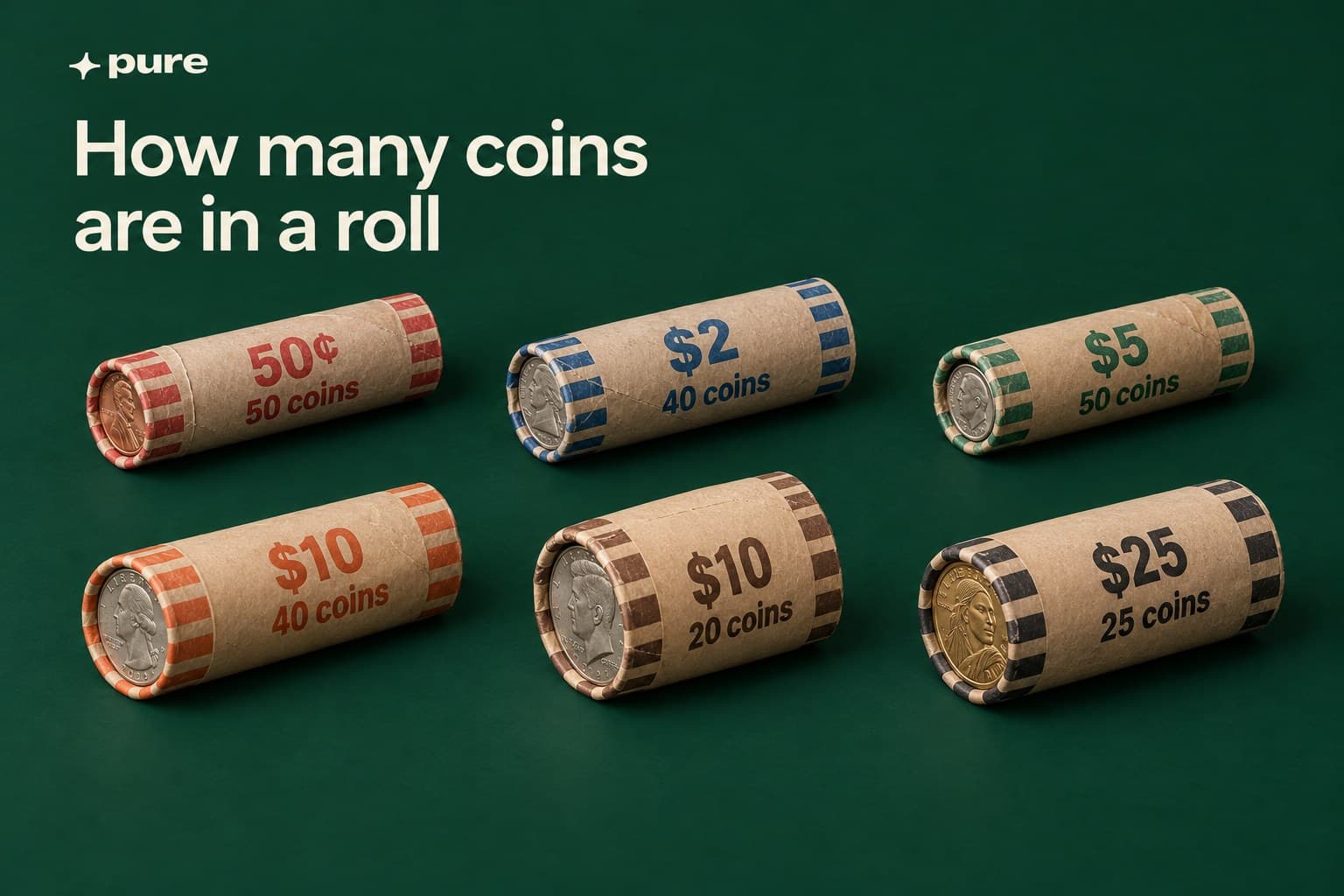
Coins in a roll chart: quarters, dimes, nickels, pennies, half dollars and dollar coins
Coin | Coins per roll | Face value of a roll | Weight of the coins alone (current clad or plated issue) |
|---|---|---|---|
Penny (cent) | 50 | $0.50 | 125 g (4.4 oz) |
Nickel | 40 | $2.00 | 200 g (7.1 oz) |
Dime | 50 | $5.00 | 113 g (4.0 oz) |
Quarter | 40 | $10.00 | 227 g (8.0 oz) |
Half dollar | 20 | $10.00 | 227 g (8.0 oz) |
Dollar coin | 25 | $25.00 | 203 g (7.1 oz) |
Weights come from the Mint's published coin specifications: cent 2.5 g, nickel 5 g, dime 2.268 g, quarter 5.67 g, half dollar 11.34 g, dollar coin 8.1 g. Multiply by the count and you get the table. The ounces in that column are kitchen-scale ounces (28.35 g), not the troy ounces silver is measured in further down. The paper wrapper adds a gram or two.
That last column is more useful than it looks. Quarters and half dollars both roll up to 226.8 g, because a half dollar weighs exactly twice a quarter and there are half as many in the wrapper. Put $10 of quarters on a kitchen scale and get 200 g, and the roll is short, or something in it is not a quarter.
Where the counts come from
The US Mint sells its own wrapped rolls, and the counts are printed on them. Quarters go out in two-roll sets of 40 coins per roll, one roll from Philadelphia and one from Denver. Kennedy half dollars ship the same way, 20 coins to a roll. Dollar coins come in 25-coin rolls. When the Mint sold Lincoln cents in two-roll sets, each roll held 50, and the Westward Journey nickel sets were 40 to a roll.
Dimes are the one denomination the Mint does not sell by the roll, so the 50-count is the bank and coin-wrapper standard rather than a Mint product spec. Preformed dime wrappers are made for 50.
Preformed wrappers follow a common color code, and once you know it you can read a tray from across the room: red for pennies, blue for nickels, green for dimes, orange for quarters. Half dollar and dollar wrappers are less standardized; brown and black turn up most often.
Bags are a different unit
The Mint also sells bags, and the bag sizes do not line up with the rolls. Quarters come in 100-coin bags ($25 face), half dollars in 200-coin bags ($100), dollar coins in 100-coin bags ($100). Banks order coin from the Federal Reserve in sealed bags too, which is why a teller may hand you loose coin in a bag when the branch is out of rolls.
Rolls of silver coins
Before 1965, dimes, quarters and half dollars were 90% silver, and these coins still trade by the roll because the count never changed. What changed is what the roll contains. The silver issues were heavier than today's clad coins (a silver dime 2.5 g, a quarter 6.25 g, a half dollar 12.5 g), and 90% of that weight is silver. Every $1 of face value in 90% silver coin holds 0.7234 troy ounces of silver, so:
50 silver dimes ($5 face) hold about 3.6 troy ounces
40 silver quarters ($10 face) hold just over 7.2 troy ounces
20 silver half dollars ($10 face) also hold just over 7.2 troy ounces
Those figures assume the coins are not heavily worn; circulated silver has lost a little metal to pockets and tills, and dealers usually quote 0.715 troy ounces per $1 face to allow for it. How to sell junk silver goes through the math, the 1965 to 1970 half dollars that dropped to 40% silver, and the wartime nickels, which are the odd one out at 35%.
On Pure, 90% silver is listed in $1 face-value units. The $1 face value 90% BU dimes listing is ten dimes; a full 50-coin roll is a quantity of five on that listing. Sellers post an asking price per dollar of face value, buyers post bids, and every bid and ask is visible before you commit to either side.
Bullion coins come in tubes, not rolls
Anyone looking up roll counts for modern silver or gold bullion coins needs a different word: tube. Mints ship bullion coins in plastic tubes, and the tubes go into a sealed case the trade calls a monster box. The counts depend on the mint:
Coin | Coins per tube | Coins per monster box |
|---|---|---|
American Silver Eagle (1 oz) | 20 | 500 (25 tubes) |
British Silver Britannia (1 oz) | 25 | 500 (20 tubes) |
Australian Silver Kangaroo (1 oz) | 25 | 250 (10 tubes) |
The Silver Eagle figures are the US Mint's own: its bullion coins leave the Mint in 500-coin boxes of 25 tubes. The Royal Mint sells Britannias in tubes of 25 and in a 500-coin monster box, and the Perth Mint sells Kangaroos in tubes of 25, ten tubes to a box of 250. Gold bullion coins ship in smaller tubes, and the count changes with the coin's size and the mint, so check the mint's own listing before you assume.
On Pure, Silver Eagles are listed per coin, so a sealed tube is one ask with a quantity of 20.
Questions people ask
How many dimes are in a roll?
Fifty. A roll of dimes is $5 in face value, and it is the one denomination where the count comes from bank wrappers rather than a Mint product.
How many nickels are in a roll?
Forty, which makes a $2 roll. The Mint's own two-roll nickel sets were packed 40 to a roll as well.
How many coins are in a roll of 50-cent pieces?
A roll of 50-cent pieces holds 20 coins and is worth $10, the same face value as a roll of quarters with half as many coins in the wrapper.
Do banks give out coin wrappers for free?
Most branches will hand you a few paper wrappers at the teller window if you ask, and some keep a box of them on the counter. If you need hundreds, office supply stores sell preformed wrappers in the standard colors for a few dollars.
How much silver is in a roll of pre-1965 quarters?
A roll of 40 pre-1965 quarters ($10 face value) contains just over 7.2 troy ounces of silver at the full 0.7234-ounce-per-dollar figure, or 7.15 at the 0.715 dealers use for worn coins.
*If you have silver dimes by the roll or Eagles by the tube to sell, see what buyers are bidding on Pure, or read how selling on Pure works start to finish.*