

How to Sell Junk Silver Coins: Value, Venues, and Fees
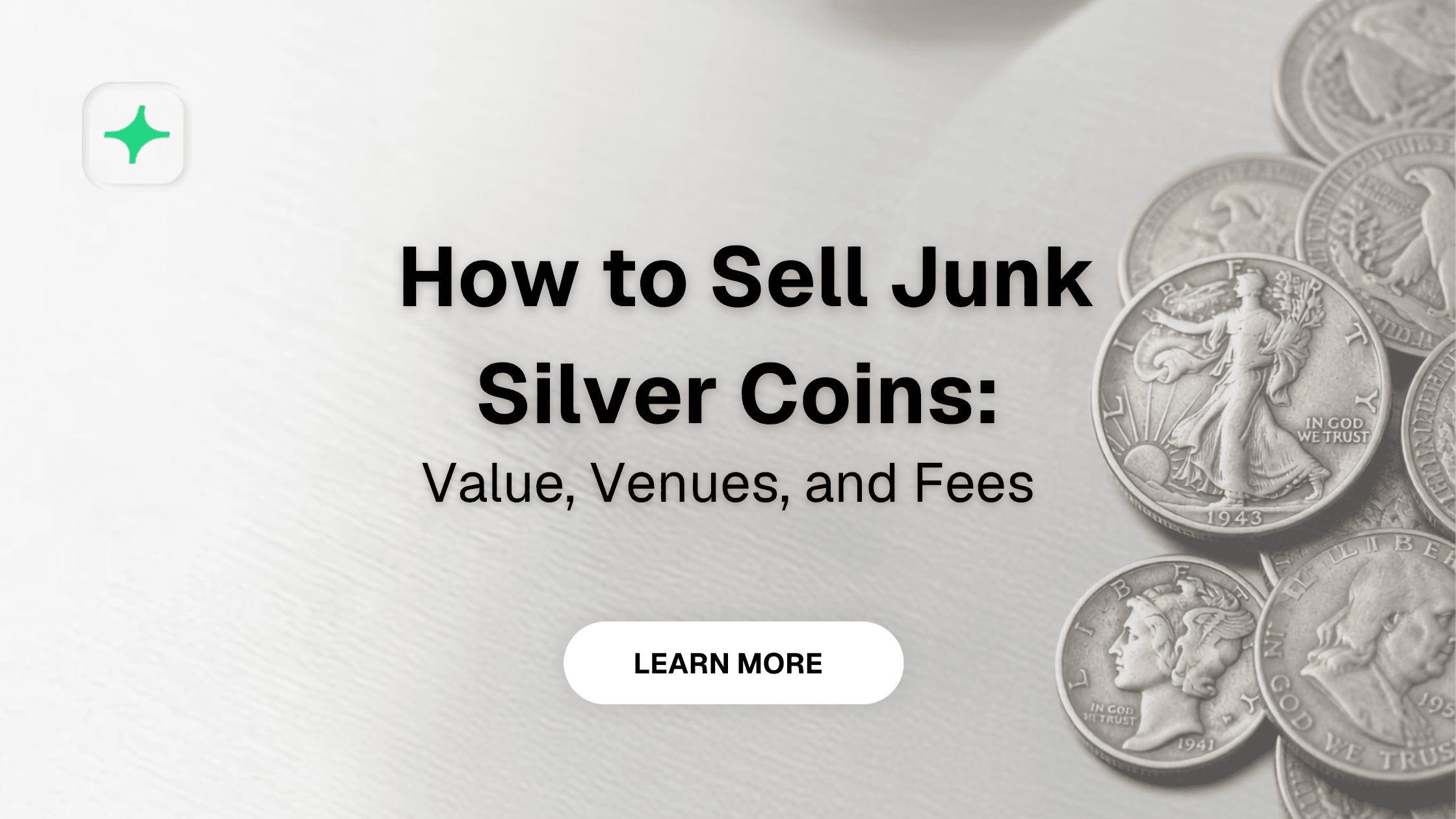

If you have a bag or a jar of old American dimes, quarters, and half dollars, there is a good chance you are holding junk silver. The name is a bad one. There is nothing junk about the metal, and the coins are not damaged or worthless. Junk silver simply means common circulated United States coins whose whole value is the silver in them. No collector premium, no grading, no judgment calls.
That makes it simpler to sell than a collection of rare coins, because the price comes down to arithmetic. The part that trips people up is that junk silver gets priced by face value, not by the coin, which nobody tells you until someone does.
What Counts as Junk Silver
Junk silver is United States circulating coinage struck with real silver content, in grades common enough that no collector premium applies. Three groups make up almost all of it.
90% Silver: Dimes, Quarters, and Half Dollars Dated 1964 and Earlier
This is the bulk of what trades as junk silver. Roosevelt and Mercury dimes, Washington quarters, and Franklin and Walking Liberty half dollars dated 1964 or earlier. The alloy is 90% silver, 10% copper, a standard federal law fixed at nine hundred parts pure metal per thousand, with copper as the balance. The copper is there because pure silver is too soft to survive circulation.
After 1964 the silver came out of dimes and quarters entirely. The Coinage Act of 1965 replaced it with a copper core clad in copper and nickel.
40% Silver: Kennedy Half Dollars, 1965 to 1970
Half dollars held onto some silver for a few more years. Kennedy halves dated 1965 through 1970 are 40% silver: the 1965 law set the coin at 11.5 grams containing 4.6 grams of silver, and a law passed at the end of 1970 took the silver out and made the half copper and nickel like everything else. Real metal, but a lot less of it per coin than the 90%.
35% Silver: Wartime Nickels, 1942 to 1945
Nickel went into armor plating during the Second World War. Congress ordered silver into the five cent piece instead, and left the Mint free to vary the proportions and add other metals. What it settled on was 56% copper, 35% silver, and 9% manganese. The date alone does not settle it. That law took effect sixty days after it passed in March 1942, so Philadelphia struck both kinds that year, and every 1942-D is ordinary copper and nickel with no silver in it.
The mint mark is the test. A war nickel carries a large P, D, or S above the dome on the reverse, bigger than a normal mint mark and in a spot no other nickel uses. No oversized letter above the dome means no silver. We go through the whole range in what year nickels are silver.
Modern clad coins contain no silver.
How Junk Silver Is Priced
Junk silver is not priced per coin. It is priced off face value, because the silver in these coins is proportional to their denomination.
A dime, a quarter, and a half dollar from the same 90% era hold silver in the same ratio as their face values. Ten dimes, four quarters, two half dollars: same silver either way, because each one adds up to a dollar. Everyone in the trade shortens "one dollar of face value" to $1 face, and that is how junk silver gets quoted. Once you have seen it written as "$100 face" it stops looking cryptic.
The standard conversion: $1 face in circulated 90% holds roughly 0.715 troy ounces of silver. The arithmetic behind it starts with the coins as struck. The 1873 law fixed the half dollar at twelve and a half grams, with the quarter and the dime at one half and one fifth of that weight, so any combination adding up to $1 face weighs 25 grams, and at 900 fine that is 22.5 grams of silver, or 0.7234 troy ounces. Coins that spent decades in circulation gave up a little of that to wear, which is why the trade calculates on 0.715 rather than the mint figure.
Forty percent silver runs on the same logic with smaller numbers. Two Kennedy halves make $1 face and hold 9.2 grams of silver between them, about 0.2958 troy ounces.
From there the calculation is mechanical. Multiply your total face value by the silver content per dollar to get total ounces, then multiply by the current silver spot price to get the raw metal value of the lot.
Say silver sat at $30 an ounce. Round number, not today's price. $100 face in 90% works out to about 71.5 ounces, so roughly $2,145 of metal. Swap in the real spot price when you run it, since silver moves all day.
That is the metal value. It is not the offer. What anyone actually pays sits above or below it, depending on who they are and how they make money.
Where to Sell Junk Silver
The venues differ mainly in one respect: who decides the price. Understanding that makes the range of offers people encounter far less mysterious.
Venue | Who sets the price | Payout speed | Best suited to |
|---|---|---|---|
Local coin shop | The shop | Same day, usually cash | Small amounts, when speed matters most |
Online dealer buyback | The dealer, by locked quote | Days, after shipping and review | Larger lots of sorted material |
Peer to peer marketplace | Competing buyers on an open book | Days, after verification | Larger lots, when you want to see demand first |
Local Coin Shops
A shop will weigh or count what you brought and make an offer on the spot. For a handful of coins this is hard to beat, because you leave with money the same day and there is no shipping to arrange.
The offer reflects how the business works. A shop buys to resell, so its price has to cover its margin and the cost of holding inventory. It is also a single quote from a single buyer, which is why people who visit two shops often hear two different numbers.
Online Dealer Buyback Programs
Larger dealers publish what they will pay for junk silver and lock that price for a window while you ship. The process is predictable and works well for sorted material, since a dealer can price 90% by face without needing to see it first.
You are still taking one buyer's quote, and you are committing to ship before payment. Confirm who covers shipping and insurance, and what happens if the count on arrival differs from what you declared.
Peer to Peer Marketplaces
On a marketplace the platform is not the buyer. Sellers list, buyers bid, and the price is whatever buyers are currently willing to pay. On an order book you can see the standing bids before committing, so you are comparing against live demand instead of one private quote.
The tradeoff is that this depends on active buyers for the material, and it involves shipping and a verification step instead of an over-the-counter handoff.
What It Costs to Sell Junk Silver on Pure
Pure is a marketplace, so we are not buying your silver. Buyers on the book are, and you can see their live bids before you decide.
Junk silver falls in our Platinum, Silver, and Palladium fee category, where the entry tier selling fee is 1.00%. Tiers run off your trailing quarterly volume and reset each quarter, and the rate comes down as volume rises. The current table is published in full in Pure's selling tiers. Buyers pay no marketplace fee, so the seller rate is the fee.
To sell, place a sell order at /checkout/sell, then ship the coins to us on a prepaid, insured label. We test every item ourselves on arrival to confirm the metal, and the order is matched and paid once it clears that check.
Pure will not be the right fit for every situation. Shipping and verification take a few days, so a small jar you want turned into cash this afternoon is simpler to sell locally. We trade bullion and certified coins. Not jewelry, not sterling flatware.
Frequently Asked Questions
What is the best way to sell junk silver?
It depends on how much you have and how quickly you want it done. A small amount is usually simplest to sell at a local shop, where you walk out the same day. Larger sorted lots are better suited to a dealer buyback or a marketplace, where the material can be priced by face and you have time to compare. Splitting the 90% from the 40% before you go anywhere makes every route easier.
How much is junk silver selling for?
Junk silver tracks the silver spot price, which changes throughout every trading day, so there is no fixed number. Calculate the metal value yourself by multiplying total face value by the silver content per dollar of face, then by the current spot price. Whatever a venue offers will sit in relation to that figure depending on their costs and how they make money.
What are dealers paying for 90% junk silver?
Dealer buyback quotes are typically expressed as a multiple of face value or as a position relative to melt value, and each dealer sets its own. Because a dealer buys to resell, the quote has to account for its margin and its inventory risk. Work out the metal value first, then read each quote against it. Comparing quotes only to each other, with no reference point, tells you much less.
Is junk silver worth anything?
Yes. Pre-1965 United States dimes, quarters, and half dollars contain real silver, and that content is what gives them value well above their face value. What they generally do not carry is a collector premium, since these coins were struck in large numbers and circulated heavily. The value is in the metal, and it is calculated from face value as described above.