

Top 100 Pennies Worth Money in 2026, With Real Auction Prices

Almost every penny you own is worth one cent. The exceptions come down to a specific date, a mint mark, a die variety or a mistake at the Mint, and then to grade, which matters more than anything else. At the very top sits a 1793 Chain cent: PCGS MS66, $2,350,000 at Heritage in January 2015, the highest auction price of any penny on this list. The famous 1943 copper penny exists too. The lone Denver example made $840,000 at auction in 2021.
Below are the top 100 pennies worth money, from the first cents of 1793 to a 2017 Shield cent, each with a dated sale in a stated grade and a straight answer on whether one could turn up in a jar.
On the prices: nearly all of them were read from PCGS Auction Prices on September 29, 2026. A "record" is the highest result PCGS has logged for that coin in any grade, which almost always means one exceptional Mint State coin. Where a worn example turned up at auction or in the PCGS Price Guide, it's there too, since that's the number closer to a jar find. These are past sales of particular coins. They say nothing about what yours is worth; grade and authenticity decide that.
The 10 highest auction prices on this list
Eight of the ten were struck before 1805. The other two are 1943 bronze cents.
Rank | Coin | Price | Grade | Sale |
|---|---|---|---|---|
1 | 1793 Chain cent, Periods | $2,350,000 | PCGS MS66 | Heritage, Jan 2015 |
2 | 1793 Chain cent, AMERI. reverse | $1,500,000 | PCGS MS64+BN | Heritage, Jan 2019 |
3 | 1795 Liberty Cap cent, Reeded Edge | $1,265,000 | PCGS VG10 | Goldberg, Sep 2009 |
4 | 1799 Draped Bust cent | $977,500 | NGC MS62 | Goldberg, Sep 2009 |
5 | 1793 Liberty Cap cent | $940,000 | PCGS AU58BN | Stack's Bowers, Mar 2017 |
6 | 1793 Wreath cent, Strawberry Leaf | $862,500 | NGC F12 | Stack's, 2009 |
7 | 1943-D bronze cent | $840,000 | PCGS MS64BN | Heritage, Jan 2021 |
8 | 1804 Draped Bust cent | $661,250 | PCGS MS63BN | Goldberg, Sep 2009 |
9 | 1794 Liberty Cap cent, Starred Reverse | $632,500 | PCGS AU50 | Heritage, Feb 2008 |
10 | 1943-S bronze cent | $504,000 | PCGS MS63BN | Heritage, Nov 2020 |
Sources: PCGS Auction Prices, read September 29, 2026. The 1943-D also sold privately for $1.7 million in 2010, which this ranking leaves out because it wasn't an auction.
Early cents, 1793 to 1909: where the seven-figure records live
The early cents own the top of every ranking, and almost none of them will ever surface in a jar. Look at the 1795 Reeded Edge. Graded VG10, a heavily worn coin, it still brought $1,265,000 in 2009, because only a handful are known. When the supply is that small, wear barely matters.
Indian Head cents are friendlier. A common 1887 in Good 4 is a $3 coin on the PCGS guide. The 1877, the key to the series with 852,500 struck, is $650 in the same grade, and a gem one hit $149,500 in 2007. Worn Indian cents of ordinary dates can still turn up in old accumulations; the keys almost never do.
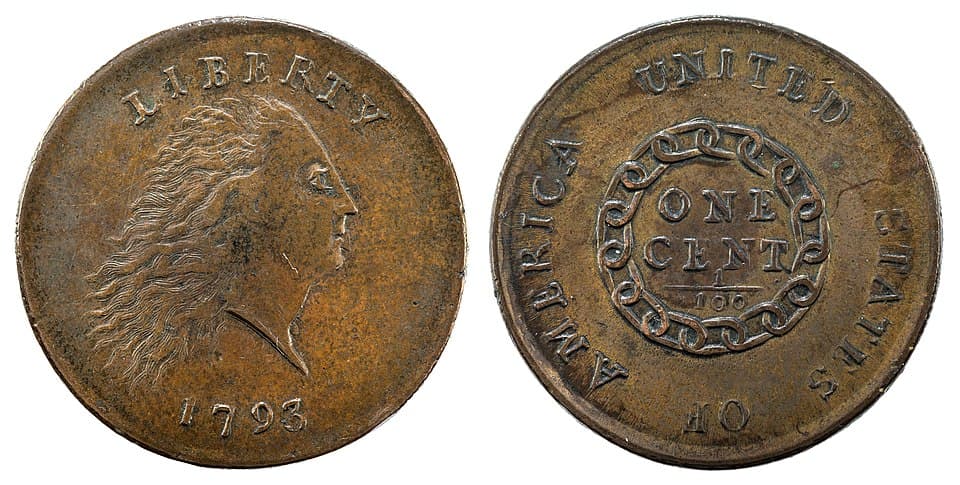
# | Coin | Why it matters | Record / benchmark | Could you find one? |
|---|---|---|---|---|
1 | 1793 Chain cent, AMERI. reverse | The first die ran out of room, so the legend stops at "AMERI." | $1,500,000, PCGS MS64+BN, Heritage, Jan 2019 | No |
2 | 1793 Chain cent, Periods | A die variety of the first U.S. cent; 36,103 Chain cents were struck in all | $2,350,000, PCGS MS66, Heritage, Jan 2015 | No |
3 | 1793 Wreath cent, Lettered Edge | Second 1793 design, replacing the unpopular chain reverse | $293,750, PCGS MS64BN, Legend, May 2017 | No |
4 | 1793 Wreath cent, Strawberry Leaf | Four known, all heavily worn | $862,500, NGC F12, Stack's, 2009 | No |
5 | 1793 Liberty Cap cent | Third 1793 design, and the smallest mintage of the three: 11,056 | $940,000, PCGS AU58BN, Stack's Bowers, Mar 2017 | No |
6 | 1794 Liberty Cap cent, Starred Reverse | A rare reverse die with tiny stars around the border | $632,500, PCGS AU50, Heritage, Feb 2008 | No |
7 | 1795 Liberty Cap cent, Reeded Edge | Experimental reeded edge; a handful known | $1,265,000, PCGS VG10, Goldberg, Sep 2009 | No |
8 | 1799/8 Draped Bust cent | Overdate: a 9 punched over an 8 | $368,000, PCGS XF45, Goldberg, Sep 2009 | No |
9 | 1799 Draped Bust cent | The key date of the large cents; very few survive, and mintage estimates vary | $977,500, NGC MS62, Goldberg, Sep 2009 | No |
10 | 1804 Draped Bust cent | Famous key date with a reported mintage of 96,500 | $661,250, PCGS MS63BN, Goldberg, Sep 2009 | No |
11 | 1823 Coronet cent | Key Coronet date; Mint records list no separate 1823 mintage | $376,000, PCGS MS66BN, Stack's Bowers, Mar 2017. PCGS guide, G4: $165 | No |
12 | 1853 Braided Hair cent | A common large cent, 6,641,131 struck | PCGS guide, G4: $30. Record $19,387.50, PCGS MS67, Stack's Bowers, Oct 2014 | Inherited accumulations, not change |
13 | 1856 Flying Eagle cent | A pattern struck before the regular series; PCGS estimates 500 to 600 known | $192,000, PCGS MS66, Heritage, Nov 2024. PCGS guide, G4: $7,000 | No |
14 | 1857 Braided Hair cent, Large Date | Last year of the large cent; most of the 333,456 never left the Mint | $24,000, PCGS MS65RD, Heritage, Aug 2018. PCGS guide, G4: $75 | Very unlikely |
15 | 1857 Flying Eagle cent | First small cent made for circulation, 17,450,000 struck | PCGS guide, G4: $32. Record $32,200, PCGS MS66, Heritage, Jan 2006 | Old jars only |
16 | 1858/7 Flying Eagle cent, Strong | An 8 punched over a 7 in the date | $74,025, NGC MS65+, Heritage, Oct 2014. PCGS guide, G4: $125 | Very unlikely |
17 | 1859 Indian Head cent | One-year laurel wreath reverse, replaced by oak wreath and shield in 1860 | $34,500, PCGS MS66+, Heritage, Feb 2012. PCGS guide, G4: $22 | Old jars |
18 | 1864 Indian Head cent, L on ribbon | Designer James Longacre added his initial partway through 1864 | $36,000, NGC MS66+RD, Stack's Bowers, Nov 2023. PCGS guide, G4: $65 | Very unlikely |
19 | 1869 Indian Head cent | Low postwar mintage, 6,420,000 | $84,000, PCGS MS66+RD, Heritage, Aug 2019. PCGS guide, G4: $90 | Very unlikely |
20 | 1872 Indian Head cent | 4,042,000 struck, one of the lowest of the 1870s | $126,500, PCGS MS66, Heritage, Aug 2007. PCGS guide, G4: $95 | Very unlikely |
21 | 1873 Indian Head cent, Doubled LIBERTY | LIBERTY on the headband shows clear doubling | $69,000, PCGS MS65, Heritage, Jul 2005. PCGS guide, G4: $250 | Very unlikely |
22 | 1877 Indian Head cent | The series key: weak economy, low demand, 852,500 struck | $149,500, PCGS MS66, Heritage, Aug 2007. PCGS guide, G4: $650 | Very unlikely |
23 | 1887 Indian Head cent (stands in for common 1880s to 1900s dates) | A common date; worn ones are a few-dollar coin | PCGS guide: $3 in G4, $350 in MS65BN. Record $51,750, PCGS MS67, Heritage, Jul 2008 | Old jars |
24 | 1888/7 Indian Head cent | An 8 punched over a 7; scarce | $74,750, PCGS MS63, Heritage, Aug 2007 | Very unlikely |
25 | 1908-S Indian Head cent | One of two San Francisco Indian cents; 1,115,000 struck | $36,600, PCGS MS67RD, Heritage, May 2026 | Very unlikely |
26 | 1909-S Indian Head cent | Lowest mintage of the series and its last issue: 309,000 | $97,750, PCGS MS67, Heritage, Jan 2006 | Very unlikely |
Sources: PCGS Auction Prices and PCGS Price Guide values (G4 = Good 4), checked the same day as the top 10. Guide values are estimates, and they move. The 1856 Flying Eagle estimate is from PCGS; early mintages conflict between references, so we left them out where they do.
Wheat cents, 1909 to 1958: the 1909-S VDB and 29 more
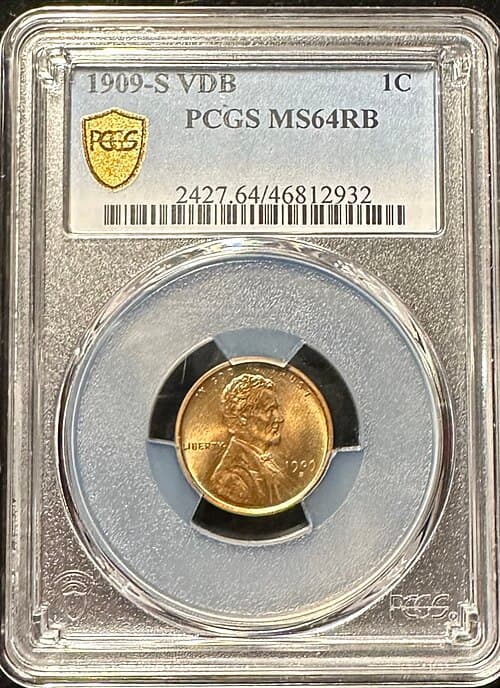
Inherited a coffee can of old cents? Read this section slowly. The Wheat cent run is where a key date can hide in a pile of common ones, and the gap between worn and gem is enormous. A 1909-S VDB in VF30 sold at Stack's Bowers for $660 in 2018. A red MS67 went for $170,800 in January 2026. Same date, same mint mark, roughly 260 times the money.
The 1914-D and the 1922 No D are both widely counterfeited, so get either one authenticated before you believe it. Several common dates, the 1918 and 1935 among them, carry big PCGS records thanks to one superb coin each. We left those out. Listing them would suggest an ordinary 1918 is valuable, and it isn't.
# | Coin | Why it matters | Record / benchmark | Could you find one? |
|---|---|---|---|---|
27 | 1909 VDB | First-year Lincoln with designer Victor David Brenner's initials; 27,995,000 struck | $56,400, PCGS MS68RD, Heritage, Jun 2021 | Old jars |
28 | 1909 VDB, Doubled Die Obverse | A doubled obverse die on the first-year VDB | $31,200, PCGS MS67+RD, Heritage, May 2023 | Very unlikely |
29 | 1909-S VDB | The Lincoln key: 484,000 struck | $170,800, PCGS MS67RD, Heritage, Jan 2026. Worn: $660, PCGS VF30BN, Stack's Bowers, Jun 2018 | Very unlikely |
30 | 1909-S | San Francisco's first-year cent without initials; 1,825,000 struck | $69,000, PCGS MS67, Heritage, Aug 2004. PCGS guide, VF35: $175 | Very unlikely |
31 | 1909-S, S over Horizontal S | The S was first punched sideways, then corrected | $32,900, PCGS MS67RD, Legend, Jul 2022 | Very unlikely |
32 | 1910-S | Early San Francisco semi-key; 6,045,000 struck | $48,000, PCGS MS67+RD, Heritage, Jan 2025 | Old jars |
33 | 1911-D | Denver's first year striking cents; 12,672,000 | $66,000, PCGS MS67RD, Heritage, Aug 2022 | Old jars |
34 | 1911-S | Low-mintage semi-key, 4,026,000 | $27,600, PCGS MS66, Heritage, May 2007 | Very unlikely |
35 | 1912-D | Early Denver date, 10,411,000 | $38,400, PCGS MS67RD, Heritage, Jan 2025 | Old jars |
36 | 1912-S | Low-mintage semi-key, 4,431,000 | $27,600, PCGS MS65, Heritage, May 2003 | Very unlikely |
37 | 1913-S | Early San Francisco semi-key, 6,101,000 | $63,250, PCGS MS66, Heritage, Jan 2006 | Old jars |
38 | 1914-D | Third-lowest Wheat cent mintage at 1,193,000; many counterfeits exist | $158,625, PCGS MS66+RD, Legend, May 2018. Worn: $192, PCGS VG8BN, Stack's Bowers, May 2023 | Very unlikely |
39 | 1914-S | Low-mintage semi-key, 4,137,000 | $105,800, PCGS MS66, Bowers & Merena, Aug 2006 | Very unlikely |
40 | 1915-S | Low-mintage semi-key, 4,833,000 | $48,300, PCGS MS66, Heritage, May 2005. PCGS guide, F12: $28 | Very unlikely |
41 | 1917 Doubled Die Obverse | A doubled obverse die in a year of 196 million cents | $120,000, PCGS MS67+RD, Stack's Bowers, Mar 2019. PCGS guide, VG10: $260 | Old jars |
42 | 1921-S | 15,274,000 struck; the big money is in top red Mint State | $36,000, PCGS MS65RD, Heritage, Jan 2025 | Old jars |
43 | 1922-D | Denver was the only mint striking cents in 1922; 7,160,000 | $56,120, PCGS MS66+RD, Heritage, Jan 2026. Worn: $28.20, PCGS EF40, Stack's Bowers, Nov 2012 | Old jars |
44 | 1922 No D, Strong Reverse | Die polishing erased the D mint mark | $92,000, NGC MS64, Stack's, Jan 2008. Worn: $720, PCGS F15BN, Stack's Bowers, Nov 2022 | Very unlikely |
45 | 1923-S | Lower-mintage 1920s San Francisco date, 8,700,000 | $67,562.50, PCGS MS65+RD, Legend, Sep 2019 | Old jars |
46 | 1924-D | Lowest 1920s Denver mintage, 2,520,000 | $19,550, PCGS MS65, Heritage, Apr 2006. Lower: $780, PCGS MS63RD, Stack's Bowers, Aug 2020 | Very unlikely |
47 | 1926-S | 4,550,000 struck; the record is one gem coin | $149,500, PCGS MS65, Heritage, Jan 2006. Worn: $71, PCGS AU55BN, Heritage, Nov 2019 | Very unlikely |
48 | 1931-S | Second-lowest Wheat cent mintage, 866,000 | $43,200, PCGS MS67RD, Heritage, Aug 2025. PCGS guide, XF40: $120 | Very unlikely |
49 | 1933-D | Depression-era semi-key, 6,200,000 | $24,000, PCGS MS67+RD, Heritage, Jan 2025 | Old jars |
50 | 1936 Doubled Die Obverse, Type 1 | The priciest of the three 1936 doubled-die types PCGS lists | $48,000, PCGS MS67RD, Heritage, Jan 2025 | Old jars |
51 | 1941 Doubled Die Obverse | A doubled obverse die in a year of 887 million cents | $9,200, PCGS MS66, Heritage, Aug 2010 | Old jars |
52 | 1944-D/S | Denver mint mark punched over an S | $49,937.50, PCGS MS67+RD, Legend, Oct 2020 | Old jars |
53 | 1946-S/D | San Francisco mint mark punched over a D | About $3,180, NGC MS67BN, an eBay sale logged by PCGS, 2023 | Old jars |
54 | 1951-D/S | Denver mint mark punched over an S | $2,350, PCGS MS67, Heritage, Apr 2014 | Old jars |
55 | 1955 Doubled Die Obverse | Hub doubling on the date and lettering; several thousand are thought to exist | $114,000, PCGS MS65+RD, Stack's Bowers, Mar 2018. Worn: $1,800, PCGS AU50BN, Stack's Bowers, May 2022 | Very unlikely |
56 | 1958 Doubled Die Obverse | Three confirmed examples, per Stack's Bowers' 2018 catalog | $336,000, PCGS MS64RD, Stack's Bowers, Mar 2018 | No |
Sources: PCGS Auction Prices, including individual lot pages, as of late September 2026. "Worn" figures are one auction each; guide values are PCGS Price Guide estimates. Mintages are from the published Lincoln cent mintage table.
Memorial and Shield cents, 1959 to now: the ones still in circulation
Pocket change is a live source here, along with a few of the errors further down. Most of the finds are varieties, not dates: a doubled die, or a reverse with the wrong spacing between the A and M of AMERICA. The money is smaller too. A 1983 doubled die reverse in MS65 red sold for $247.52 on eBay in 2018, and PCGS now calls a 1995 doubled die in MS65 red "a $45 coin".
That $45 is the realistic guide figure for most modern finds. The big figures in the table mostly belong to coins at MS66 and above, a level few pennies from a cup holder reach.
# | Coin | Why it matters | Record / benchmark | Could you find one? |
|---|---|---|---|---|
57 | 1960 Small Date | A short-lived early-1960 date style that set off a roll-and-bag buying frenzy | $4,600, MS67, Heritage, Dec 2008 | Very unlikely |
58 | 1960 Proof, Large Date over Small Date | A proof die with a large date punched over a small one | $7,475, PR69, Heritage, Jul 2003 | No (proof sets) |
59 | 1960-D/D, Small Date over Large Date | A doubled date plus a repunched D | $4,025, MS66, Heritage, Jul 2008. Lower: $156, MS65RD, Stack's Bowers, Jan 2018 | Very unlikely |
60 | 1964 SMS cent | Satin-finish special strike; an estimated 20 to 50 sets exist | $19,200, SP67RD, Heritage, Jan 2025 | No |
61 | 1969-S Doubled Die Obverse | Dramatic doubling; about 30 known, per the PCGS CoinFacts estimate Stack's Bowers cites | $126,500, MS64RD, Heritage, Jan 2008. Lower: $27,600, MS61BN, Heritage, Sep 2017 | Very unlikely |
62 | 1970-S Large Date, Doubled Die Obverse | A rare doubled obverse on the Large Date | $38,400, MS66+RD, Heritage, Aug 2024 | Very unlikely |
63 | 1970-S Small Date ("High 7") | The top of the 7 lines up with the other digits; PCGS estimates 60 to 70 million struck | $2,464, NGC MS67, David Lawrence, Jun 2008. PCGS guide, MS65RD: about $80 | Yes, in change |
64 | 1971 Doubled Die Obverse | Doubling on LIBERTY, IN GOD WE TRUST and the date | $14,950, MS66, Stack's Bowers, Nov 2011. Lower: $3,120, MS66RD, Stack's Bowers, Nov 2017 | Very unlikely |
65 | 1971-S Proof, Doubled Die Obverse | Found only in 1971 proof sets | $9,775, PR68, Heritage, Sep 2003 | No |
66 | 1972 Doubled Die Obverse | Strong obverse doubling that Stack's Bowers compares with the 1955 | $14,400, MS67+RD, Heritage, Jun 2019. Lower: $518, MS65RD, Heritage, Jan 2010 | Very unlikely |
67 | 1982 Small Date, bronze | Scarce bronze Small Date; bronze weighs 3.11 g, zinc 2.5 g | $9,987.50, MS67+, Heritage, Feb 2014. Lower: $277.30, MS67RD, eBay, May 2018 | Yes, in change |
68 | 1983 Doubled Die Reverse | Stack's Bowers estimates 2,000 to 3,000 known | $7,050, MS68RD, Heritage, Jul 2017. Lower: $247.52, MS65RD, eBay, Aug 2018 | Yes, in change |
69 | 1984 Doubled Ear | Doubling at Lincoln's ear | $3,910, MS68, Heritage, Jul 2009. Lower: $142.90, MS65RD, eBay, Dec 2018 | Yes, in change |
70 | 1992 Close AM | Struck with a reverse not used on circulation cents until 1993; very few known | $25,850, MS67RD, Heritage, Jan 2017 | Very unlikely |
71 | 1992-D Close AM | The same early reverse, at Denver | $14,100, MS65, Heritage, Feb 2014. Lower: $2,115, AU58BN, Heritage, Mar 2016 | Very unlikely |
72 | 1995 Doubled Die Obverse | Doubling on LIBERTY and IN GOD WE TRUST; PCGS estimates 300,000 to 500,000 struck | $5,052.50, MS69RD, Heritage, Jan 2017. PCGS: MS65RD is "a $45 coin" | Yes, in change |
73 | 1995-D Doubled Die Obverse | PCGS rates it about 170 times scarcer than the Philadelphia version | $4,200, MS67RD, a 2019 auction reported by PCGS | Very unlikely |
74 | 1998 Wide AM | Circulation cent with a proof-style reverse; the A and M sit clearly apart | $940, MS67, Heritage, Jun 2014 | Yes, in change |
75 | 1998-S Proof, Close AM | A proof with a circulation-style reverse; PCGS reported fewer than 10 known at the time | $5,160, PR70DCAM, Heritage, Feb 2024 | No |
76 | 1999 Wide AM | The scarcest of the three Wide AM dates | $192, PCGS MS66RD, Stack's Bowers, Sep 2018. Also $200, PCGS AU58BN, eBay, Mar 2023 | Yes, in change |
77 | 1999-S Proof, Close AM | The same swap as the 1998-S, and easier to find | $1,035, PR69, Heritage, Dec 2008. PCGS News range: $250 to $3,500 | No |
78 | 2000 Wide AM | The last Wide AM circulation date | $800, MS68RD, a single eBay sale, Apr 2012 | Yes, in change |
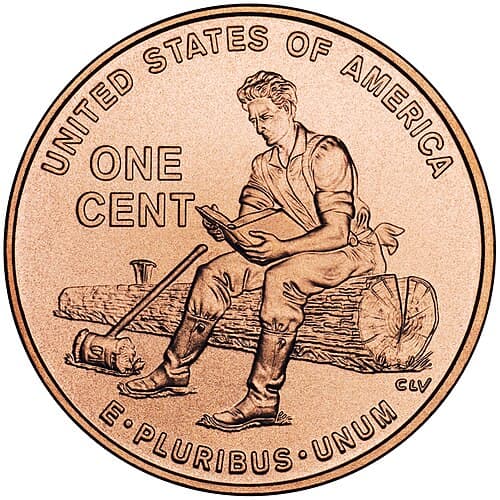
79 | 2009 Formative Years, Doubled Die Reverse | Extra fingers on young Lincoln's hand; PCGS recognizes eight doubled-die reverses | $55 (FS-804, MS65RD) and $49.99 (FS-802, MS66RD), eBay Buy It Now, Mar 2025, per CoinWeek | Yes, in change |
80 | 2017-P Shield cent | The first cent ever to carry a P mint mark, for the Philadelphia Mint's 225th anniversary | $74.95, PCGS MS67RD, eBay, May 2018 | Yes, in change |
Sources: PCGS Auction Prices and lot pages, PCGS News, and CoinWeek (row 79), all read the same week. Grades are shown as PCGS logged them; where no color appears, none was listed. The 1995-D and 2000 figures each rest on one reported result. Treat them as rough.
Errors, off-metal strikes and proofs: the 1943 copper and its relatives
Errors are the penny videos' favorite subject, and the 1943 copper is the coin the fakes copy. The 1943 bronze story is true: the Mint switched the cent to zinc-coated steel that year, a few leftover bronze blanks went through the presses anyway, and fewer than two dozen are known across all three mints. The 1944 steel cents are the same mistake run backwards, a leftover steel blank struck the year the Mint went back to copper alloy.
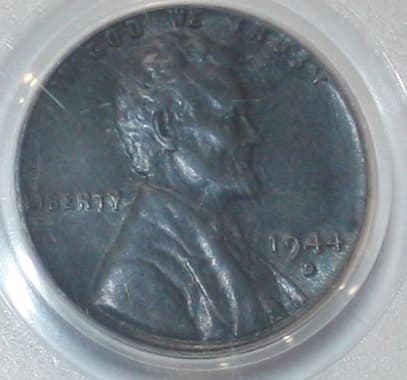
The generic errors at the bottom of the table are the realistic ones. PCGS puts most slabbed off-center Lincoln cents from 1959 to 2001 at $40 to $100, with about ten scarcer dates at $200 to $500. Fun to own. Not a windfall.
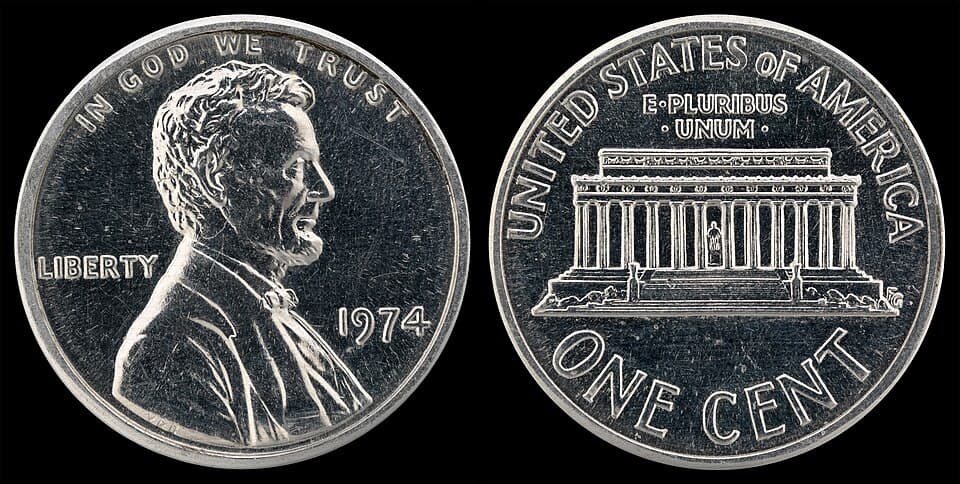
One row here has no price at all. The Mint says 1974 aluminum cents can't be lawfully owned, and the one that came to auction in 2014 was pulled and handed back.
# | Coin | Why it matters | Record / benchmark | Could you find one? |
|---|---|---|---|---|
81 | 1909 VDB matte proof | First-year Lincoln proof; fewer than 150 survive, per PCGS | $258,500, PCGS PR67+, Heritage, Aug 2014. Recent: $43,920, PCGS PR66RD, Heritage, Jan 2026 | No |
82 | 1936 proofs, satin and brilliant | First Lincoln proofs since 1916; the satin finish gave way to brilliant mid-year; 5,569 struck across both | Satin: $18,250, PCGS PR66+RD, David Lawrence, Nov 2022. Brilliant: $21,150, PCGS PR66, Heritage, Jun 2013 | No |
83 | 1943 bronze (Philadelphia) | Struck on a leftover bronze blank in the year of steel; 10 to 12 known, per CoinWeek | $372,000, PCGS MS62BN, Heritage, Feb 2021. PCGS reports an MS63RD sold privately for over $1 million in 2018 | Very unlikely |
84 | 1943-D bronze | The only known Denver 1943 cent on bronze | $840,000, PCGS MS64BN, Heritage, Jan 2021. Private sale: $1.7 million, 2010 | No |
85 | 1943-S bronze | Seven confirmed, per CoinWeek; most show wear | $504,000, PCGS MS63BN, Heritage, Nov 2020. Also $456,000, PCGS AU55, Stack's Bowers, Mar 2026 | Very unlikely |
86 | 1943 cent struck over a Cuba 1 centavo | Lincoln dies hit a finished Cuban coin; likely unique, per Greg Reynolds in CoinWeek | $38,187.50, PCGS MS62, Heritage, Nov 2013 (the same coin brought $10,925 in 2006) | No |
87 | 1944 steel (Philadelphia) | A leftover 1943 steel blank struck in 1944; 25 to 35 known | $180,000, PCGS MS64, Heritage, Jun 2021 | Very unlikely |
88 | 1944-D steel | Far scarcer than the Philadelphia version; 7 to 10 known, per CoinWeek | $122,000, PCGS MS62 CAC, Heritage, Jan 2026 | Very unlikely |
89 | 1944-S steel | Just two known, per a 2015 CoinWeek count | $408,000, PCGS MS66 CAC, Heritage, Aug 2021 | No |
90 | 1974 aluminum cent | Experimental cents Congress rejected; the Mint recalled almost all and says they can't be lawfully owned | No public sale on record. A PCGS MS63 1974-D was pulled from Heritage's April 2014 sale and surrendered to the Mint. A legal cousin, a 1974-S struck on a Philippine aluminum planchet, brought $19,200, PCGS MS61, Heritage, Jan 2023 | No |
91 | 1983 cent on a bronze planchet | A leftover pre-zinc blank used after the switch; about 6 known to one Numismatic News writer | $29,250, PCGS MS65RD, GreatCollections, Jul 2024 | Yes (weigh it) |
92 | 1990 No S proof | The only Lincoln proof missing its S; fewer than 200 have surfaced, and the Mint destroyed 145 | $20,700, PCGS PR69, Bowers & Merena, Aug 2007. Recent: $4,560 to $4,920, PCGS PR69DCAM, Heritage, 2023 to 2025 | No (1990 proof sets only) |
93 | 2001-D cent muled with a dime reverse | A cent obverse paired with a Roosevelt dime reverse die; 4 known | $114,000, PCGS MS66RD, Heritage, Jun 2021 (a second brought $114,000 in Jan 2024) | Very unlikely |
94 | Cent struck on a dime planchet | Cent dies hit a dime blank, so the design runs off the edge; one specialist estimates 4,000 to 5,000 known | $900 (1956-D, ANACS AU58, Stack's Bowers, Mar 2023); $1,920 (1986-D, PCGS MS63, Heritage, Mar 2021). A 1943 on a silver dime planchet: $15,275, NGC AU50, Heritage, Nov 2013 | Very unlikely |
95 | Cent struck on a finished dime | A struck dime takes a second hit from cent dies | $558.13 and $763.75 (1996, PCGS MS66, Stack's Bowers, 2014); $720 (1986, NGC AU58, Heritage, Nov 2020). Undated, 50% off-center: $7,637.50, NGC MS67, Heritage, Jan 2014 | Very unlikely |
96 | Off-center strike | The blank sat off-center in the press; 40% to 60% off with a full date is the collector sweet spot | PCGS estimate: $40 to $100 for most graded 1959 to 2001 dates. A cent struck 25% off-center brought $1,800, PCGS MS62BN, Heritage, Sep 2019 | Yes |
97 | Double struck | The coin didn't eject and got hit twice | $66 (1997, ANACS MS64RD, Heritage, Nov 2014); $59 (1999-D, second strike 55% off-center, NGC MS67, Heritage, Feb 2005) | Yes |
98 | Broadstrike | Struck without the collar, so the coin spreads wider than normal | $9.52 (1999, NGC MS64RD, eBay, Jun 2019); $168 for one double struck and broadstruck (1975-D, NGC MS65BN, Heritage, Oct 2019) | Yes |
99 | Clipped planchet | The blanking press overlapped the strip edge or an earlier hole | $336 for a 1928-S ragged clip, PCGS MS64RB, Stack's Bowers, Feb 2025 | Yes |
100 | BIE die break | A die crack fills the gap between B and E, so LIBERTY reads LIBIERTY | $15.50 for a 1954-S, ungraded MS60BN, eBay, Jan 2019 | Yes |
Sources: PCGS Auction Prices, PCGS News and the PCGS Top 100 page, CoinWeek, Numismatic News and CoinNews. The generic errors (rows 94 to 100) rest on one or two results each, or on a PCGS writer's range, not records.
What the viral penny prices trace back to
The 1999 penny "worth $4,500"
An ordinary 1999 cent is worth a cent. The variety behind the headlines is the 1999 Wide AM, a circulation cent struck with a proof-style reverse, where the A and M in AMERICA sit clearly apart. It's a legitimate variety, and it does turn up in change. The sales we could actually read: $192 for a PCGS MS66 RD at Stack's Bowers in September 2018, and $200 for a PCGS AU58 BN on eBay in March 2023.
We couldn't confirm a $4,500 sale for any 1999 cent on a page we could open. PCGS's page for the plain 1999 cent does list a $138,000 top result, from Heritage in 2006. That lot appears to be a 1999 cent struck with a Roosevelt dime reverse, a mint error of the same family as the 2001-D mule, and nothing like a normal 1999.
The $2.3 million penny
It's the 1793 Chain cent, Periods variety: PCGS MS66, $2,350,000, Heritage, January 2015. A lot of posts hang the big number on the 1943 copper penny instead. The closest verified figure there is the $1.7 million private sale of the 1943-D bronze in 2010. Since it's unique, that's the same coin Heritage sold for $840,000 in 2021.
Four-figure prices on ordinary modern cents
Some of the scariest numbers come straight off PCGS's own pages, which log eBay sales alongside auctions. The highest 2017-P result shown there is $4,500. The coin behind it was graded NGC PO1 RD and sold on eBay in 2018. PO1 is Poor 1, the bottom of the grading scale, and RD means full red, a pairing that is odd on its face. A PCGS MS67 RD 2017-P went for $74.95. The 2019-W reverse proof has the same pattern: a $5,000 eBay high next to normal PR70 RD sales of $86 and $172.50.
The penny videos high in search results, with titles along the lines of "retire if you find this," quote numbers like these. Check the grade behind any figure they use. And the hype has happened before: 1995 doubled dies briefly topped $500 during that year's media frenzy, then fell once collectors learned hundreds of thousands existed.
How to check a penny from your jar
Start with the date and the mint mark. On Lincoln cents a D (Denver) or S (San Francisco) sits under the date (a few recent collector-only cents carry a W), and Philadelphia cents carry no letter at all, the 2017-P aside. Match what you have against the tables. A 1909-S is interesting. A plain 1909 mostly isn't, unless the reverse has VDB at the bottom.
Doubling next, with a 10x loupe: LIBERTY, IN GOD WE TRUST and the date, looking for a second outline offset from the first. That's what makes a 1955 or a 1972. On 1998, 1999 and 2000 cents, flip the coin and check the gap between the A and M of AMERICA.
The 1943 magnet test, and what it misses
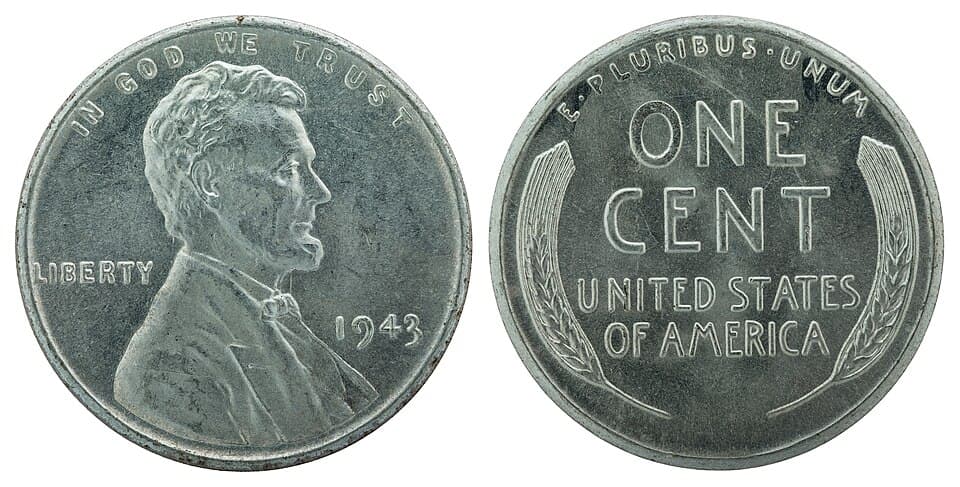
Normal 1943 cents are steel, and steel sticks to a magnet. A genuine 1943 bronze cent doesn't. Simple enough, except the fakes come in two kinds. One is an ordinary steel 1943 plated with copper, and the magnet catches it. The other is a cent from another year, usually 1945, 1948 or 1949, with the date altered to read 1943. That coin really is bronze. It won't stick, and the magnet tells you nothing.
For those, look hard at the 3. CoinWeek notes that on a genuine 1943 bronze cent it's identical to the 3 on a steel cent, and that the typical fake is an altered date. Run the magnet the other way on 1944: a true 1944 steel cent should stick, and a "1944 steel" that doesn't isn't steel. So the magnet can rule a coin out, but it can never prove one genuine.
Weigh it: 3.11 grams or 2.5
Bronze cents weigh 3.11 grams. The copper-plated zinc cents that replaced them during 1982 weigh 2.5, per PCGS. Any scale that reads tenths of a gram will separate them, and that's how the 1982 bronze Small Date and the rare 1983 cents on leftover bronze blanks get found: a 1983 that weighs about 3.1 grams may be struck on one, per Numismatic News. A genuine 1943 bronze cent should also weigh 3.11. Steel cents run about 13% lighter.
Then grade and color, the part that decides most of the money. Coins are graded 1 to 70, and copper gets a color call on top: RD for red, RB for red-brown, BN for brown. On the PCGS guide an 1887 Indian cent is a $3 coin in Good 4 and a $350 coin in MS65 brown, and nothing separates the two but wear.
Think you found one? Authenticate it before anything else
Hold it by the edge and put it somewhere soft. Don't clean it. Cleaning leaves hairlines a grader spots right away, and on copper it can strip the original color that the RD and RB designations depend on.
Then send it to PCGS or NGC for authentication and grading. CoinWeek's line on 1943 coppers is that no coin valued over $500 should be bought or sold without authentication, and it's a sensible bar for every key date and error in this list. Grading is paid per coin, so compare the fee with the numbers in these tables before you send in a BIE like the one that sold for $15.50.
If a graded coin or a whole inherited collection is headed to market, our guide on how to sell a coin collection goes through the options. (A disclosure, since it's our guide: we run Collect Pure, a marketplace for coins and bullion.) We test every item ourselves before it ships, and you can browse numismatic coins on the marketplace. For other denominations, see which nickels are worth money and the rare quarters worth money.
Penny questions people ask
What are the top 20 most valuable pennies?
The first ten are in the table near the top. Numbers 11 through 20 on this list, by auction record: the 1944-S steel ($408,000), the 1823 large cent ($376,000), the 1943 bronze from Philadelphia ($372,000), the 1799/8 ($368,000), the 1958 doubled die ($336,000), the 1793 Wreath with lettered edge ($293,750), the 1909 VDB matte proof ($258,500), the 1856 Flying Eagle ($192,000), the 1944 steel ($180,000) and the 1909-S VDB ($170,800).
Only one of the twenty, the 1958 doubled die, was struck after World War II.
How much is a 1943 steel penny worth?
Not much, in the grades most people have. Philadelphia alone struck 684,628,670 of them, and PCGS says steel 1943s are common in average circulated grades and only collectible in pristine Mint State. Be wary of very shiny ones sold as "brilliant uncirculated." Some steel cents have been stripped and replated; collectors call them reprocessed. The 1943 that brings serious money is the bronze one, and it won't stick to a magnet.
Which years of pennies are worth money?
For modern cents, no year is valuable across the board; it's a date plus a mint mark, variety or error. For coins that can still turn up in change, the years to check are 1970 (S mint, Small Date), 1982 (bronze Small Date), 1983, 1984, 1995, 1998, 1999, 2000, 2009 and 2017 (P mint), each for the specific variety in the modern table. In an old jar, the Wheat cent keys are the 1909-S VDB, 1914-D, 1922 with no mint mark, 1931-S and the 1955 doubled die.