

How to Sell a Canadian Gold Maple Leaf
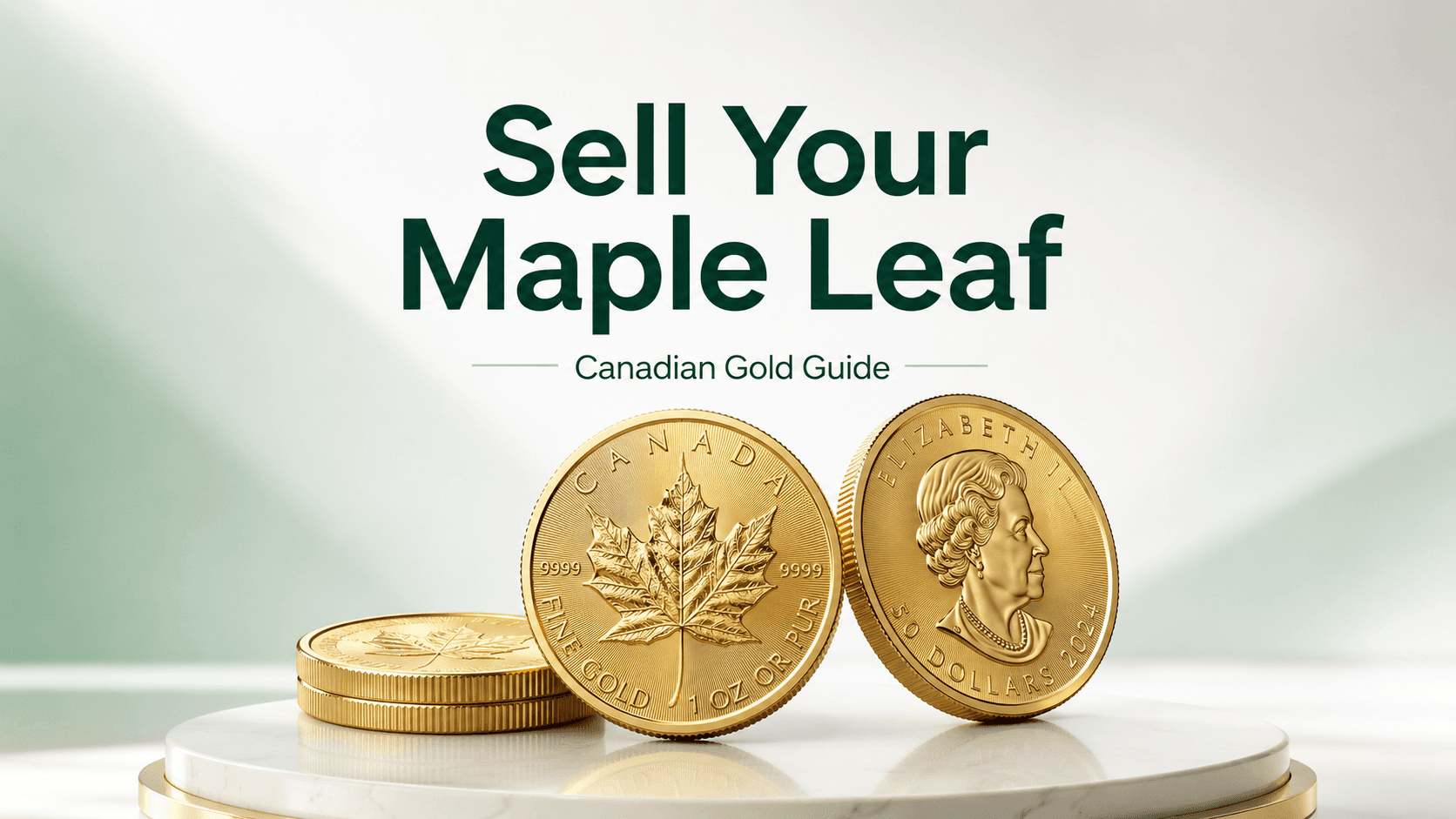

A Canadian Gold Maple Leaf sells for the live spot price of gold times the coin's gold content, plus or minus a spread. A 1 oz Maple Leaf carries exactly one troy ounce of pure gold, so before anyone makes you an offer, you already know the melt value: it is whatever spot says today. The $50 face value stamped on the coin is the least useful number on it. Maple Leafs trade on gold content, never at face.
The spread is where the channels differ. A coin shop, an online dealer's buyback desk, and a marketplace order book will each put a different number on the same coin, and picking between them is most of the work of selling well.
Check the coin before you price it
Start with the date. The Royal Canadian Mint has struck the Gold Maple Leaf at .9999 fine since 1982 (mint.ca); the earliest coins, dated before 1982, are .999. Both are pure gold coins and both sell on metal content, but the fineness belongs in your listing description, and a buyer will notice if it is wrong.
The date also tells you which security features your coin carries. A micro-engraved privy mark arrived on 2013 coins, radial lines on the fields in 2015, and coins dated 2014 and later are registered in the Mint's Bullion DNA program, which lets participating dealers authenticate them with a dedicated reader. 2024-dated coins switched to the King Charles III effigy. None of this changes the gold inside, but a pre-2014 coin sits outside Bullion DNA, so some dealers will lean harder on their own testing before quoting you.
Two variants are worth separating out. The Mint has issued special 99.999% five-nines versions, which are a different product from the standard bullion coin and should never be lumped into a generic listing. And fractional Maple Leafs (1/2 oz down to 1 gram Maplegrams) trade at their own per-ounce premiums, so price them as what they are rather than dividing a 1 oz quote.
Condition matters more than people expect with this coin. Pure 24-karat gold is soft. Rim dings, deep scratches, and coins that lived loose in a drawer trade closer to melt, whatever the sticker on the original card said.
Where you can actually sell it
A local coin shop is the fastest route: walk in, get an offer, leave with payment. The offer varies shop to shop because each shop is pricing its own resale risk, and the only way to know whether the first quote was fair is to get a second one. If you need money today, this is the right channel, and no online option matches it on speed.
Online dealer buyback desks work differently. You request a quote, lock the price, and ship the coin in. The dealer's margin lives inside the quoted number, which is not a criticism, just how the model works. It fits sellers who want a fixed figure before the coin leaves their hands.
A marketplace order book shows you both sides. Every standing bid and ask on the coin is visible, so instead of taking one party's offer you can accept the current best bid or set your own ask and wait. The trade-off is time and shipping. The full comparison, with a worked example, is in selling gold online vs. a local dealer; the short version is that the channels price the same coin differently and none of them wins every situation.
Selling on Pure, step by step
Pure is a US marketplace; onboarding takes about 15 minutes of document verification.
Open the order book. The 1 oz Gold Maple Leaf product page shows live bids and asks quoted as premiums over spot. When I checked on July 8, 2026, buyers wanted 56 coins at the top bid of $4,086.88, with standing bids for hundreds more stacked underneath.
Take a bid or place an ask. Accepting the highest standing bid fills immediately. Placing an ask names your price and waits for a buyer. The mechanics, including ask pricing types and what happens when a bid does not cover your full quantity, are in the guide to selling on Pure.
Ship it. You get a prepaid FedEx label, insured both ways up to $125,000, and transit to the Los Angeles facility runs 1 to 3 business days.
Verification. Every coin is checked in-house with XRF and a Sigma Metalytics verifier, typically within about 24 hours. This tests the coin itself, so it covers any year of Maple Leaf, including pre-2014 coins that Bullion DNA cannot. If a coin cannot be verified as listed, the sale does not complete and Pure follows up on next steps.
Get paid. Payout is automatic once the coin checks in and verifies: 24 to 72 business hours, by ACH or check.
The sell-side fee on bullion starts at 0.75% at the baseline Copper tier and steps down with quarterly sales volume: 0.7% from $50,000 in quarterly sales, 0.625% from $300,000, and 0.5% at $1,200,000 and up. Tiers reset each quarter. Buyers pay no marketplace fee. Current rates and shipping detail live in the fees and shipping breakdown.
You can see the whole Maple Leaf lineup, from Maplegrams to five-nines issues, on the Canadian Gold Maple Leaf page.
What moves the number you actually get
Mostly the spread, at the moment you sell. Spot moves all day and the bids move with it, which is an argument for looking at the order book before you commit to any channel, even if you end up selling elsewhere; it is a free read on what buyers are paying right now.
After that, it is the coin. Size sets its own premium, and a 1/10 oz coin will not simply fetch a tenth of the 1 oz price. A five-nines issue or a vintage .999 coin should be listed as exactly that. And condition does its usual quiet work: a clean coin sells as a Maple Leaf, a rough one sells as gold.
FAQ
What is my 1 oz Gold Maple Leaf worth to sell?
Spot price times one troy ounce, plus or minus the spread in the channel you pick. On July 8, 2026 in the afternoon, the best bid on Pure's book was $4,087, 0.35% over spot, one dated read from a live two-sided market; the gold chart has the current spot number.
Do I need the original packaging or assay card to sell on Pure?
No. Verification at the Los Angeles facility tests the coin itself with XRF and a Sigma Metalytics verifier, so loose coins and coins in tubes sell the same way. Condition still shows in what buyers bid.
How fast do I get paid?
Payout runs automatically once your coin checks in and clears verification, 24 to 72 business hours after check-in, by ACH or check.
Do I owe taxes when I sell a Gold Maple Leaf?
Possibly. Sales of precious metals can carry tax and reporting rules, and they depend on your situation. Talk to a tax professional before you sell or file; this post does not cover tax treatment.
Ready to sell yours?
Pull up the 1 oz Gold Maple Leaf order book and see what buyers are bidding right now, or browse the full lineup on the Canadian Gold Maple Leaf page.