

Selling Gold Online vs. a Local Dealer: How to Compare Offers

You have gold to sell, and two obvious ways to do it: drive it to a local shop, or ship it to an online buyer. A local shop may pay you that afternoon. Selling online takes longer, so the real question is whether the final payout makes the extra time worthwhile.
The best place to sell gold is not the one with the highest figure on the wall. It is the one that leaves the most money in your pocket after fees, while fitting what you need around speed, security, and hassle. Depending on the coin and the day, that can be a local dealer or an online marketplace. This guide is how to compare them.
Fair warning: we run a marketplace where people sell gold. A dealer with a firm cash offer still beats us plenty of the time, and the post says where. The method works wherever you sell.
What sets the number you actually receive
Every offer for a piece of gold is built from the same handful of inputs, whether it comes from a counter or a screen:
The spot price. The live wholesale price of raw gold, which moves all day.
Weight and purity. How much actual gold is in the item, in troy ounces of fine metal.
The product itself. A recognized coin or bar prices differently than a ring or a broken chain.
Mint or maker. A coin from a sovereign mint is easier to price than an unmarked bar.
Condition and packaging. Original capsules, assay cards, and certification can matter for some items.
Collector demand. A few coins trade above their raw metal value because of demand, mintage, or grade. Most common bullion does not.
The buyer's spread and fees. Every buyer needs a margin between what they pay you and what they can resell for. Where that margin sits, and whether it is shown to you or buried in the price, is the whole game.
Your offer is not the spot price itself, but spot adjusted for the product, current demand, and the buyer's margin. So compare offers for the exact coin you own, not a melt-value guess: a one-ounce American Gold Eagle is priced as a coin, not as raw metal.
How selling to a local dealer works
Selling to a local coin shop or bullion dealer is the version most people picture:
You bring the item into the store.
The dealer inspects it and verifies the metal.
The dealer gives you an offer.
You accept it, walk, or try to negotiate.
You get paid, usually on the spot.
Where a local dealer shines
The appeal is speed and a handshake. You leave with cash the same day, you never put your gold in the mail, and you can ask a person questions and read their answer. For jewelry, scrap, an inherited mix of odds and ends, or anything hard to identify, a dealer who can hold the item and test it is often the practical choice. Some sellers also have a shop they have used for years and value that relationship on its own.
Where it can fall short
A single shop is a single bid. You see one number, and unless you drive to a few stores you have nothing to weigh it against. Offers vary from shop to shop, the pricing is not always itemized, and a counter conversation can put a little pressure on you to decide before you have compared anything. Checking three dealers means three drives. None of that makes a local sale wrong. It just means the one offer in front of you is harder to sanity-check.
How selling on Pure works
Pure is an order-book marketplace, so selling looks less like a quote and more like a market. The sequence:
Find your gold item in the marketplace.
Look at the live bids and recent activity for it.
Accept the highest bid, or set your own asking price and wait for a buyer.
Ship the item on a prepaid, insured label.
It is verified at Pure's facility.
Payment is issued automatically once the sale completes.
A few things matter to a seller here. You are not taking one buyer's word for the price; you can see every bid competing for the coin before you accept anything. The seller fee is shown to you rather than folded into the offer: it starts at 0.75% for bullion and drops as your selling volume grows. Every item is checked at Pure's Los Angeles facility using XRF and a Sigma Metalytics verifier, and shipments are insured both ways up to $125,000 through FedEx. Payment runs automatically, typically 24 to 72 business hours after the item checks in, by ACH or check. If an item cannot be verified, the sale does not complete, and Pure contacts you about what happens next.
The tradeoff is plain: you do not get cash this afternoon. You ship the coin and wait a few business days for a market-set price instead.
How to compare two gold offers the right way
This is the part that actually decides it. Four steps.
Step 1: make sure it is the same coin, down to the year
You cannot compare two offers if they are not for the same thing. Line up the metal, the weight, the purity, the mint or brand, the year, the condition, and any certification. A one-ounce American Gold Eagle is not interchangeable with one ounce of raw gold, and a certified, graded coin is a different item than the same coin loose. Pin down exactly what you are selling first.
Step 2: get a firm number from the dealer
A ballpark is not an offer. Ask the dealer four questions directly: Is this the final amount I receive? Are there testing, processing, or payment fees on top? How long is the offer good for? Does the price reflect the coin's premium, or just its gold content? Write the firm number down.
Step 3: check Pure at about the same time
Gold moves throughout the day, so an offer from this morning and a bid from tonight are not a fair match. Pull up your coin on Pure close to when you got the dealer's number and note the Pure price, the highest live bid for your coin.
Step 4: subtract every fee and compare the net
Compare what lands in your account, not the sticker:
Pure net = the bid you accept, minus the seller fee.
Dealer net = the firm cash offer, minus any testing or payment fees.
Whichever leaves more is the better deal on money. Then factor in what money does not capture: how soon you need paying, and whether you would rather not ship at all.
What you are weighing | Local dealer | Selling on Pure |
The offer you see | One shop's quoted price | Live bids from the whole order book |
Selling fee | Usually built into the offer | Shown separately, from 0.75% for bullion |
Shipping | None, you walk in | Prepaid, insured both ways via FedEx |
When you get paid | Often same day, in cash | Automatically, ~24 to 72 business hours after check-in |
Price visibility | Whatever the shop tells you | Every bid and recent sale, before you accept |
Setting your price | Sometimes negotiable | Accept a bid or set your own ask |
Best fit | Fast local cash, odd or raw items | Standardized, actively traded coins and bars |
A worked example with the same gold coin
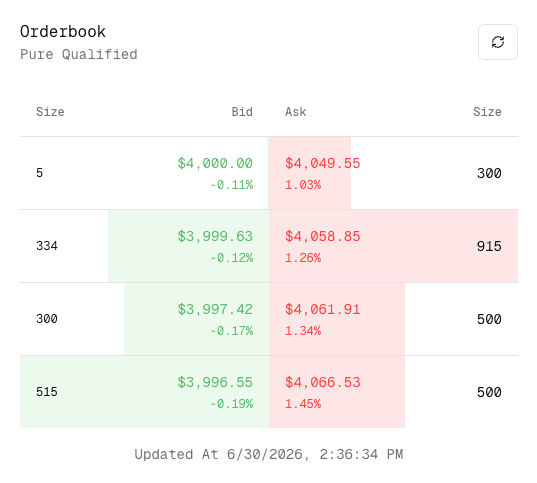
On June 30, 2026, the highest live bid on a one-ounce American Gold Eagle on Pure was $4,000.00, about 0.11% under spot. The bullion seller fee at the base tier is 0.75%, which is $30 on that bid, so a seller accepting it nets $3,970.
Now set that next to a sample local dealer. Say a shop offers $3,975 in cash, firm, today, with no extra fees. The math:
Pure accepted bid: $4,000.00
Less 0.75% seller fee: $30
Pure net: $3,970
Sample dealer offer: $3,975, paid today
Difference: about $5, in the dealer's favor here
Here the two are within a few dollars: the dealer's cash is in hand today, while Pure's price is market-set and paid after the coin ships and clears. Whether five dollars is worth a few days' wait is your call, and the gap can swing either way on a different coin or a different day. Run the math on your own offers.
When a local dealer is the better call
A dealer is genuinely the smarter move when:
You want cash or payment immediately.
You would rather not ship your gold at all.
The dealer's firm offer matches or beats the online net.
You are selling jewelry, scrap, or a damaged item.
The piece is hard to identify or does not match a standard product.
You have a shop you trust and value dealing with a person.
If any of those describe you, do not overthink it. Get the firm number and weigh it.
When selling on Pure makes more sense
Selling on a marketplace tends to fit when:
You are selling recognized coins or bullion that trade actively.
You want to see live demand instead of one shop's quote.
You would like to compare bids, or set your own ask, before committing.
You are not in a rush to close today.
The net after fees comes out ahead for you.
You want a defined verification and shipping process behind the sale.
Standardized, liquid product is where an order book does its best work, because there are real bids competing for it.
Questions to ask before you sell gold anywhere
Run this list against either route before you hand anything over:
What is the exact item I am selling?
What is the current market price for it?
Is the offer firm, and for how long?
What fees come out before I get paid?
How and when will I actually be paid?
Is the item insured in transit or while it is in the buyer's hands?
What happens if it does not pass verification?
Can I decline and get my item back?
What documentation will I receive?
So where should you sell your gold?
The best place to sell gold depends on the item and the net offer, not on a slogan. Compare the same product at about the same time, subtract every fee, and decide how much you value same-day cash, an in-person look, market visibility, and not having to drive anywhere. For jewelry, scrap, or anything unusual, or when you need money today, a local dealer is often the answer. For recognized coins and bars you are not rushing to sell, compare a dealer's offer against what an open market of competing bids returns after fees.
If your gold is the kind of coin or bar that trades on a marketplace, see what buyers are actually bidding for it on Pure, work out your net after the seller fee, and set that against your dealer's firm offer. Then pick the bigger number. And if your gold is a bar from a warehouse shelf, we wrote a dedicated guide to where to sell Costco gold bars, including what Costco itself will and will not take back.
Common questions about selling gold
Is it better to sell gold online or in person?
Whichever leaves you with more after fees, once you have weighed how much speed and skipping a shipment are worth to you. In person wins on same-day cash and odd items; online can win on price for standard coins because more buyers are competing for them.
Do local gold dealers pay spot price?
Some price their offers off spot, but the amount you receive reflects the coin's demand, the dealer's resale costs, and their margin, so it can land above or below spot depending on the item. Always ask whether the number quoted is the final amount.
Is it safe to ship gold to an online buyer?
It can be, if the buyer's process is built for it. Look for insured shipping in both directions, a stated verification step, and a clear policy for what happens if an item is disputed. On Pure, shipments are insured both ways up to $125,000 and every item is verified before the sale completes.
Are gold coins worth more than their melt value?
Some are. A coin can trade above its raw gold content because of demand, mintage, condition, or the mint behind it. Most common bullion trades close to its metal value, so check the live market for your specific coin rather than assuming a premium either way.
How long does it take to get paid when you sell gold online?
It depends on the platform. A local dealer pays the same day; an online sale takes longer because the item ships and is verified first. On Pure, payment is issued automatically, usually 24 to 72 business hours after the item checks in.
Selling gold? See the Pure price for your coins and bars, or read how selling on Pure works start to finish.