

Gold Buying App Checklist: What to Check Before You Trust One

A gold buying app is only as good as what happens after you tap buy. If you're about to move a four or five-figure order through one, find out who tests the metal ahead of shipping, what the shipping insurance covers, and if the price you see is a live bid and ask or a single set price. On fees, the CFTC's advisory for metals buyers is blunt: if the fees aren't available in writing before your purchase, that is a red flag.
Figure out what kind of app it is
Search for a gold app and the results mix several different products. A price app shows spot and sends alerts, and you can't buy anything in it (the gold price app guide covers those). A digital-gold app sells you metal that stays in its vault, sometimes by the gram. A dealer or marketplace app, what you'd call a bullion app, sells physical coins and bars and ships them.
Then there's geography: plenty of gold apps are built for buyers outside the US.
This checklist is for the third kind, on a US address: you pay, and a box shows up. So start by confirming the app sells to US customers and ships to your state. The App Store listing's country and the company's own help pages usually settle it in a minute.
Seven checks for your first order
Who tests the metal, and when
Counterfeit coins and bars exist, and a photo on your phone tells you nothing about purity. So ask one question: does someone test this item on its way to me? Some sellers check every piece. Others rely on the mint's sealed packaging. The listing or the help center should say which, and if neither does, ask support. Then order.
What the shipping insurance covers
Gold ships through ordinary carriers. What you need to know is who carries the loss if a box goes missing between their door and yours, and up to what dollar amount. Look for a stated ceiling. If your order is $30,000 and the policy stops at a lower number, you've found that out while it's still free to walk away.
Ask, too, what happens when tracking says delivered and the box isn't there.
Whether you see bids and asks, or one set price
Many dealer apps show one price per product, set by the dealer, and a separate, lower price they pay to buy it back. The gap between the two is the spread, the difference between the dealer's buy and sell price.
A marketplace with an order book works differently. You see the highest bid other buyers have posted and the lowest ask a seller will take, and you can post your own bid and wait for a seller to meet it. If the terms are new, our guide to reading an order book walks through a real one. Either way, know which one you're looking at when you compare prices across apps.
Where premiums and fees show up
Nobody pays spot. You pay spot plus a premium, and then whatever checkout adds: a card surcharge, shipping, sometimes a flat order fee. The useful apps show the premium on the product card or the listing, while you're still deciding. The frustrating ones let you find the total on the last screen.
The CFTC's red flag is specific: fees that aren't available in writing before your purchase. So get the full breakdown (premium, surcharge, shipping) in front of you ahead of confirming, and screenshot it. That's your record of what you agreed to.
What it asks you to prove about yourself
Expect an identity check. A driver's license and a selfie can feel like a lot for a one-ounce coin, but federal rules require dealers in precious metals to run a written anti-money-laundering program, and identity checks are a normal part of how legitimate sellers handle that. An app that will take a $20,000 wire from an email address and nothing else is the one to be careful with.
While you're on the listing, read the App Store privacy label. It shows the data types the app may collect and whether that data is linked to you.
Card, wire, ACH, and the surcharge question
Bank wire and ACH are the normal rails for bullion. Card payments cost the seller processing fees, so apps that take cards tend to add a surcharge, limit cards to certain items, or both. Apple Pay runs on a card underneath, so it follows the card rules. Check which items take which method, then build the cart.
Delivered to you, or kept in a vault
If the app keeps your gold in a vault, the details decide everything: whose vault, in which country, and whether you can take delivery later and at what cost. The CFTC's precious metals fraud advisory lists an agreement that does not identify where the physical metal is located as a warning sign.
If the app ships to you, the testing and insurance checks above carry most of the weight.
Frequently asked questions
Which app is best to buy gold?
That depends on what you want delivered and how you pay. For physical coins and bars shipped to a US address, price trackers and most digital-gold apps are out of the running. Then check who tests the metal, the insurance limit on the package, and if the full price shows up while you can still back out. Our app, Pure: Buy Gold & Silver, is one option built for US buyers; run it through this list like any other.
Is it safe to buy gold on an app?
The app is the storefront, so this is really a question about the company behind it. Match the developer name on the App Store listing to the company you think you're buying from, then look that company up. The CFTC suggests your state attorney general or securities regulator as a place to start when you're sizing up a metals dealer.
Can you buy physical gold on an app, or only digital gold?
Both, and they share a results page. A digital-gold app sells you metal that stays in its vault, sometimes by the gram, and taking delivery may cost extra or not be offered at all. A dealer or marketplace app ships the coin or bar to you. We run Pure, a marketplace where sellers list physical coins and bars, and orders ship to you insured both ways up to $125,000.
How the Pure app answers the same checklist
We make one of these apps, so read this section as our answers to the questions above rather than a verdict. Pure is a peer-to-peer marketplace: buyers and sellers post their own prices, and every order is visible on the product's order book. The iPhone app, Pure: Buy Gold & Silver, is free and runs on iPhone and iPad with iOS 16.4 or later. There's no Android version yet.
Check | How Pure handles it |
|---|---|
Kind of app | A full account: buy, sell, and manage orders. Same account as collectpure.com. |
Testing | We test every item ourselves before it ships. Items that pass are Pure Qualified. |
Shipping insurance | Insured both ways, up to $125,000. |
Pricing | Each product shows its highest bid and lowest ask, and you can place your own bid or ask. Product cards carry a tag with the premium over spot. |
Fees | No marketplace fee for buyers. Card payments carry a 2.9% surcharge. Shipping is $25 on orders under $10,000 and free above that. |
Identity | Signup runs in the app: your documents, a selfie, and a bank link. |
Payment | Wire or ACH on any order. Card and Apple Pay on Pure Priority orders only. |
Delivery | Ships to you. |
Availability | US customers only. |
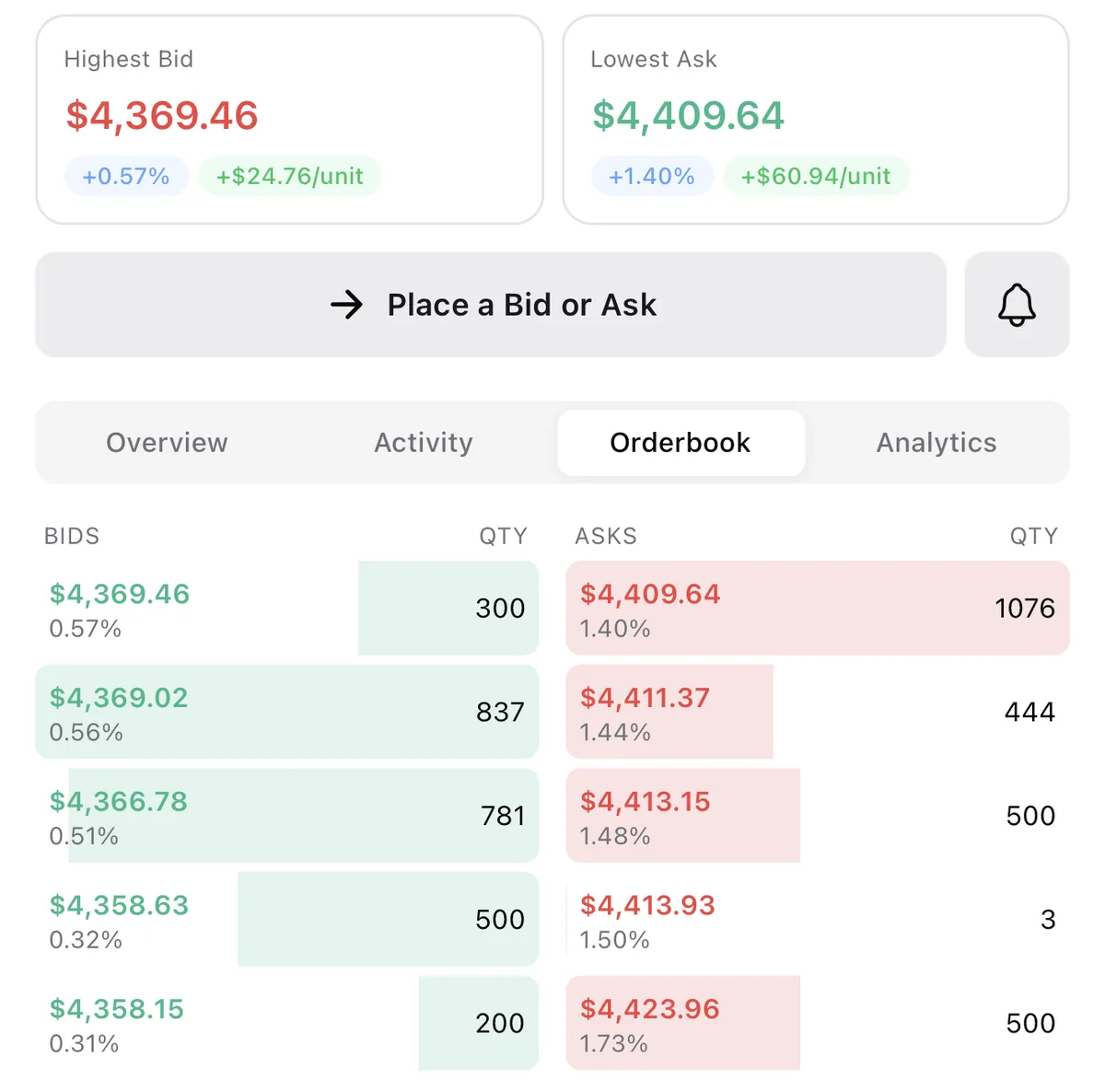
*The order book tab for a 1 oz American Gold Eagle in the Pure app, captured on an iPhone on September 21, 2026 at 12:42 PM Pacific. Prices and quantities change as orders are placed and filled, so treat these as an example of what the screen shows, not a quote.*
Selling runs in the same app: you can create a listing or start a sell order without switching to a computer. The app also sends price alerts and has a spot price widget, which the price app guide above covers. For the full tour of the app, see the Collect Pure app. For the wider question of who to buy from, our guide to the best place to buy gold online compares premiums and fees across the options.
None of this tells you whether to buy gold. It's a way to check where you buy once you've decided. You can browse the live marketplace without the app, and the website's product pages show the same highest bid and lowest ask.