

How to Read an Order Book: A Beginner's Guide
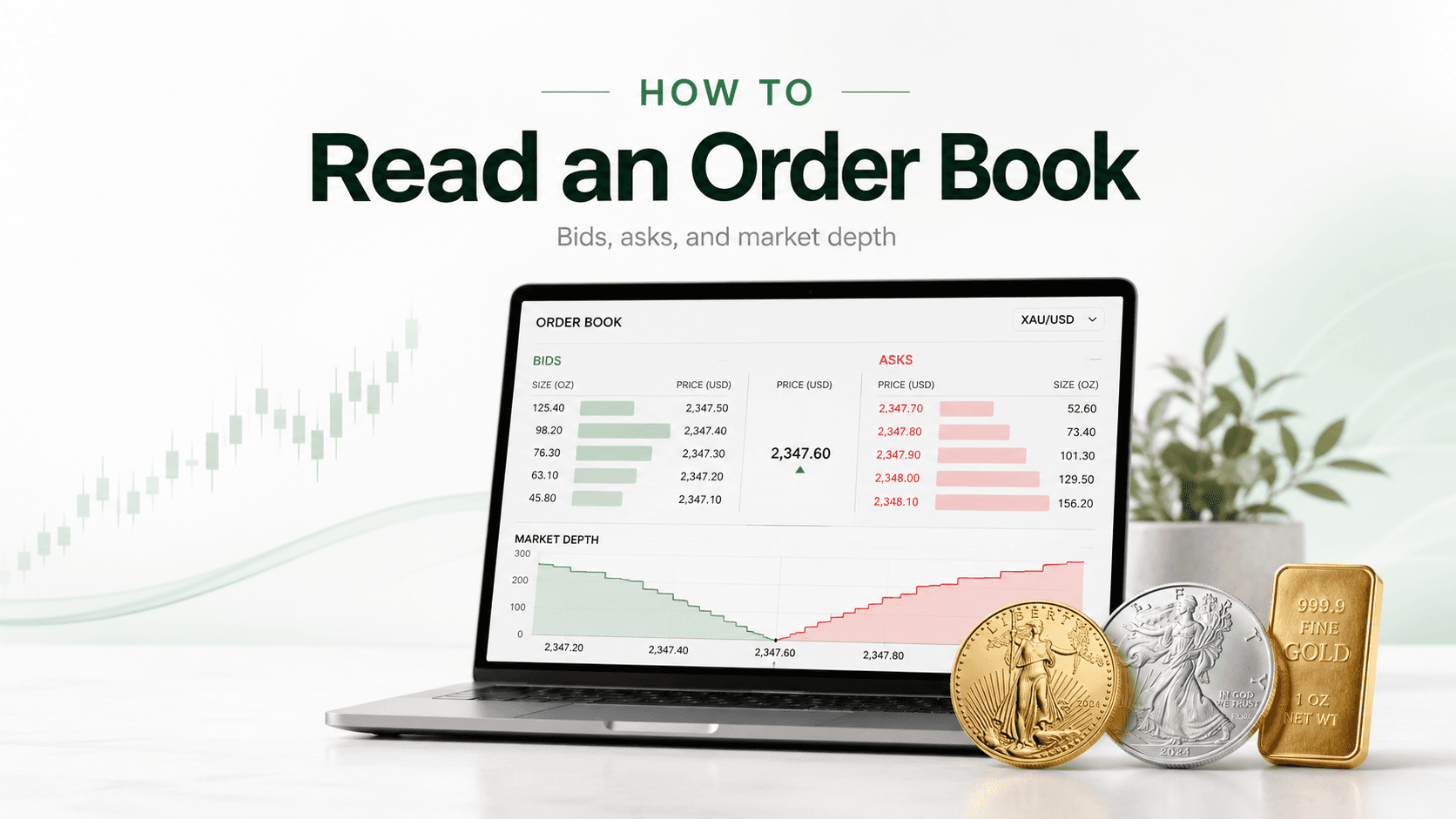

An order book is a live list of every buy and sell order waiting to be filled for an asset, sorted by price. Buyers sit on one side, sellers on the other, and the gap between the best buyer and the best seller is where the next trade happens. Once you can read those two columns, you can see exactly what an asset is selling for right now and how much is available at each price.
This guide walks through every part of a standard order book: the bids, the asks, the spread between them, and the depth behind each price. The examples use round numbers so the mechanics stay clear, but the layout is the same whether you are looking at a stock, a crypto pair, or a marketplace for physical metal.
Bids and asks: the two sides of an order book
Every order book splits into two columns.
Bids are buy orders. Each bid says "I will buy this many units at this price." The bids are sorted from highest price at the top to lowest at the bottom. The highest bid is the most anyone is currently willing to pay, and it sits closest to the middle of the book.
Asks (also called offers) are sell orders. Each ask says "I will sell this many units at this price." Asks sort the other way: lowest price at the top, highest at the bottom. The lowest ask is the cheapest anyone is currently willing to sell at.
A trade fills when a bid and an ask meet at the same price. So the action lives in the middle of the book, where the highest bid and the lowest ask sit closest together.
How to read an order book ladder
Most order books display as a "ladder," with asks stacked on top and bids below. Here is a simple example for an asset trading around $100:
Side | Price | Size | Total |
Ask | $100.40 | 50 | 130 |
Ask | $100.30 | 30 | 80 |
Ask | $100.20 | 50 | 50 |
Bid | $100.00 | 40 | 40 |
Bid | $99.90 | 60 | 100 |
Bid | $99.80 | 25 | 125 |
Read it from the middle out. The lowest ask is $100.20 and the highest bid is $100.00. Those are the two prices that matter most, because the next trade happens at or between them.
Three columns to know:
Price is the level a buyer or seller has named.
Size is how many units are available at that exact price.
Total (sometimes "sum" or "cumulative") adds up all the size from the best price out to that level. In the table above, there are 50 units offered at $100.20, and 80 units offered at $100.30 or cheaper.
The size column tells you how much you can trade at a single price. The total column tells you how far the price moves if you want to buy or sell more than the top level holds.
The bid-ask spread
The spread is the gap between the highest bid and the lowest ask. In the ladder above, the best bid is $100.00 and the best ask is $100.20, so the spread is 20 cents.
The spread is a real cost. If you buy at the ask and immediately sell at the bid, you lose the spread on the round trip. A tight spread (a few cents on a $100 asset) usually means lots of buyers and sellers competing close together. A wide spread means fewer orders near the current price, so each trade costs more to get in and out of.
Spread is the first thing experienced traders check, because it sets the floor on what a position costs before the price moves at all.
Market depth and what size tells you
Depth is the amount of orders stacked up behind the best price. A "deep" book has large size at many price levels, so a big order can fill without pushing the price far. A "thin" book has small size, so even a modest order eats through several levels and moves the price.
Say you want to buy 100 units in the example ladder. The top ask only holds 50 at $100.20. To fill the rest, you take 30 more at $100.30 and 20 at $100.40. Your average fill price ends up around $100.27, not $100.20. That climb through the levels is called slippage, and it is exactly what depth predicts.
This is why size matters as much as price. A great-looking top-of-book price is only useful if there is enough volume behind it to fill the order you actually want.
Order book imbalance: buy walls and sell walls
When one side of the book holds far more size than the other, traders call it an imbalance. A large cluster of buy orders at one price is sometimes called a "buy wall," and a large cluster of sell orders a "sell wall."
A wall shows where a lot of resting orders currently sit. It does not tell you what the price will do next, and it should not be read as a signal to act. Orders can be cancelled or added at any moment, so the book is a snapshot of intentions right now, not a forecast. Read it for what it is: a live picture of supply and demand at each price, updated tick by tick.
Limit orders vs market orders
How your own order interacts with the book depends on the type you place.
A limit order names a price and joins the book as a new bid or ask. It waits until someone trades against it. A limit buy at $99.95 would slot into the bid side above the $99.90 line and sit there until a seller drops to meet it. Limit orders add depth to the book.
A market order skips the waiting and fills immediately against the best available prices on the other side. A market buy takes the lowest asks in order until it is filled, which is what causes the slippage described above. Market orders remove depth from the book. The SEC's investor guidance lays out the same distinction for stock orders.
In short, limit orders build the book and market orders consume it.
Level 1 vs Level 2 data
You will see order-book data sold in two tiers.
Level 1 shows only the best bid and best ask, plus the size at each. It answers "what is the price right now" and nothing more.
Level 2 shows the full ladder: multiple price levels on both sides with the size at each. This is the view that lets you judge depth, spot imbalances, and estimate slippage. When people talk about "reading the order book," they almost always mean the Level 2 view.
Order books for physical metal
Order books are not just a stocks-and-crypto tool. A marketplace can run the same model for physical gold and silver, matching buyers and sellers directly on a live book instead of quoting one take-it-or-leave-it price like a traditional dealer. Collect Pure uses an order-book model for bullion and rare coins, so a buyer can see the resting bids and asks and place an order at a price that actually clears, rather than paying a fixed dealer markup. The mechanics on this page (bids, asks, spread, depth) read the same way there.
FAQ
What is the difference between a bid and an ask?
A bid is a buy order and an ask is a sell order. The highest bid is the most a buyer will currently pay; the lowest ask is the least a seller will currently take. The gap between them is the spread.
What does a wide bid-ask spread mean?
It usually means fewer orders are clustered near the current price, so there is less competition between buyers and sellers. A wide spread raises the cost of getting in and out, since you buy at the higher ask and sell at the lower bid.
Does the order book predict which way the price will move?
No. The book shows the buy and sell orders resting right now, and those can be added or cancelled at any second. It is a live snapshot of supply and demand, not a forecast.
What is the difference between Level 1 and Level 2 data?
Level 1 shows only the best bid and ask with their sizes. Level 2 shows the full ladder of price levels and the size at each, which is what you need to judge depth and slippage.
Ready to see an order book for physical metal in action? Browse the Collect Pure marketplace and watch real bids and asks fill.