

What Happens to Gold and Silver if the Dollar Collapses?

If the dollar collapses, gold and silver get more expensive in dollars because each dollar is worth less; that's the dollar talking, which says nothing at all about how much bread an ounce of either metal would actually buy you.
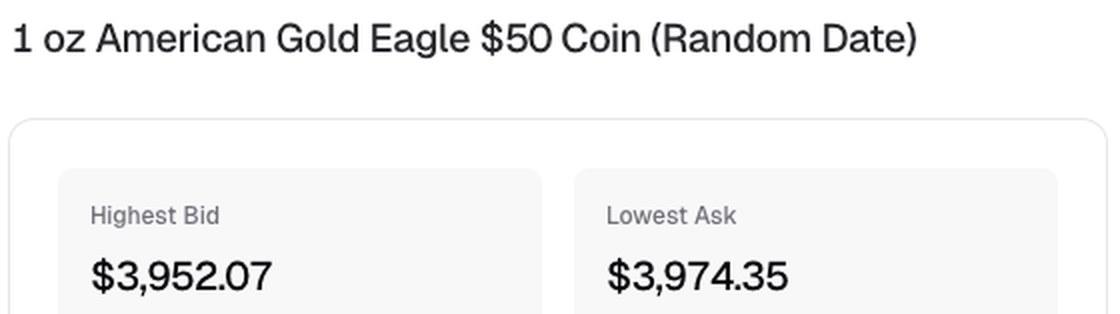
There is a lot of writing on this question that promises gold will save you. History is less tidy. In 1933, before Washington cut the dollar's value in gold, Americans holding gold coins were required to turn them in (with narrow exemptions). In March 2020 silver spot fell 25% in six days while one dealer charged a 42.5% premium on physical silver, so spot went one way and premiums went the other. At 9:39 am Pacific on November 17, 2026, the highest bid on Pure for a 1 oz American Gold Eagle sat at $3,952.07. It has moved since.
Gold is priced in dollars, so the dollar is the unit
The LBMA Gold Price, the main global benchmark, is set in London twice a day in US dollars (LBMA also publishes pound and euro figures but calls those indicative prices for settlement only). So the dollar is the unit. Take it away and gold gets quoted in whatever replaces it, whether that's euros, yuan or something nobody has built yet, while an ounce stays 31.1 grams of metal.
Gold also moves on plenty that has nothing to do with the dollar.
The US devalued the dollar against gold in 1934 and closed the gold window in 1971
For anyone holding gold coins, 1933 is the year to know.
On April 5, 1933, Executive Order 6102 required everyone to deliver their gold coin, gold bullion and gold certificates to a Federal Reserve bank on or before May 1. Owners were paid in other coin or currency. Among the exemptions were up to $100 in gold coin per person and "gold coins having a recognized special value to collectors of rare and unusual coins."
The following January, Roosevelt signed the Gold Reserve Act and the official price went from $20.67 to $35 an ounce, which cut the dollar's gold value to 59% of what it had been; the hand-in order came first, the devaluation after. Not until 1974 could Americans own gold freely again.
Under Bretton Woods, dollars were convertible to gold at $35 an ounce right up to the evening of August 15, 1971, when Nixon closed the gold window; the fixed-rate system was gone soon after, gold traded freely, and on January 21, 1980, London had it at $850.
Then it fell. Gold didn't get back to levels not seen since 1980 until around September 2007, roughly 27 years later, a stretch the usual telling of 1971 leaves out.
Spot and the price of a physical coin can split apart in a panic
Spot is a wholesale price for big bars and futures. Coins are different. Somebody has to strike them and a dealer has to stock them; when everyone wants them in the same week, premiums can climb even while spot falls.
March 2020 is the clearest recent case: silver spot dropped to $12.59 on March 19, $4.19 below the COMEX close six days earlier (about a quarter of its price), while one dealer had physical silver at $17.94 an ounce, a 42.5% premium. The spot chart showed silver getting cheaper.
It can run the other way, too; through parts of 2025 and 2026, with refiners backed up, 90% junk silver was bid under melt and sellers got less than spot. The screen price is a reference. The real price is whatever a buyer and seller agree on that day.
More than half of silver demand is industrial
Silver gets used up in manufacturing in a way gold mostly doesn't: 657.4 million ounces of 2025 demand was industrial, out of 1.13 billion total, going into things like solar panels and electronics, with the same survey forecasting a 3% drop in industrial use for 2026, mostly because solar makers are buying less. So factories pull on silver's price too, not always in the same direction as the dollar or the people buying coins.
Survival forums tend to point to pre-1965 dimes and quarters (90% silver, about 0.715 oz per $1 face; our junk silver guide covers pricing), which are also the coins that traded under melt when refiners backed up.
What a dollar collapse has looked like so far
Most people picture a sudden crash. The US record is slower: a devaluation by law in 1934, the gold window shutting in 1971 and, today, a gradual slide in the dollar's share of world reserves, which stood at 56.70% of allocated foreign exchange reserves in the second quarter of 2026, down from 57.18% the quarter before.
Half a point in three months.
Nobody knows if that speeds up. This post isn't a forecast or advice to buy or sell anything.
The highest bid sets what you'd sell at
If you already own gold or silver, the number that sets what you'd get is the highest bid (what a real buyer is offering at that moment, before any selling fees), not spot. At 9:39 am Pacific on November 17, 2026, someone on Pure was bidding $3,952.07 for a 1 oz American Gold Eagle, and the 2026 American Silver Eagle showed $49.30 as its highest bid for a single coin. Both have moved.
Pure is a peer-to-peer marketplace for precious metals and rare coins. Buyers and sellers set their own prices; a product's bid and ask are right there on its page without signing in. The gold coins page lists what's available now.
Questions people ask
Will I be able to sell my gold if the dollar collapses?
A sale needs a buyer. Nobody can promise what bids look like in a crisis, though on Pure you can open a product's page, see its highest bid without an account and know what someone is offering before you list.
Can the government make you turn in your gold?
It happened once. Executive Order 6102, signed April 5, 1933, required Americans to hand in their gold (with narrow exemptions), and private ownership has been legal since 1974; what a future government might do is a legal question nobody can answer in advance.
What will silver be worth if the economy collapses?
No one can give you that number. Over half of silver demand today is industrial, with coin and bar buyers among the rest, so in a collapse the price would depend on who is buying and in what currency. March 2020 had spot and physical premiums moving in opposite directions.