

Why Is Junk Silver Below Spot? Melt Value, Refiner Backlogs, and Dealer Bids

Junk silver sells below spot when dealers and refiners bid less than the melt value of its silver. That is what the trade press reported from late 2025 into 2026, when turning 90% coins into .999 bars could take weeks and the buyer carried the metal in the meantime. On November 9, 2026, the highest bid on Pure's 90% book was about 5% under melt, and Pure keeps a live list of silver posted below spot that updates as orders fill.
The people who turn coins back into bars got buried. Start with what a bag is: pre-1965 dimes, quarters, and halves, 90% silver, about 0.715 troy ounces of metal in every dollar of face. In a rising market that metal normally fetches a bit more than it melts for. Then 2025 happened. Silver rose more than 142% over the year, people cashed out by the bagful, and in the fall several refiners stopped taking anything under .999 fine for a while. By March 2026 many were quoting payment delays of up to eight weeks. Dealers who could not get paid for weeks started bidding under melt to cover the wait, and by January 2026 Jeff Garrett was reporting wholesale 90% silver at $5 to $7 under melt.
The rest is the arithmetic and the plumbing, which matter if you are holding a bag or buying one.
Junk silver melt value per $1 face
Nobody prices junk silver by the coin. It goes by face value, because a dime, a quarter, and a half dollar from before 1965 carry silver in exact proportion to what is stamped on them. Ten dimes or two halves, same thing: 25 grams of coin, 900 fine, 22.5 grams of silver. That is 0.7234 troy ounces fresh from the Mint. Forty years of pockets took a little off, which is why the trade calculates on 0.715 ounces per $1 face. The full breakdown, including 40% halves and war nickels, is in How to Sell Junk Silver Coins.
To calculate junk silver melt value, multiply the face value in dollars by 0.715, then by the current silver spot price. There is no separate junk silver spot price. It is the silver spot price applied to the 0.715 ounces in $1 face. With silver at $53.42, the spot price Pure's ticker showed at 3:10 pm Pacific on November 9, 2026, the metal works out like this.
Coin | Silver (troy oz) | Melt value at $53.42 |
|---|---|---|
Dime | 0.0715 | $3.82 |
Quarter | 0.1788 | $9.55 |
Half dollar | 0.3575 | $19.10 |
$1 face (any mix) | 0.715 | $38.20 |
$100 face bag | 71.5 | $3,820 |
Swap in the current spot price and the table reprices itself. Melt value is the metal's worth at spot, before any premium or discount. The question is why the bids sit under it.
Why 90% silver used to sell above melt
A bag of 90% has usually cost more than its metal when silver is rising. CoinWeek's March 2026 explainer puts the normal state plainly: when silver prices rise, 90% silver "usually trades at a premium to melt value," with demand from stackers and collectors keeping it there. The reason is simple enough. A Roosevelt dime is small, recognizable, divisible silver, and dealers could count on moving it at spot plus something.
Then the fall of 2025 flipped it, and by early 2026 the trade press was writing explainers about why.
The refiner bottleneck
Here is the plumbing. A coin shop that buys 90% over the counter has two exits: sell it to another buyer who wants coins, or send it to a refiner who melts it into .999 bars. When retail demand for coins thins out, the refiner is the exit of last resort, and in late 2025 that exit jammed.
Patrick Heller described it in Numismatic News in January: in the fall of 2025, higher prices prompted people to liquidate so much silver that multiple refiners built up backlogs, and several "stopped accepting any silver items that were not already at least .999 purity." US 90% and 40% coins were refused outright or taken for delayed processing. CoinWeek reported in March that many refiners were quoting payment delays of up to eight weeks. Don Rinkor, quoted by Garrett, put the lag at 15 to 30 days for shipments to large marketers.
A refiner can run .999 bars through with minimal processing. Ninety percent coin has to be melted, the copper separated, and the silver assayed before anyone knows exactly what came in. When the queue is eight weeks long, the dirtiest material goes to the back of it.
What a dealer's below-melt bid is paying for
A shop that pays melt for a bag today and gets refiner money in eight weeks has lent the seller its own cash for two months, in a metal that moved 142% in 2025. CoinWeek lists what the discount is covering: price volatility over the wait, storage and security, transport to the refiner, assaying, and financing the transaction during the delay. None of those are new costs. What changed is that the wait got long enough for all of them to add up to more than the premium stackers used to pay.
Garrett's January column showed the shape of the market that results. Wholesale 90% at $5 to $7 under melt. Circulated Morgan and Peace dollars, which had been collector coins, also selling below their silver content. Sterling silver near 20% under. One dealer he quoted was seeing "a large influx of sellers," and the well-capitalized shops were skipping the discount by sending metal straight to the refiner and waiting out the queue themselves.
It is not a dealer deciding your coins are worth less than silver. It is a dealer pricing the time between your counter and the refiner's wire.
What a live order book showed
Reported wholesale prices are one thing. A standing bid is another. On Pure, 90% silver trades on a public order book priced per $1 of face value, where buyers post what they will pay and sellers post what they want, and anyone can look without an account.
On November 9, 2026, at 3:10 pm Pacific, the highest bid on that book was $36.13 per $1 face. Against the $38.20 of metal in the table above, that is $2.07 under melt, about 5.4%, and the page tagged it that way. The asks posted by sellers that afternoon were also under melt. Junk silver under spot means exactly this: a bid or an ask below the metal's melt value at the current spot price.
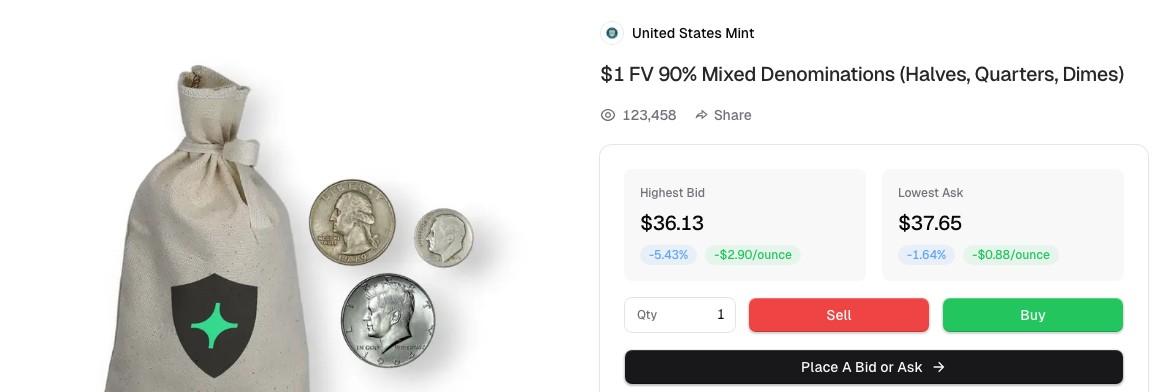
Two things Pure's order book does that a wholesale quote does not. Sellers post the price they want, buyers post the price they will pay, and the book shows both. The number moves with every fill, so by the time you read this it will be different, and the silver under spot page lists whatever is posted below spot at that moment.
Questions people ask
Is junk silver worth less than spot?
In metal, no. $1 face of circulated 90% holds about 0.715 ounces of silver whatever the market is doing. What the sources cited here and Pure's November 9, 2026 book show below spot is the bid, meaning what refiners and dealers will pay for it, because, through at least March 2026, turning coins back into .999 bars took weeks and the buyer carried the metal in the meantime.
How much silver is in $100 face value of junk silver?
About 71.5 troy ounces for circulated coins, or 72.34 ounces as the coins left the Mint. Multiply by the current spot price for the melt value. At $53.42 silver, that is $3,820.
Does junk silver still trade at a premium over spot in 2026?
Not in the data cited here. In January 2026, wholesale 90% was reported at $5 to $7 under melt, and on November 9, 2026, the highest bid on Pure's book was $36.13 per $1 face against $38.20 of melt. Those are dated snapshots, not a forecast.
Do refiners still buy 90% silver coins?
Several refiners refused anything under .999 fine in the fall of 2025. Heller reported in mid-January 2026 that almost all of them were accepting lower-purity silver again, with delays. CoinWeek was still reporting payment waits of up to eight weeks in March.