

What Determines a Morgan Silver Dollar's Value
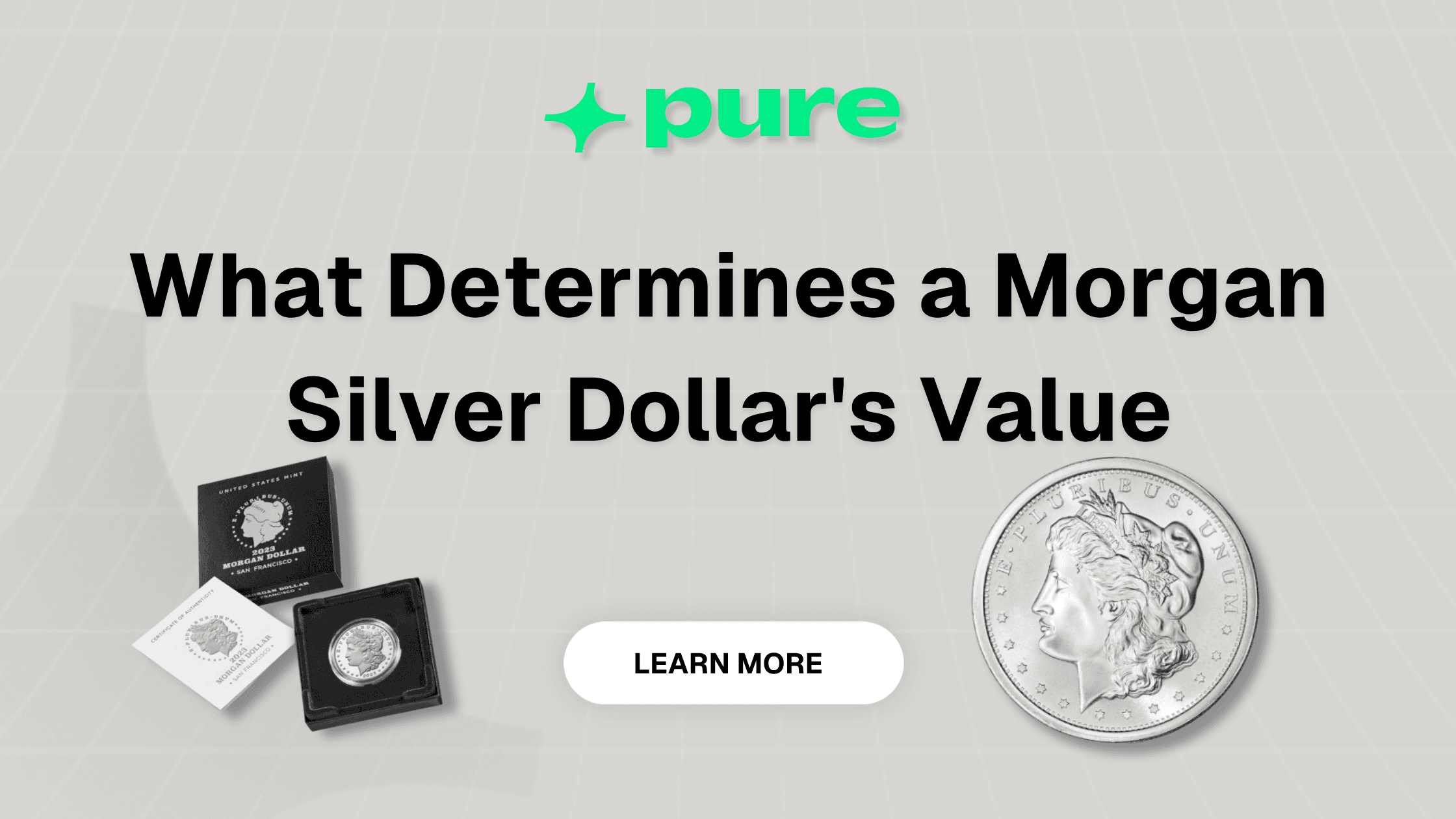

Most people asking this just found a Morgan silver dollar in a drawer, a jar, or an estate, and have no idea whether it is worth twenty five dollars or twenty five hundred. Both are possible. The coin looks the same either way. The difference comes down to a handful of things you can actually check.
The Two Kinds of Value: Melt and Numismatic
Every Morgan dollar has a melt value, the silver it contains priced at the current spot rate. Some also carry a numismatic value on top, set by date, mint mark, and condition rather than metal content.
The decision rule is simple. A common date in circulated condition is worth its melt value and little more. A scarce date, an uncirculated coin, or both, can be worth a multiple of that. Most Morgan dollars in circulation fall into the first group; that is exactly why the ones that do not stand out.
The melt side is pure arithmetic: silver content times the spot price. We work through that calculation, with the exact 0.7734 troy ounce figure, in how much silver is in a Morgan silver dollar. This post covers the other side, what pushes a coin above that floor.
Date and Mint Mark
Where to find the mint mark and what it means
Morgan dollars were struck at five mints between 1878 and 1921. The mint mark sits on the reverse, below the wreath, just above the "O" in "DOLLAR."
Philadelphia coins carry no mark at all. San Francisco coins are marked S, New Orleans O, and Carson City CC. Denver only struck Morgan dollars once, in 1921, the final year of the series, and those carry a D. If you have a 1921-D, that single year is the whole story of why Denver is on the list.
Carson City coins get outsized attention because that mint ran in small numbers and closed for good in 1893, so CC mintages are lower across the board than Philadelphia's.
Which dates are scarce
Mintage numbers vary enormously across the run, and a handful of dates sit far below the rest. The clearest example is 1893-S: 100,000 struck, the lowest mintage of any Morgan dollar, and most of those went straight into circulation and wore down. A well preserved 1893-S sold at auction for $2,086,875 in 2021.
Philadelphia's 1895 is a different kind of rare. That year the mint struck proofs only, 880 coins, and no circulation strikes at all. There is no worn, everyday version of a 1895 Philadelphia Morgan to find in a jar.
Neither fact means every old coin is secretly valuable. It means two very specific combinations of date and mint are worth checking for before you assume yours is a common one.
Condition and Grade
Two Morgan dollars from the same year and mint can be worth very different amounts depending on how much wear they show.
A circulated coin has visible flatness on the high points, most noticeably Liberty's cheek on the front and the eagle's breast on the back. An uncirculated coin still shows its original mint luster, the soft shine from the strike, with no flattening in those spots.
Certified coins carry a number from the Sheldon scale, which runs 1 to 70. Sixty and above marks mint state or proof condition, and 70 means no imperfections are visible even under magnification. That number, assigned by a third-party grading service and sealed in the coin's holder, is what lets a buyer bid with confidence without inspecting the coin themselves.
How to Check What Yours Is Worth
Read the date and the mint mark first. Then look at the coin's surface for wear, or check whether a grading service has already certified it.
With those two things in hand, current values for a specific date, mint mark, and grade combination are published by NGC's price guide and PCGS CoinFacts. We are not listing a value chart here on purpose. Numismatic values move, and a printed table goes stale the moment the market does. Checking a live source takes the same few minutes and gives you a current number instead of an old one.
What to Do Next
What you do here depends on which bucket your coin landed in.
A common date in circulated condition is worth roughly its melt value, and that is a straightforward thing to sell. How to sell junk silver coins and how to sell a coin collection both cover that process, whether you have one coin or a mixed lot.
A scarce date, or a certified and graded coin, holds value independent of melt, which changes the calculus. Some people sell a coin like that outright. Others hold onto it or add to a small collection around it. Either way, Morgan dollars currently listed give you a sense of what similar coins are trading at.
Frequently Asked Questions
How much can I sell my Morgan Silver Dollar for?
It depends on the same factors covered above: date, mint mark, and condition. A common circulated coin sells close to its melt value. A scarce date or a graded, uncirculated coin can sell for considerably more. Checking a current price guide for your specific combination is the only way to get a real number.
What is the current scrap value of a Morgan Silver Dollar?
Scrap value is the same thing as melt value here, since Morgan dollars are 90% silver with no other precious metal in the mix. It moves with the spot price of silver, so check the silver chart for the current figure and multiply by 0.7734 troy ounces.
What years of Morgan silver dollars are worth the most?
There is no single answer, because scarcity comes from a mix of low mintage and how many coins survived in good condition, not the date alone. 1893-S is the standout example: the lowest mintage of any Morgan, at 100,000. Philadelphia's 1895 issue is rare for a different reason, it was struck only as a proof, with no circulating version at all.
Do coin dealers pay melt value?
For common dates in worn condition, most offers cluster around melt value, since that is what the silver itself is worth regardless of who buys it. A dealer's offer will typically sit at or somewhat under that figure to leave room for their own margin. A scarce date or a certified coin should be priced above melt, and a dealer who does not distinguish between the two is worth a second opinion.
How much is a Morgan Silver Dollar worth in scrap value?
The same calculation as melt value: 0.7734 troy ounces of silver times the current spot price. That number changes throughout the trading day, so treat any fixed figure as a snapshot rather than today's price.