

What Is the Greysheet? How Coin Dealer Bid Prices Work

The Greysheet is the Coin Dealer Newsletter, the wholesale price guide US coin dealers have quoted each other from since 1963. Its pages list what dealers pay dealers for US coins, by date and grade, for coins they can see in hand. That is the number a shop owner has in mind when a collection comes across the counter, and the reason an offer on your coins lands under the figure you looked up. Greysheet bid is a dealer-to-dealer price. The public is usually offered less.
The publisher, CDN Publishing, says it carries nearly 100,000 wholesale prices across the US coin market. In print, the Greysheet price guide is a monthly magazine. The digital version updates between print issues, and the app is free to install but needs a paid subscription to show prices.
Who publishes it, and where the name came from
The sheet started in a back room in Hawthorne, California. The first issue in 1963 was called the National Coin Broker's Bulletin, put out by a local dealer named Orvil Payne as a weekly list of bid levels. The second issue carried the name Coin Dealer Newsletter. The trade has called it the Greysheet for decades, spelled grey sheet or gray sheet depending on who is typing.
The Downing family ran it from 1984 until 2015. For most of that stretch the sheet landed every Wednesday morning. In 2015 the family sold it to CDN Publishing, a group led by John Feigenbaum that included Jim Halperin, Steve Ivy, Mark Salzberg and Steve Eichenbaum, all major names on the dealer and grading side. Jeff Garrett wrote at the time that one of the big questions would be whether the pricing stayed independent of the new owners, and Feigenbaum answered that they would be passive investors with no say over pricing. CDN went on to buy Whitman Publishing, the Red Book company, in 2023, so the wholesale sheet and the retail Red Book now sit under one roof.
Bid, ask and CPG: three numbers for three audiences
Open a page of Greysheet coin prices and the number that matters is the bid.
Greysheet bid is what a dealer is willing to pay another dealer for a coin of that date and grade, sight seen. Sight seen means the buyer gets to look at the coin and reject it if the coin is ugly for the grade. That one detail is why bid is not a floor for your coin. Veteran dealer Vic Bozarth put it bluntly in CoinWeek: "Basically Greysheet lists sight seen bids for attractive coins," and "bids are just numbers on paper or a computer screen."
Greysheet ask is the price at which a dealer will sell that coin to another dealer. The gap between the two is the trade's working spread.
CPG stands for Collector Price Guide, CDN's retail number. Feigenbaum has described it plainly as Greysheet values with a markup. His example in an April 2025 market update was an 1885 Liberty nickel in XF40: $1,000 on the Greysheet, $1,250 CPG, and the CPG figure is what prints in the Red Book Quarterly. CPG is the number a collector should expect to pay a dealer, not receive from one.
Two cousins round out the family. The Bluesheet, the Certified Coin Dealer Newsletter, covers the highest bid for certified coins traded sight unseen, meaning the buyer commits on the slab's grade alone. Bozarth noted the gap between Greysheet and Bluesheet on the same coin could run as much as 70%. The Greensheet does the same job for US paper money.
Where the numbers come from
There is no formula. Feigenbaum said so himself on the PCGS forum in 2018: "We monitor all the price and market sources possible. There is no set formula for how we derive prices."
In practice the inputs are three. Auction results, with Heritage, Stack's Bowers and David Lawrence Rare Coins named as data partners. Dealer bids posted on CDNX, CDN's own dealer-only trading network, where a few hundred member dealers act as market makers and say what they will pay. And the editors' judgment, which includes throwing out outliers. For coins whose value rides on metal content, like Silver Eagles in high grades, the sheet ties the price to spot and updates it every hour or so.
That last point is the quiet limit of the whole system. The sheet is a reference. The number on the page is not an order you can fill.
Do coin dealers pay Greysheet prices?
Not to the public, as a rule, and the reason is structural rather than greedy. Bid is a price between two professionals who both know the coin, both have a buyer in mind, and both carry inventory risk every day. When a shop buys from a walk-in it adds grading risk, the chance the coin is cleaned or problem, and the time it will sit in the case.
Dealers on the PCGS forum have described the arithmetic for years. In a 2008 thread asking what percentage of bid dealers offer, one answer was "They usually offer 10-20% back of bid for a coin they want," another poster said he had just paid 5% back of bid on a $10,000 collection, and a third pointed out that if a dealer needs the coin for a customer, "they'll often pay Greysheet bid or higher." A 2024 thread said the same thing in different words: bid less 10 to 20 percent, or as little as two thirds of bid for material the shop does not want, and over bid for coins it does.
The honest reading of a dealer's offer, then, going by what those dealers described. Somewhere between 80% and 100% of Greysheet bid for a coin the shop can sell, less for a coin it cannot, and the shop decides which is which when it looks at the coin. None of that tells you whether to sell. It tells you what the number on the sheet does and does not promise.
Where a price guide stops and a live bid starts
Bullion is where the two tools part ways. A 2026 Silver Eagle, a 1 oz gold bar, or a $1,000 face bag of 90% silver is priced off the metal, and the premium over spot moves all day as buyers and sellers show up. The sheet can tie a Silver Eagle price to spot each hour, but the only price you can actually sell into is a bid someone is holding open right now.
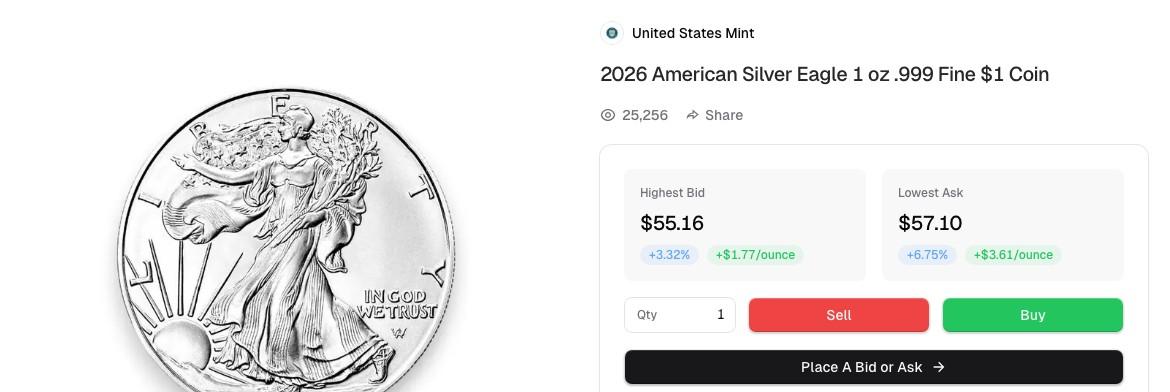
That is what Pure's public order books are for. Every product has its own book with live bids and asks posted by other members, visible without an account. On November 9, 2026, at 3:54 pm Pacific, the highest bid on the 2026 American Silver Eagle was $55.16, which the page showed as about 3% over the silver spot price at that moment. A seller can take that bid and the price locks, or post an ask at their own number. The bid will be different by the time you read this. What matters is that a real order sits behind it, not a reported figure.
The two tools answer different questions. The sheet tells a dealer what the trade has been paying for an 1893-S Morgan in VF. Pure's live order book shows anyone what buyers have bid on a Silver Eagle right now. A shop that handles both kinds of material ends up using both. If you want the mechanics of reading bids, asks and depth, How to Read an Order Book covers it, and Coin Dealer Marketplace covers how shops use Pure's book in both directions.
What it costs
As of November 2026, the Monthly Greysheet magazine sells for $45 an issue through Whitman, at 130-plus pages. The Red Book Quarterly, which carries the CPG retail values, is $25.
The Greysheet app is free to download, but pricing is behind a subscription. Listed in-app tiers run from Collector at $10 a month or $100 a year, through Collector+ at $16 or $159, to Coin Dealer at $40 a month or $399 a year, with a digital-only dealer tier at $30 or $299 and a Dealer Plus tier at $56 a month. Prices change, so check the listing before you buy.
Questions people ask about the Greysheet
What is the difference between the Greysheet and the Bluesheet?
Greysheet bids are for coins traded sight seen, where the buyer can inspect and reject. Bluesheet bids cover certified coins traded sight unseen, on the slab's grade alone, so they run lower, sometimes by a wide margin.
How much does a Greysheet cost?
As of November 2026, the monthly print magazine is $45 an issue from Whitman. The app is free to install, and seeing prices in it takes a paid subscription, from $10 a month at the collector level to $399 a year at the dealer level.
Is the Greysheet legit?
Yes, as a reference. The Coin Dealer Newsletter has been published continuously since 1963 and is owned by CDN Publishing, which also owns Whitman and the Red Book. What it is not is a price anyone is obliged to pay you. The numbers are wholesale, dealer-to-dealer, and sight seen.
Does Pure use the Greysheet?
No. Pure does not publish a price list. Every number on a Pure order book is a bid or ask someone posted, and anyone can see them without an account. The sheet is a reference for what dealers have paid. Pure's book is a list of what buyers and sellers are offering right now.