

Trump Gold Coin: What We Know About the Mint's $250 Proof
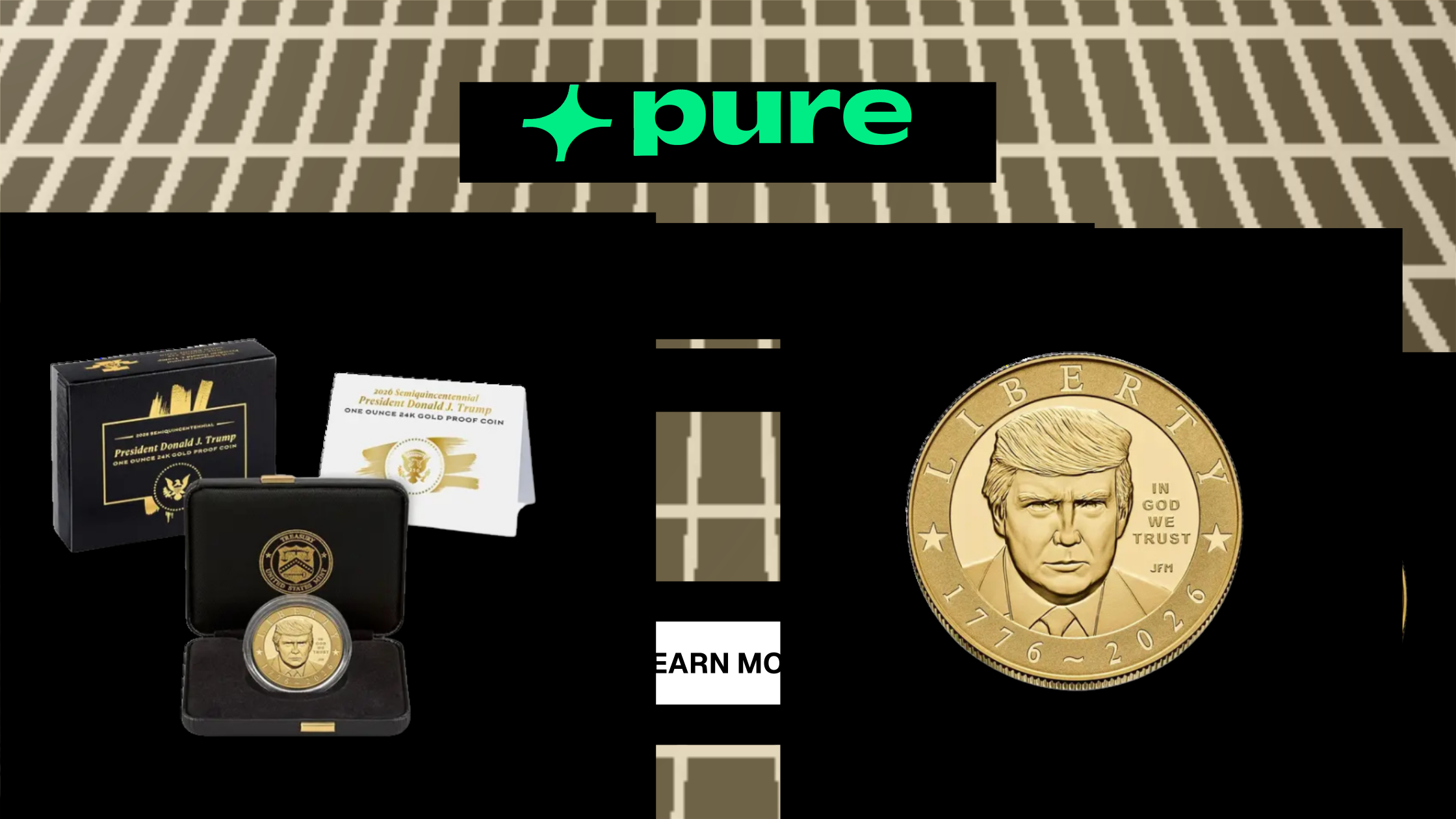

The United States Mint's Trump gold coin is a $250 proof struck in one troy ounce of .9999 fine gold at West Point, and $250 is its face value, not what it will cost. The Mint's product listing has it going on sale Thursday, November 5, 2026 at noon Eastern with a limit of one per household. The Mint has not announced what it will charge or how many it will strike. If you have seen a "Trump gold coin" for sale already, it is one of two other things: the $1 coin released September 2, which is gold in color and contains no gold, or a privately made gold-plated medal with no connection to the Mint.
Key takeaways
The 2026 Trump gold coin (US Mint product 26SQG) is a $250 face-value proof containing one troy ounce of .9999 fine gold, struck at West Point with a W mint mark.
Release date: November 5, 2026, 12:00 pm ET, per the Mint's product listing. Household limit: one.
Price: not announced. Mint gold coins are priced from a grid that resets every Wednesday against the LBMA gold average. The Mint's one-ounce Proof Gold Eagle was $5,300 on that grid in the week of September 11, 2026.
Mintage limit: not announced. A Mint official described it to the Commission of Fine Arts in March 2026 as "a very limited production run."
The Trump $1 coin released September 2, 2026 contains no gold. It is 88.5% copper with a manganese-brass layer.
The final design uses the same Joseph Menna portrait and Frank Gasparro Presidential Seal as the $1 coin. The desk-leaning portrait and eagle-and-Liberty-Bell reverse CFA approved in March were dropped.
Pure lists the coin with no sellers yet, since none have been issued. Bids can be posted now.
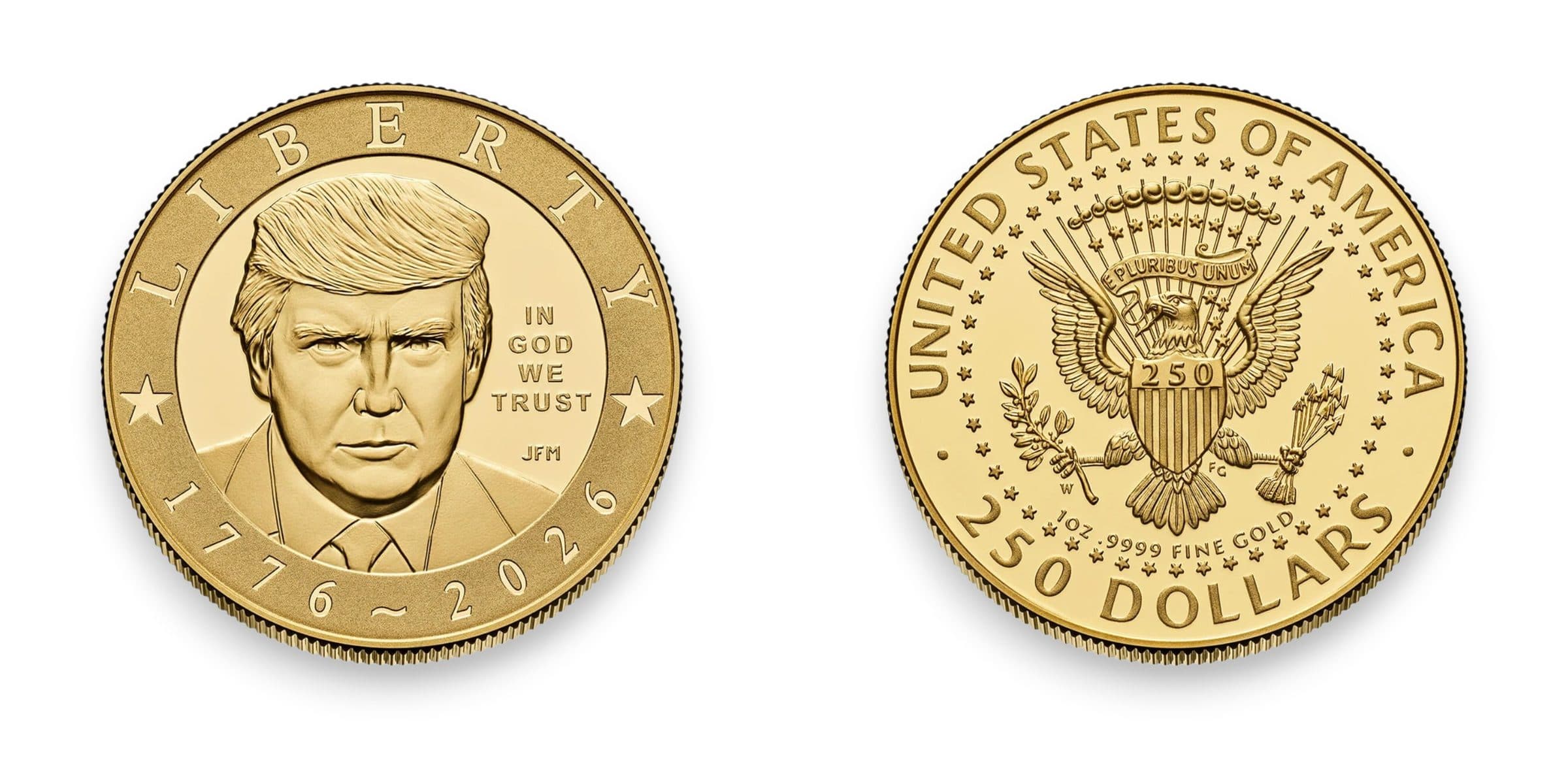
*Both sides of the $250 gold proof. Image: United States Mint.*
Three coins are being called the Trump gold coin
The confusion is understandable, because the Mint put one portrait on two coins a few weeks apart, both dated 1776 ~ 2026 for the country's 250th anniversary, and one of them looks like gold.
The $1 coin came first. It went on sale September 2 in 25-coin rolls at $61 and 100-coin bags at $154.50. It is manganese brass over a copper core, 88.5% copper, 6% zinc, 3.5% manganese, 2% nickel, which is how every dollar coin has been made since 2000. The BBC's launch coverage put it plainly: "The coins have a golden colour but do not contain any actual gold." Both products sold out within hours. Those are the coins now showing up in the news as "Trump's gold coin," and singles, rolls, and bags of them are listed on Pure.
The $250 coin is the actual gold one. Same portrait, same reverse, one ounce of 24-karat gold, and it does not exist in anyone's hands yet.
Then there are the private pieces: gold-plated Trump medallions sold online by companies that are not the Mint. They have no denomination, no legal-tender status, and the gold on them is a surface plating. If a listing says "24K gold-plated" or "gold clad," that is the tell.
What the US Mint has said about the $250 coin
The US Mint's details on the Trump coin reached the trade press on September 11, and CoinNews covered the reveal in full. The product code is 26SQG.
Denomination: $250 face value, the Mint's second $250 coin of 2026 after the Liberty Bell gold coin, per CoinNews
Metal: one troy ounce, .9999 fine 24K gold
Finish: proof
Mint: West Point, with the W mint mark
Release: November 5, 2026, noon ET, per the Mint's product listing
Household limit: one
Price: not announced
Mintage limit: not announced
Product limit: not announced
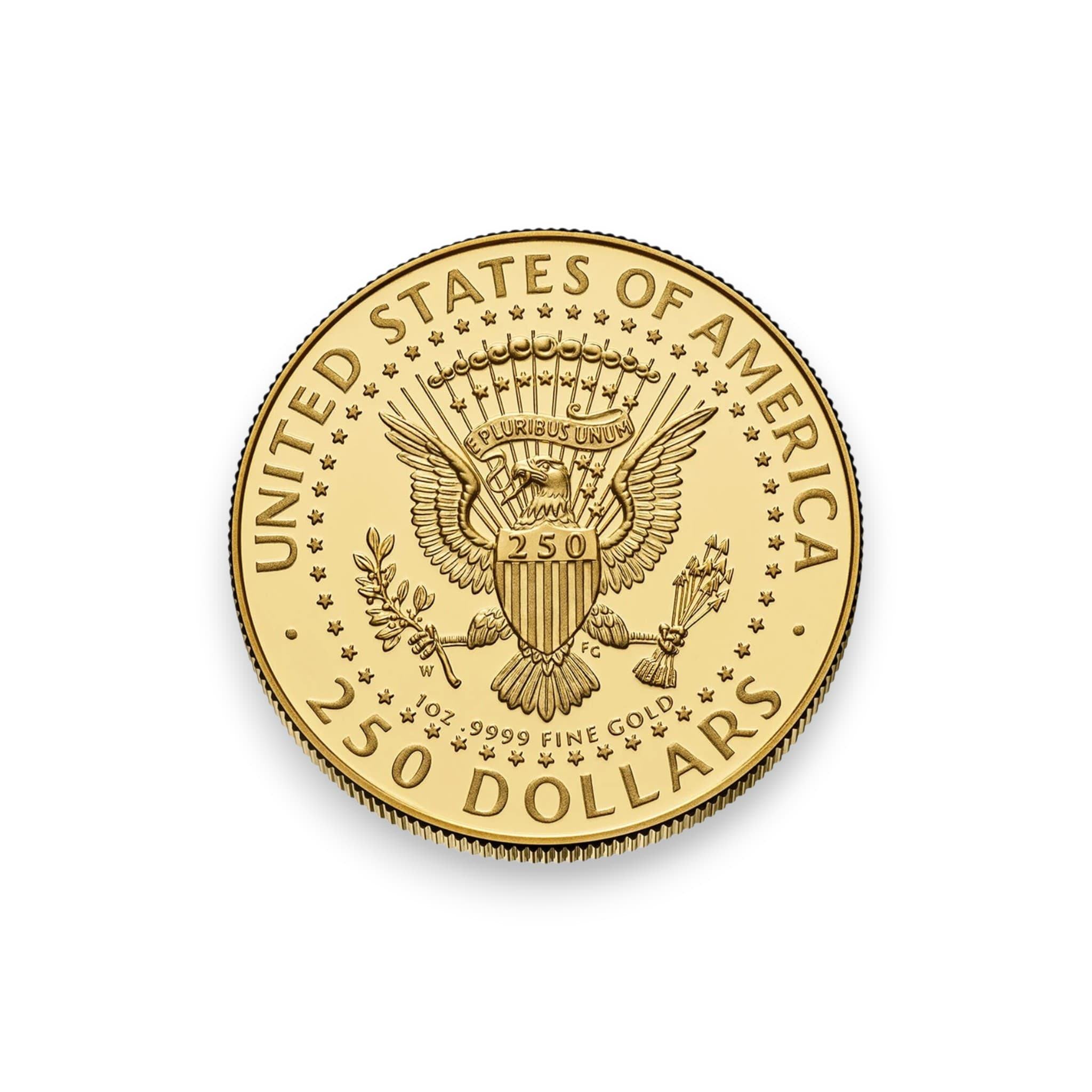
*The reverse. The 250 sits on the shield, the W for West Point is below the olive branch, and FG marks Gasparro's design. Image: United States Mint.*
The obverse portrait is by Chief Engraver Joseph Menna, working from an official White House photograph by Daniel Torok. The reverse is Frank Gasparro's Presidential Seal, carried over from the $1 coin, with 250 on the eagle's shield. The gold coin's inscriptions add 250 DOLLARS and 1 OZ. .9999 FINE GOLD where the dollar reads ONE DOLLAR.
The Mint's product listing includes a "Remind Me" signup that emails you before the sale opens. It also carries the Mint's standard line that all dates and prices are subject to change without notice.
Why there is no price yet, and what the grid says
The Mint does not set a fixed price on its gold coins. The August 12 Federal Register notice that set the $1 roll and bag prices listed the gold coin as "TBD" and explained the mechanism: "Pricing can vary weekly dependent upon the London Bullion Market Association (LBMA) gold price weekly average. The pricing for all United States Mint numismatic gold, palladium, and platinum products is evaluated every Wednesday and modified, as necessary."
So the price on November 5 will be whatever the grid says that week. Nobody, including the Mint, can state it today.
The grid is public, so the trade press has been reading the coin's column off it since the August notice, and CoinNews has published estimates that shift each time gold crosses a $50 band. We are not repeating a number here, because whatever it is today will not be the number on November 5. For scale, the Mint's own one-ounce gold proofs on the same grid were $5,300 for the Proof Gold Eagle and $5,340 for the Proof Gold Buffalo in the week of September 11, per CoinNews. The Trump coin has its own column on that grid, and it will read whatever gold says that Wednesday.
The design changed between March and September
When the Commission of Fine Arts approved a Trump gold coin on March 19, it approved a different-looking coin. The AP's report from the meeting described an obverse with the President leaning forward, "his fists rest on top of what is supposed to be a desk," and a reverse with "a bald eagle midflight." CoinNews adds that the March reverse paired the eagle with the Liberty Bell.
Size was open too. Megan Sullivan, acting chief of the Mint's Office of Design Management, told the commission the Mint had looked at a planchet larger than one ounce, up to its 3-inch maximum. "So we're looking somewhere in there," she said. She also said the coin would be part of "a very limited production run," with the number not yet determined.
The finished coin is one ounce and reuses the $1 coin's portrait and seal. None of the coverage we read explains the change. What survives from March is that the Mint has still not put a number on the run.
How a sitting president ends up on a US coin
The AP, the BBC, and CoinWeek all bring up the law against living presidents on currency. The mechanics matter here because the gold coin and the $1 coin rest on different legal footing.
The $1 coin was issued under the Circulating Collectible Coin Redesign Act of 2020, Public Law 116-330. That law lets the Treasury Secretary issue a semiquincentennial dollar during 2026 and, as the BBC noted, "prohibits portraits of living people on the reverse (tails side) of coins, it does not explicitly cover the obverse (heads side)." The Trump portrait is on the obverse.
The gold coin does not rely on that law. Sullivan told the CFA that the Treasury Secretary has standing authority to mint and issue new 24-karat gold coins, per the AP. The Mint has not named the section in anything we have seen; the provision usually cited for that authority is 31 U.S.C. 5112(i)(4)(C), which lets the Secretary issue gold coins "in accordance with such program procedures and coin specifications, designs, varieties, quantities, denominations, and inscriptions as the Secretary, in the Secretary's discretion, may prescribe from time to time." The American Liberty high-relief gold coins come out of that paragraph too. As written, it has no living-person clause and sets no mintage, which fits the Mint leaving the number open.
The precedent everyone cites is Calvin Coolidge. His portrait shared the obverse of the 1926 Sesquicentennial half dollar with George Washington while he was in office, and CoinWeek's Coolidge comparison notes that he stayed the only living president on a US coin for exactly a century.
What "one per household" looked like last time
The $1 coin sale on September 2 is the closest thing to a rehearsal for November 5. The Mint set product limits of 150,000 rolls and 50,000 bags of the dollar and sold 148,524 rolls and 49,604 bags of it on the first day, 99.0% and 99.2% of the limits. The bags were gone in under an hour, the rolls in about seven and a half. Those are the Mint's figures for the $1 coin, reported by CoinNews; the gold coin has not been offered yet, so it has no sales figures at all.
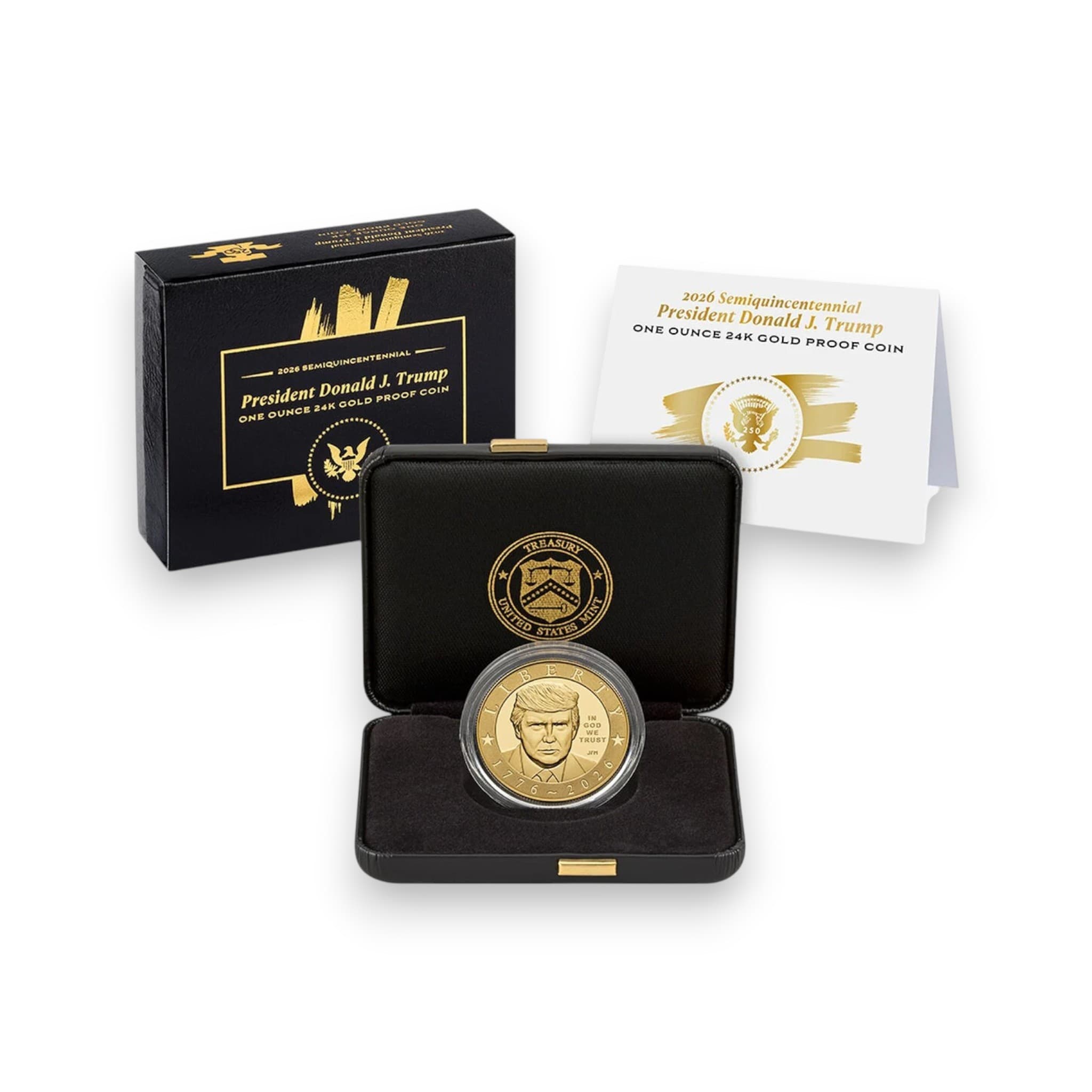
*What a Mint order ships as: the coin in a capsule, the presentation case, the outer box, and the certificate of authenticity. Image: United States Mint.*
A $61 roll sold by the roll and bag and a one-ounce gold proof limited to one per household are different sales, so the September numbers say more about interest in the portrait than about what November 5 will look like. What the household limit does do is rule out multiple orders: one coin per household, whatever the mintage turns out to be.
If the Mint does sell through, the mechanics of what usually happens next are in what happens when a US Mint coin sells out.
Where the coin stands on Pure
Pure lists the coin already, on the 26SQG product page and alongside the $1 rolls, bags, and singles on the Trump coins page. As of September 14 nothing is listed for sale on it, for the obvious reason that no one owns one. Pure is a peer-to-peer marketplace, so a buyer can post a bid at a price of their choosing today, and every bid and every ask is visible to everyone. If a Mint buyer later lists one here, buyers and sellers will see each other's prices directly.
Any coin sold through Pure is tested in house before it ships to the buyer and listed as Pure Qualified. That matters more than usual here, because the first question anyone asks about this coin is whether it is the real one or a plated one.
Questions people are asking
Is the Trump gold coin real gold?
The $250 coin is one troy ounce of .9999 fine gold. The $1 coin from September is not; it is copper with a manganese-brass layer. Anything else sold as a Trump gold coin is a private medal with a thin gold plating.
How much will the Trump gold coin cost?
The Mint has not said, and it cannot before the sale week, because the price comes off the Mint's gold pricing grid, which reprices every Wednesday against the London Bullion Market Association weekly average. For comparison, the Mint's own one-ounce Proof Gold Eagle, priced off that grid, was $5,300 in the week of September 11 per CoinNews. Any figure you see quoted for the Trump coin before November 5 is someone's reading of the grid, not a Mint price.
Is it part of the Semiquincentennial coin program?
The Mint markets it as a Semiquincentennial coin, its term for the 250th anniversary series, and it carries the 1776 ~ 2026 dual date. The Mint has pointed to the Treasury Secretary's general gold-coin authority for it, though, not to the 2020 Act that created the Semiquincentennial quarters and dollar, and that provision sets no mintage.
What is the Trump gold coin worth?
It contains one troy ounce of gold and carries a $250 face value, and the Mint will sell it at whatever its gold pricing grid says the week of November 5. After that, the price is whatever buyers and sellers agree on. Nobody can tell you that number in advance, and we do not estimate it. A gold-plated Trump medal from a private seller contains a trace of gold and has no face value at all.
Where can I buy the Trump gold coin?
From the US Mint on November 5, one per household, and nowhere before that. The Mint has not sold any, so anything offered for delivery before November 5 as a Trump gold coin is either the $1 coin or a privately made piece. Pure lists the coin on its own product page now, as a peer-to-peer marketplace where buyers and sellers each post their own price and every bid and ask is visible to everyone. Nothing is listed for sale there yet, and any coin that does sell through Pure is tested in house before it ships to the buyer.