

Trump Dollar Privy Mark: Where It Sits and What It's Worth
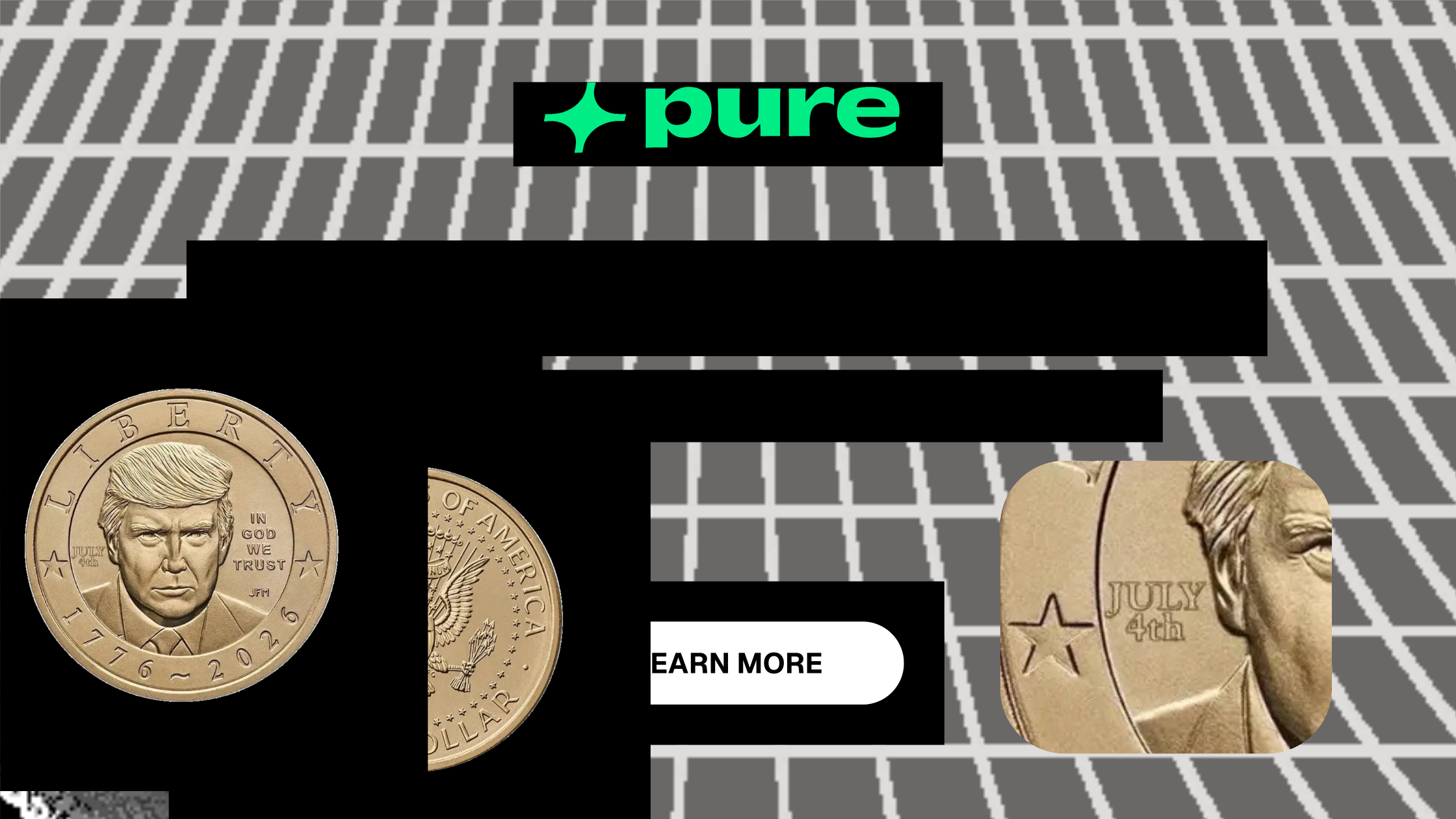

On the 2026 Semiquincentennial Trump $1 coin, the July 4th privy mark sits on the obverse, to the left of the portrait: a small two-line inscription reading JULY above 4th, tucked directly over the star at the left edge of the field. Hold the coin with the portrait facing you and it lands at about nine o'clock. On a standard 2026 Trump dollar that space is blank. The Philadelphia Mint struck 250,000 of these on Independence Day 2026 and mixed them at random into the 25-coin rolls and 100-coin bags it put on sale September 2, 2026, which makes the obverse the only place you need to look.
Where the July 4th privy mark sits on the Trump dollar
Here are both versions side by side, photographed for our listings, with the privy area magnified. The mark is circled on the coin at right.
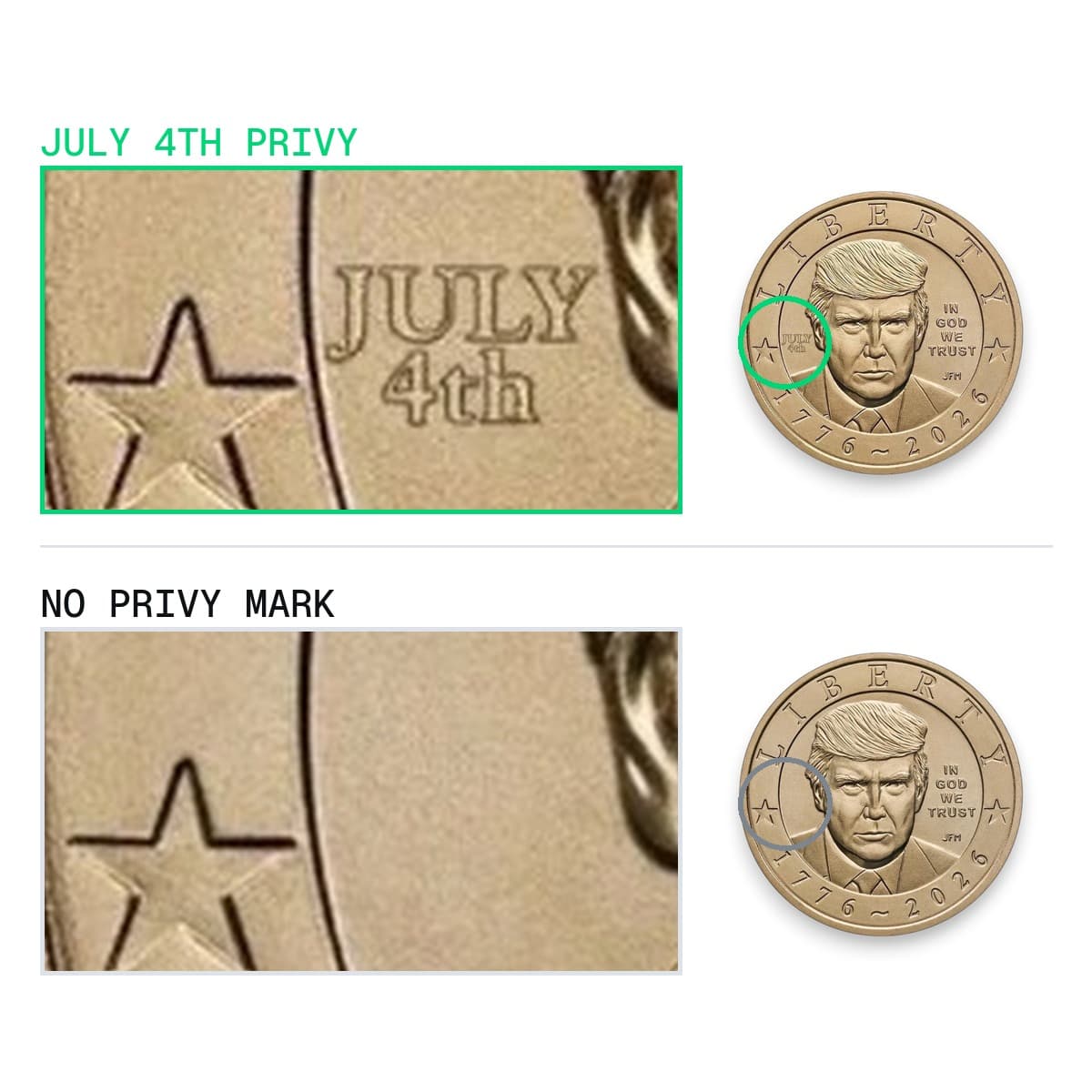
Hold the coin portrait-side up and look at the left edge, level with where IN GOD WE TRUST begins on the opposite side. There is a five-pointed star there on every one of these dollars. The privy inscription is recessed into the space just above it, two short lines, JULY on top and 4th beneath. On the standard coin that space carries nothing at all, which is what makes the two easy to tell apart once you know where to point your eye. The collectors who first documented the mark put it in the same place, directly above that star.
Everything else on the obverse matches: LIBERTY curving across the top, the dual date 1776 ~ 2026 along the bottom, and the designer's initials JFM below the motto.
Flipping the coin over will not help you. The reverse carries the Presidential Seal, with the eagle, the olive branch, and a 250 worked into the shield, and it is the same on both versions.
The Mint lists both as the Semiquincentennial President Donald J. Trump 2026 $1 coin, and neither version carries a mint mark. Both were struck in Philadelphia, both have a plain edge, both weigh 8.10 grams at 26.49 mm across, and both are 6% zinc, 3.5% manganese, 2% nickel with the balance copper. One small inscription is the only physical difference between the two versions.
The odds a roll or bag holds a privy dollar
Run the Mint's own numbers and you can work this out yourself. It offered 150,000 rolls and 50,000 bags. That is 8.75 million coins, with 250,000 privy pieces scattered through them, so roughly one coin in 35 carries the mark.
By our arithmetic, a 25-coin roll works out to about a 52% chance of holding at least one, averaging 0.7 per roll. A 100-coin bag comes out near 94%, averaging close to three. Both figures assume the 250,000 were spread evenly across everything the Mint sold. Nobody outside the Mint can confirm that they were.
Worth knowing before you go looking: both products sold out the day they went on sale, at $61 for a 25-coin roll and $154.50 for a 100-coin bag. Anything you buy now comes from another collector rather than from the Mint, which changes the price you pay and nothing about the odds inside a sealed roll. We wrote about what happens to a coin's market after the Mint sells out when the Silver Proof Set did the same thing.
What a July 4th privy dollar is worth
Two things separate a privy dollar from the ordinary version on price, and only one of them is fixed. The mark is binary: the coin either carries it or it does not. Condition is where the whole range comes from.
On a coin struck for collectors and never meant to circulate, grade does almost all the work. One that went from a sealed roll straight into a holder sits at one end of the scale. One that rattled around loose in a drawer sits at the other, and because there is no honest wear history to read on a coin like this, handling marks are close to the entire thing a grader is assessing.
For current pricing on either version, read it off the listing rather than an article. Both have their own page on Pure, the July 4th privy dollar and the standard non-privy dollar, and each page carries the live bids and asks. Those move, so check the listing for where either one stands.
One number never moves, and it is the reference worth holding onto: the Mint's own issue price. A 25-coin roll cost $61, which works out to $2.44 a coin, and the Mint charged that whether or not a privy piece happened to be inside.
Handling a privy dollar you pulled from a roll
Handle it by the edges and keep it dry. Circulating-finish coins mark easily, and an uncirculated example and a handled one are two different objects to a grader. The discovery coin came out of an advance-delivery roll, found by a Heritage Auctions numismatist, and was certified MS64.
If you are opening rolls to hunt, sort into two piles as you go, privy and not, and do not stack coins loose against each other. Fingerprints and rim dings are the two things you can still cause after the Mint has done its part.
Questions people keep asking
Is the Trump dollar coin gold?
No. The 2026 Trump dollar gets its color from manganese brass over a copper core, the same build the US Mint has used for its golden dollars since the Sacagawea series began in 2000. There is no silver version either, and no precious metal in either variety, which is why this coin's price has nothing to track the way a Gold Eagle tracks gold.
Could I have ordered the privy version from the Mint?
The July 4th privy dollar was never sold on its own. All 250,000 went into ordinary 25-coin rolls and 100-coin bags, unmarked on the outside and unannounced by count, so every buyer got the same product and found out afterward.
How is this different from the July 4th privy quarter?
Different coin, different hunt. The 2026 July 4th quarter went into circulation through banks and can still turn up in pocket change, which we covered in the guide to the 2026 July 4th quarter. The Trump dollar only ever existed inside Mint rolls and bags.
Is the Trump dollar coin legal tender?
Yes. It is a United States one dollar coin with a face value of one dollar, spendable like any other. That is also why the Mint's roll price is the honest reference point: $61 for 25 coins is $2.44 apiece for something that carries a dollar of face value.
Where to buy a 2026 Trump dollar coin
Both versions are listed on Pure alongside the rolls and bags on the 2026 Trump dollar coins page. Pure runs as a two-sided book, so buyers post bids, sellers post asks, and both sides stay visible on the page before you commit to anything. If that format is new to you, we wrote a beginner's guide to reading an order book. Both versions carry the Pure Qualified label, which means we test every item ourselves before it reaches a buyer. If you are working through the wider 250th-anniversary program, our guide to the 2026 quarters covers the five designs released alongside it.