

Sealed vs. Opened Gold Bars: Does the Assay Card Change Your Offer?
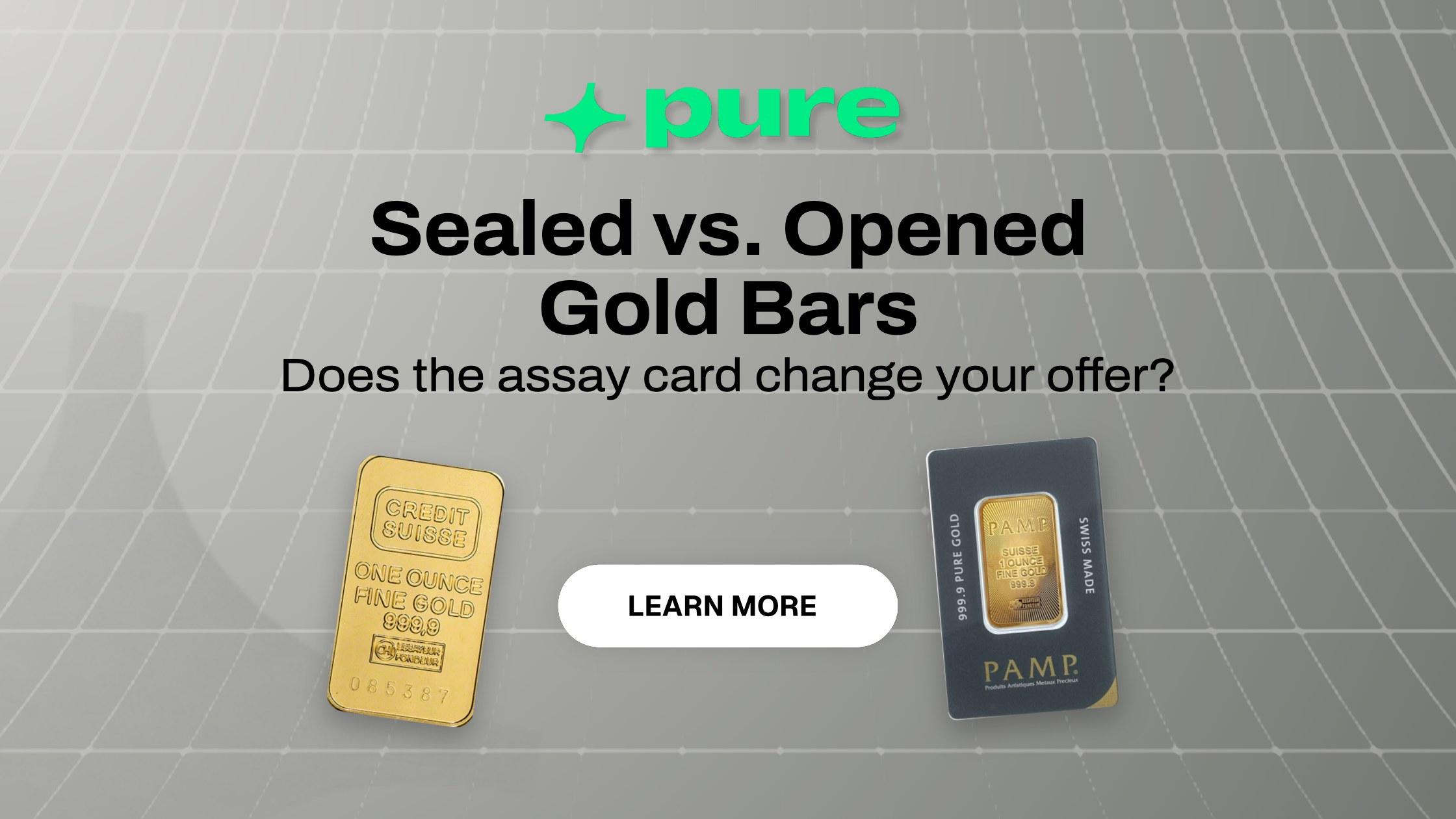

We checked on the morning of November 25, 2026. That day the answer came to about $14. At 11:03 a.m. Pacific, the highest bid on Pure for a 1 oz gold bar sealed in its assay card stood at $3,559.10. For the same class of bar with no card it stood at $3,545.50. That was the gap that morning, on a bar priced above $3,500. It will be a different number by the time you read this, because both bids move all day.
Maybe you've already cut yours open, or it reached you loose. Nothing about the metal changed. It's still an ounce of .9999 gold with the refiner's stamp on its face. What changed is the paperwork that travels with it, which decides which product page the bar sells on here and what the next buyer has to do before trusting it.
What a gold bar assay card is, and what it does for the next buyer
"Assay" is the trade's word for a test of what a piece of metal is. An assay card is the refiner's test result, printed on a sealed holder and wrapped around the bar it describes: weight, fineness and, on most, a serial number that matches the one stamped on the bar.
The name changes by refiner. PAMP calls its card CertiPAMP and describes it as protective packaging that doubles as an official assay certificate for the bar's weight and fine gold content. The Perth Mint ships each minted bar in a serial numbered, tamper-proof display card.
What the card really does is save the next person a step. Somebody holding a sealed one can match the serial on the card to the serial on the bar and see that the seal is intact, all without touching the gold. Once the card is cut that shortcut doesn't come back, so the bar has to be tested like any other loose piece of metal.
The bids, carded and uncarded
Pure (collectpure.com) is a peer-to-peer marketplace for gold, silver, platinum, palladium and rare coins. Buyers and sellers set their own prices, and a person on our team checks every item before it ships. For this question the useful part is that carded and uncarded bars each get their own product page with its own order book. Every bid on both is public. You don't have to take anyone's word for the gap, ours included.
We pulled these three pages signed out, seven seconds apart, at 11:03 a.m. PT on November 25, 2026:
1 oz gold bar | Highest bid | Over spot | Lowest ask | Sold on Pure |
|---|---|---|---|---|
Accredited brands, uncarded | $3,545.50 | +$2.40 | $3,684.74 | 167 |
Accredited brands, sealed in carded assay | $3,559.10 | +$16.00 | $3,574.10 | 41,861 |
PAMP Lady Fortuna Veriscan, in assay | $3,572.68 | +$29.88 | $3,589.80 | 102,894 |
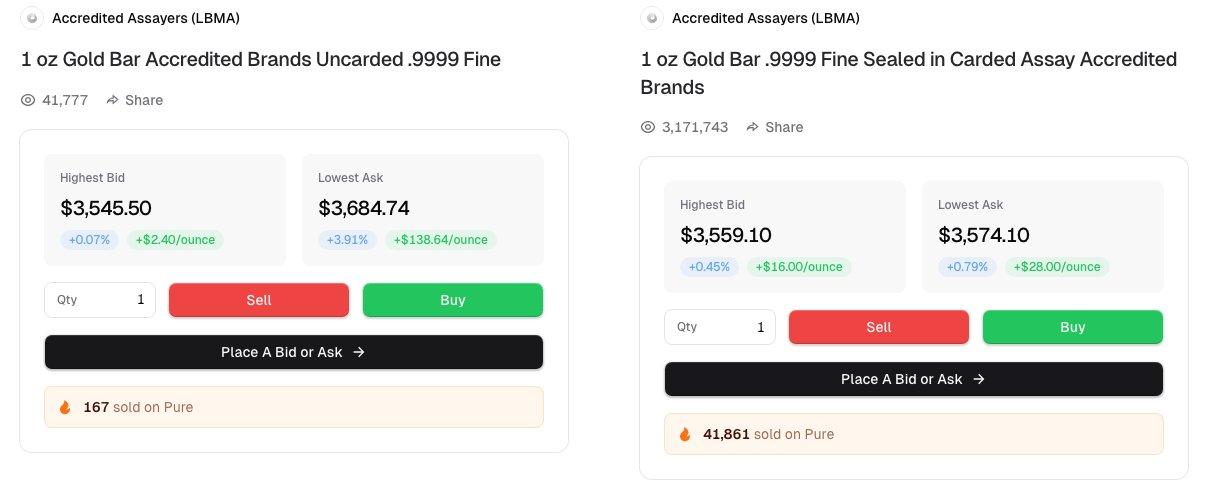
Rows one and two are like for like. Both pages are for bars from LBMA-accredited refiners (the uncarded page names the Good Delivery list), one row without the card and one with it. About $14 apart on the bid. The third row is a single named bar sealed in its card, the PAMP Lady Fortuna. Its bid sat higher again at $3,572.68.
Then read across. The carded page showed 41,861 sold and a lowest ask $28.00 over spot, while the uncarded page showed 167 sold and a lowest ask $138.64 over spot, a long way from its own bid.
For a seller the bid is the number to read, because a bid is a price a buyer has already posted and you can sell straight into it, where an ask is only what a seller is hoping to get.
All of that is one capture on one morning, so open the pages yourself before you count on any of it.
A loose bar can still be checked
Losing the card doesn't make a bar anonymous. A bar from a listed refiner has the maker's mark, the weight and the fineness struck into its face. Most carry a serial number there as well. In other words the card repeats what the bar already says about itself.
PAMP bars have one more thing going for them. Veriscan records the microscopic surface of each bar on the production line (PAMP compares it to a fingerprint), which is how the app can authenticate a registered bar within or without its sealed card. PAMP made the scans free in 2021.
On Pure the card was never the only check anyway. Most orders ship from the seller to Pure first, where someone on our team opens the package and matches the item to the order. Every item is tested in house before it goes on to the buyer, whether it shows up sealed in a card or as bare metal.
Selling an opened bar on Pure
List it on the uncarded page for its size. Pure has uncarded pages for accredited-brand gold bars from 1 gram up to 100 grams, the 1 oz page above included. If your bar doesn't have a page yet you can request one.
After that it's an ordinary sale on Pure:
Sell into the highest bid and the trade fills right away at that price. Or post an ask at your own number and wait for a buyer.
Pure sends you an insured shipping label at no extra cost. The packing guide covers the box.
Payout is automatic, about 3 business days after the bar checks in.
Seller fees range from 0.5% to 1.5%. There's no minimum to sell.
If yours is still sealed
You don't need to open the card to check the bar. The weight and the fineness are printed on the card, with the serial where there is one, and a card that has been cut doesn't go back to being a sealed one.
Whether the gap matters is your call, and the gap moves with the bids. The 1 oz carded gold bar page and the uncarded 1 oz gold bar page are both public with no account needed, so you can open them in two tabs and see where the bids are sitting right now.
Questions sellers ask about assay cards
Can you sell a gold bar without its assay card?
Yes. On Pure, a loose bar from an LBMA-listed refiner sells on the uncarded page for its size, where buyers post bids for bars that come without cards.
What does "in assay" mean on a gold bar listing?
It means the bar is still sealed in the refiner's original card. Dealers write it a few ways ("new in assay," "sealed in carded assay," "w/ assay") and they all mean the same thing. On Pure the product title tells you which kind you're looking at, so check for the word "uncarded" before you list.
Does a sealed card mean nobody tests the bar?
No. On Pure, a person on our team checks every item before it ships, sealed or not. An item that clears the check ships Pure Qualified.