

Liberty Bell Dollar Coin Value: What Your 1976 Coin Is Worth
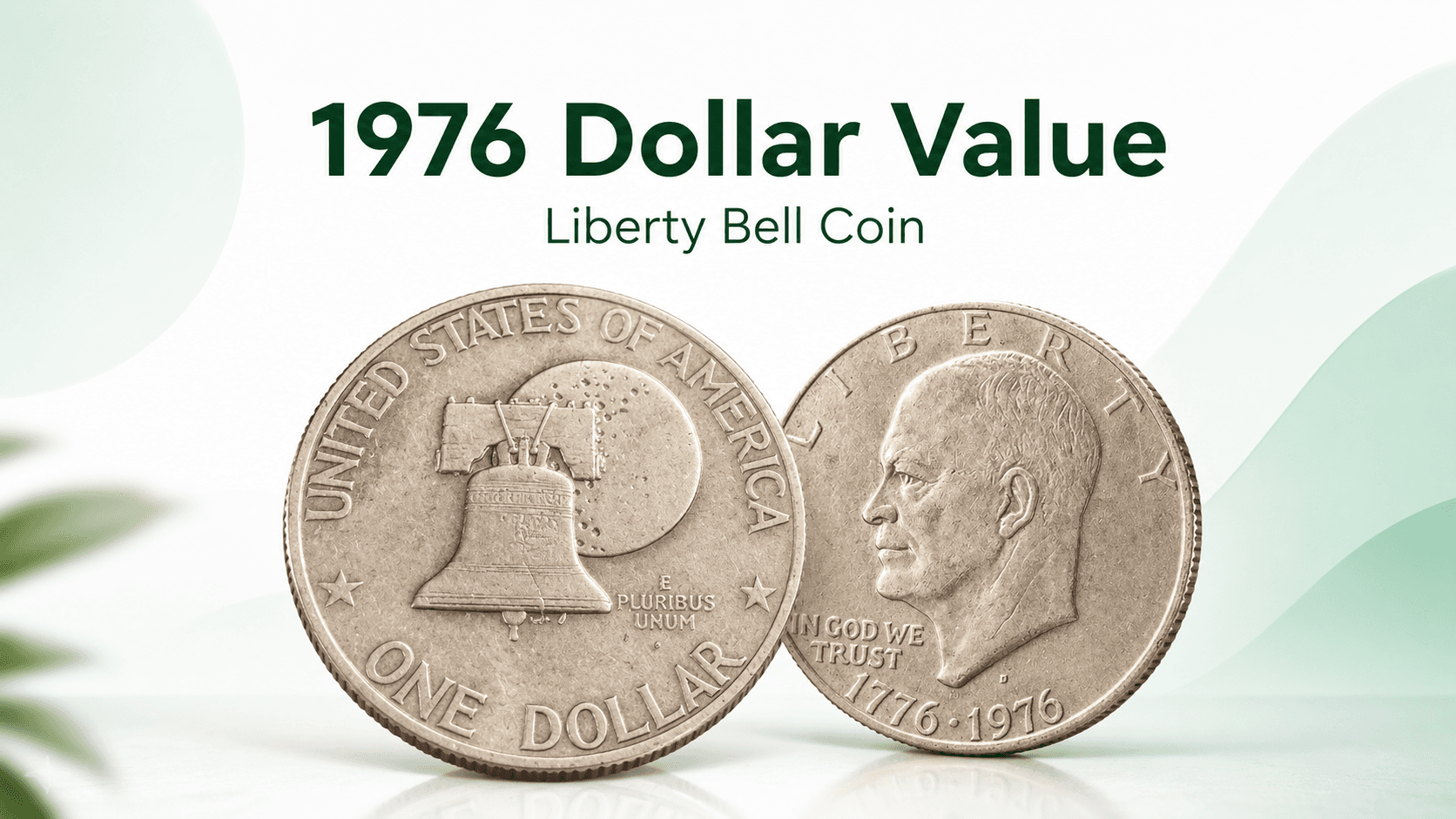

Most 1776-1976 Liberty Bell dollars are worth exactly one dollar, and a real minority run into the thousands, a gap wide enough that it's worth finding out which one you actually have. If you pulled yours out of an old coffee can or an inherited coin album, the mint mark and a kitchen scale settle it faster than any guess.
What the 1776-1976 Liberty Bell dollar actually is
Dwight Eisenhower's portrait sits on the front of every large dollar coin the Mint struck from 1971 to 1978. The 1776-1976 version is the two-year Bicentennial run, and it's the only Eisenhower dollar with a different reverse: a Liberty Bell floating in front of the Moon, with the dual date replacing the usual single year. It's the old large-size dollar, 38.1 millimeters across, nothing like the smaller Susan B. Anthony or presidential dollars that came later. Production of the Eisenhower series ended in 1978; the Anthony dollar took over in 1979.
That reverse design wasn't an in-house Mint decision. It came out of a national competition, a $5,000 award under Public Law 93-127, and the winner was Dennis Williams, a 22-year-old sculpture student at the Columbus College of Art and Design who submitted it as a class assignment. Chief Engraver Frank Gasparro reworked the details afterward, simplifying the lunar surface and adjusting the lettering so the design would actually hold up on a production line. The Mint's own history calls the whole Bicentennial program the first time American circulating coinage was redesigned specifically to mark an anniversary of independence.
Copper-nickel or 40% silver: check this first
Two different coins share this exact design, and the split matters more than anything else for value.
Most of them are copper-nickel clad, the same 75% copper/25% nickel outer layers over a pure copper core used on dimes and quarters, weighing 22.68 grams. These are the ones that actually circulated. If yours came from a bank roll, pocket change, or a jar with regular coins, it's this version, worth face value plus whatever a collector pays for the grade.
A smaller batch is 40% silver: higher-silver outer layers bonded around a lower-silver copper core, for a net 40% silver, 60% copper composition, weighing 24.59 grams. Every 40% silver Bicentennial dollar carries an S mint mark for San Francisco, and none of them ever circulated. The Mint sold them by mail order in blue-packaged uncirculated sets and brown-packaged proof sets, so a genuine silver piece usually still lives in its original holder or a certified slab, not a coin jar.
The two checks that settle it
Mint mark first. No mint mark means Philadelphia. A "D" means Denver. Both are clad, both common. An "S" rules out plain circulation entirely, it's either a clad proof (also common) or the 40% silver piece.
Weight settles anything the mint mark doesn't. A kitchen or postal scale accurate to a tenth of a gram works fine: 22.68 grams is clad, 24.59 grams is silver, a gap of almost two grams. It's the same trick that separates a genuine silver war nickel from an ordinary one: the edge can hint at it, but weight is the number that doesn't argue with you.
Type 1 vs. Type 2: the lettering change that moves the price
Even within the clad coins, two reverse varieties exist, and collectors pay very differently for them. Type 1 came first: bolder, thicker lettering, lower relief. It didn't strike up cleanly at high volume, so partway through, the Mint switched to Type 2, narrower and sharper, in higher relief. Which letters to compare isn't obvious at a glance; PCGS's own guide walks through exactly where to look. Every 40% silver Bicentennial dollar, uncirculated or proof, is Type 1. The silver run ended before the Type 2 switch happened.
Version | Mint mark | Mintage |
|---|---|---|
Clad, Type 1 | none (Philadelphia) | 4,019,000 |
Clad, Type 1 | D (Denver) | 21,048,710 |
Clad, Type 2 | none (Philadelphia) | 113,318,000 |
Clad, Type 2 | D (Denver) | 82,179,564 |
Clad proof | S, Type 1 (1975 set) | 2,845,450 |
Clad proof | S, Type 2 (1976 set) | 4,149,730 |
40% silver, uncirculated | S | 11,000,000 struck; roughly 4.3-4.9 million actually sold |
40% silver, proof | S | 4,000,000 struck; about 4.0 million sold |
Mintage figures per PCGS CoinFacts. The no-mint-mark Type 1, at 4,019,000, is roughly 28 times scarcer than its Type 2 counterpart from the same mint, and that gap is exactly why it commands so much more once a coin actually grades gem.
A large chunk of that 11-million uncirculated-silver mintage was never sold. Demand ran weak enough at the original price that the Mint reportedly melted a significant share of the unsold coins years later, some of it during the silver price runup of the early 1980s. That's part of why the surviving population is smaller than the raw mintage number suggests.
What a 1776-1976 Liberty Bell dollar is worth today
A reality check first: the ordinary clad version circulated in the hundreds of millions. A worn, average one is worth close to its $1 face value plus maybe a dollar or two of collector interest. Nothing more.
Condition changes that fast once a coin is uncirculated, and a grading service, PCGS or NGC, is what actually settles the grade rather than a guess from a photo.
A common Type 2 clad dollar, from either mint, runs roughly $5 to $40 through MS65, climbs toward $100 or more at MS66, and reaches four figures at the genuinely rare MS67.
The scarcer no-mint-mark Type 1 is worth meaningfully more at the same grades. Heritage Auctions and Stack's Bowers both sold MS66 examples in 2023 for $1,320 to $1,380, a direct result of that mintage gap.
The 40% silver pieces carry a silver floor on top of any collector premium. Each contains about 0.316 troy ounces of silver, so raw examples generally trade in the teens to $30s and move with the silver spot price day to day. Certified gem examples, MS69 uncirculated or PR69/PR70 proof, bring meaningfully more, independent of melt.
None of this is a forecast. Values move with the graded-coin market and the price of silver, and the only way to know what a specific coin is worth is to have it looked at directly.
Same bell, new coin: the Mint brought it back for 2026
The Mint came back to the Liberty Bell on purpose. Fifty years after using it to mark 200 years of independence, it did the same for the 250th: the 2026 semiquincentennial program redesigned the quarter, dime, and half dollar, and the Liberty Bell got its own standalone release on top of that.
If you're holding a 1776-1976 dollar and you've also seen headlines about a brand-new bell-shaped gold coin, that's a separate, unrelated release. The Mint's 2026 Freedom Ringing Liberty Bell coins are struck in the literal silhouette of the bell, crack included, not a round coin with a bell pictured on it. The two share a motif and nothing else. We cover the shape and design of that new release in our Liberty Bell shaped coin guide, and the full pricing, mintage, and secondary-market picture is in our Freedom Ringing buyer and seller guide.
Frequently asked questions
Is my 1976 Eisenhower dollar worth more than a dollar?
Usually only a little. A worn, average clad dollar sits close to face value. It takes an uncirculated grade, the scarcer no-mint-mark Type 1, or genuine 40% silver content to move meaningfully past $1, and grading is what actually proves which of those you have.
Where can I sell a 1776-1976 Liberty Bell dollar?
The same places most US coins trade: a local shop, a major auction house once a coin is gem-graded, or a marketplace with a live, two-sided order book. Pure's certified-coin listings are one place to see what graded coins are actually changing hands for, rather than relying on a single dealer's asking price.
Was there a rare 1976 dollar without an S mint mark?
Yes, exactly one confirmed example. A 1976 proof dollar was mistakenly struck at Philadelphia without the S mint mark every other San Francisco proof carries, and it surfaced years later in a department store purchase. PCGS considers it one of the rarest modern US coin errors and has carried a six-figure price-guide valuation on the single known piece for years. It's not a variety to expect from an ordinary coin.
Does this coin have anything to do with the new 2026 Liberty Bell coins?
No more than the name. Your 1976 dollar doesn't gain or lose value because the Mint reused the bell fifty years later, and it isn't an earlier version of the 2026 release or part of any set collectors pair with it. The new coins are priced, mintage-capped, and sold entirely on their own.
---
For the full story on the Mint's brand-new bell-shaped coins, see our Freedom Ringing buyer and seller guide, or browse certified coins already trading on the Collect Pure marketplace.