

How Much Gold and Silver Should You Own? What Nobody Can Tell You

Nobody can give you an honest number for how much gold and silver to own without knowing your budget and why you want metal in the first place, and a blog post knows neither, which is why this one doesn't offer a percentage. What we can show you at Pure is how big the pieces are: a single 1 oz American Gold Eagle had a highest bid of $3,923.61 on Pure at 2:26 pm Pacific on November 17, 2026 (it's moved since).
Yes, that's the unsatisfying answer, but the amount is a personal decision for your own budget and nothing here is advice to buy or sell.
Official emergency guidance says cash, in small bills
Cash is what the government's own page tells you to keep. Tip 2 on Ready.gov's financial preparedness page (last updated 03/13/2026) is one line: "Keep a small amount of cash at home in a safe place."
It even says why, and what kind of cash: "It is important to have small bills on hand because ATMs and credit cards may not work during a disaster when you need to purchase necessary supplies, fuel or food."
There's one other money idea on the page, a bank account: "Consider saving money in an emergency savings account that could be used in any crisis."
Gold isn't on that page, and neither is silver or bullion or coins or precious metals of any kind. The official money advice for a disaster is small paper bills and a bank account. How much metal to own is a different decision, one that page doesn't cover.
What one coin brings in a single sale
You can't break a gold coin into change at a gas station. That's the thing about a 1 oz American Gold Eagle: at a highest bid of $3,923.61 in that 2:26 pm capture it's a nearly $4,000 object, and it goes in a single sale or it doesn't go. Nobody buys a third of one.
There are smaller pieces too, starting with the 2026 1/10 oz American Gold Eagle (a $5 coin), which had a highest bid of $416.51 in the same capture. In silver, the highest bid shown for a single 2026 American Silver Eagle was $49.13. Then there's junk silver, meaning the pre-1965 dimes, quarters, halves that are 90% silver and hold about 0.715 oz per $1 face: $1 face of 90% mixed denominations had a highest bid of $31.86 (our junk silver guide covers how those get sold).
Don't hold onto those four numbers. Every one has moved since.
The sizes are what you're after. Whatever amount you land on gets built out of pieces like these, each of which sells whole: one lump near $4,000 for the gold coin, hundreds for the tenth-ounce, tens of dollars for the silver.
Turning metal back into money takes a buyer and a few days
Until somebody buys it, a coin isn't dollars. That's true anywhere metal gets sold.
Buyers and sellers on Pure each set their own prices. Sell into an existing highest bid and the trade fills, with that price locked. The order isn't finished yet, though: you ship the item (shipping is insured both ways), it gets checked in, then Pure verifies it before anything goes on to the buyer. Standard payout is automatic. It's sent about 3 business days after the item checks in, by ACH or check.
So you know your price at the fill, and the money is sent later (after the mail, after check-in, about 3 business days after that). List at your own ask instead and the coin waits for a buyer who agrees with your number.
The fee comes out of the seller's side. At the starting (Copper) tier that's 0.75% on gold bullion and 1.00% on silver (platinum and palladium too), with the rest in the tier table. Buyers pay no marketplace fee on Pure.
Small pieces cost more to buy
Smaller pieces cost more per ounce to buy. Pure product pages tag the lowest ask with a premium over spot: in the 2:26 pm Pacific capture on November 17, the 1 oz Gold Eagle's tag read +2.66% and the 1/10 oz Gold Eagle's (same coin family, a tenth of the gold) read +10.35%. The tag on the single Silver Eagle was +8.29%.
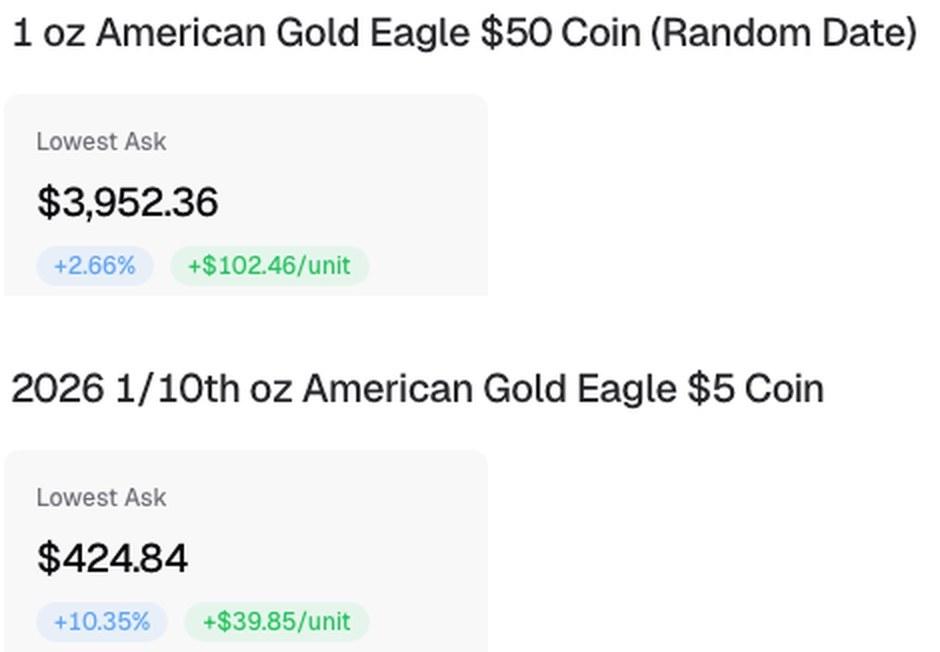
Those tags move too. Still, the tenth-ounce tag was a lot higher than the full ounce's. Premiums on small pieces are the annoying part, and you pay them on the way in.
Storage, insurance and taxes are part of the cost
Metal you keep at home has to live somewhere, so you'll be asking yourself about a safe. Check your policy too, because whether your home insurance covers coins and bullion at all (and up to what amount) is written in that document and nowhere else. Third-party storage is the other route. Storage companies charge fees.
Taxes come in when you sell. Selling metal can produce a taxable gain. Ask a tax professional how that applies to your situation.
None of this shows on a product page, though it's all part of the cost of owning or selling metal.
The CFTC's checklist before you buy
Before you buy anything, read the bulletin the CFTC and FINRA put out, "10 Things to Ask Before Buying Physical Gold, Silver, or Other Metals". The questions in it are plain ones: whether to respond to a precious metals dealer who calls or emails with an attractive offer, how to find a reputable dealer, what the spot price is, what the spread is, which fees and commissions you will be charged, what other costs to consider.
It's blunt about fees: "If fees are not available in writing before your purchase, that is a red flag."
The pressure moves are in there as well: "They might offer a free gift or limited-time offer." Give sales pitches built on fear of a crisis the same extra care, because a rushed buyer skips the questions on that list.
The spread question is one you can answer yourself on Pure, where a product page shows the highest bid and lowest ask without signing in.
Questions people ask
Does gold or silver belong in an emergency kit?
Ready.gov's money advice for a disaster is small bills at home and an emergency savings account. Metal isn't on the page. Whether you own any is a separate decision that you make for your own reasons, out of your own budget.
Can you spend a Silver Eagle at a store?
At face value it's a dollar. A Silver Eagle is a $1 coin, so as money that's what it counts for, even though the highest bid shown for a single 2026 coin on Pure was $49.13 at 2:26 pm Pacific on November 17, 2026 (it's moved since). To get the bid, you'd have to sell the coin.
How do I find out what my gold or silver is worth right now?
Open the product page and read the highest bid. No account is needed to see it, and it's what a buyer is offering at that minute, before seller fees. With 90% silver, count your face value first, because the bid is quoted per $1 face.