

Gold Maple Leaf vs American Gold Eagle: Comparison Guide
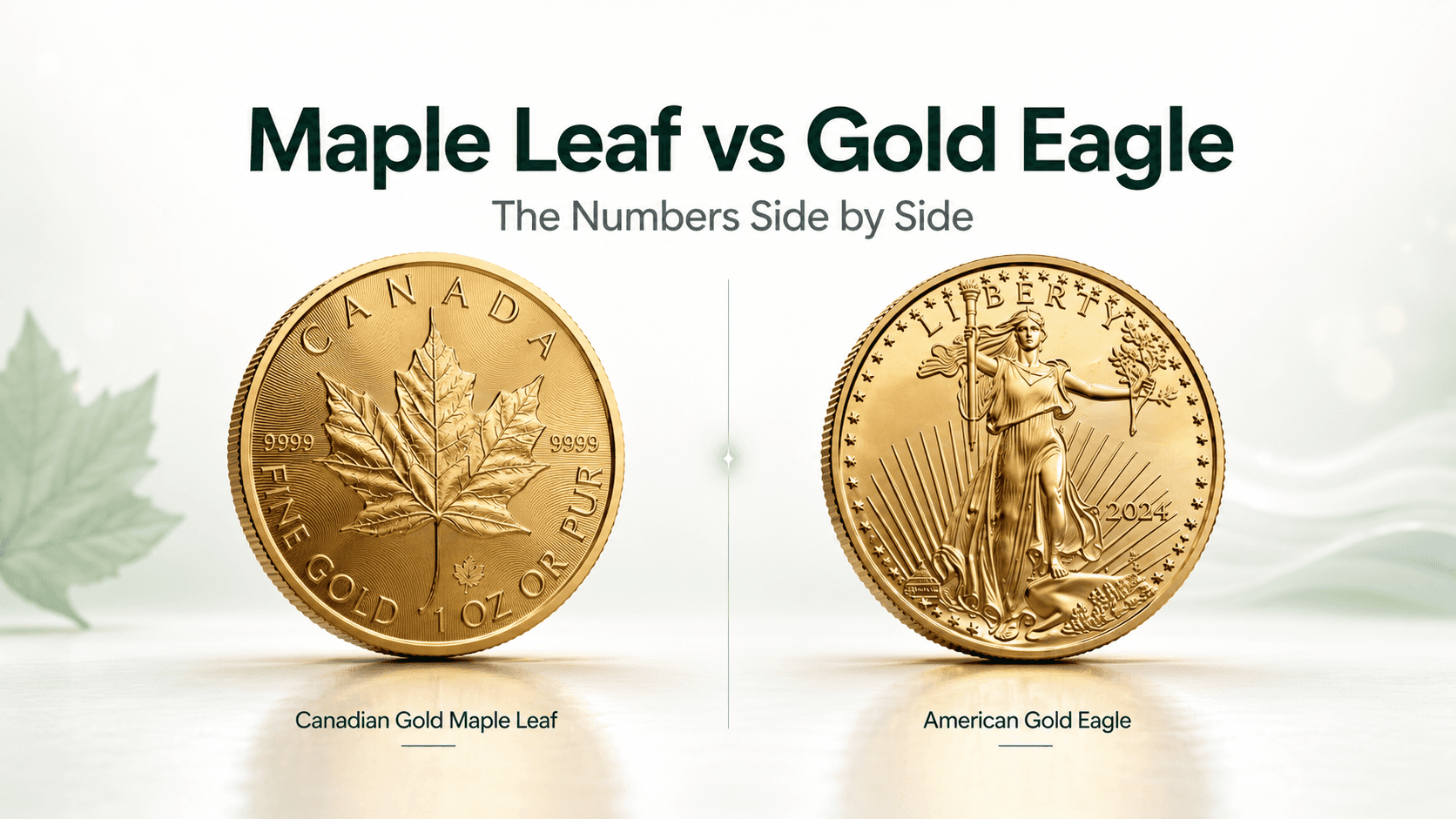

Both coins hold exactly one troy ounce of gold. The differences sit everywhere else. The Canadian Gold Maple Leaf is .9999 fine, 24 karat, and pairs that purity with anti-counterfeiting features the Royal Canadian Mint documents publicly: a micro-engraved privy mark since 2013, radial lines since 2015, and Bullion DNA digital verification on coins dated 2014 and later. The American Gold Eagle reaches the same ounce a different way. It is 22 karat gold alloyed with silver and copper, which pushes its gross weight to about 33.93 grams and makes the coin harder to scratch. Each carries a $50 face value, Canadian dollars on one and US dollars on the other, and each is its mint's flagship one ounce gold bullion coin.
So the verdict depends on what you weigh. If purity and built-in verification matter most to you, the numbers point to the Maple Leaf. If you care how the coin survives handling, the alloy points to the Eagle. And if you care about premium, that is not a fixed property of either coin. It is a live number, and further down this page it comes from a real order book with a timestamp instead of a rule of thumb. Pure lists both coins, so we have no reason to steer you toward either one.
The two coins side by side
1 oz Gold Maple Leaf | 1 oz American Gold Eagle | |
|---|---|---|
Pure gold content | Exactly 1 troy oz | Exactly 1 troy oz |
Purity / karat | .9999 fine, 24 karat (since 1982; the earlier issues from 1979 were .999) | .9167 fine, 22 karat, alloyed with silver and copper |
Gross weight | About 31.1 g | About 33.93 g |
Face value | $50 CAD | $50 USD |
Security features | Micro-engraved privy mark (2013), radial lines (2015), Bullion DNA verification (coins dated 2014+) | Fixed physical specs and the distinct color of the 22k alloy |
First issued | 1979, Royal Canadian Mint | 1986, US Mint |
Ask premium on Pure (July 8, 2026) | 0.66% over spot ($4,103.50) | 1.03% over spot ($4,118.57) |
Best bid on Pure (July 8, 2026) | 0.35% over spot ($4,086.72) | 0.34% over spot ($4,086.20) |
The purity row is the one people argue about, and the gold content row is the one that settles most of the argument. The Eagle's silver and copper sit on top of a full troy ounce of gold, never in place of it. That is why it weighs almost three grams more than the Maple Leaf.
What the premiums actually are
Premiums on both coins are set by live supply and demand, and on an order book you can read the number directly. The ask premium is the distance between the lowest resting ask and gold's spot price, per troy ounce. The best bid is what a real buyer is offering for the same coin at the same moment. Reading a book takes about two minutes.
Here is what Pure's order books showed for both coins, captured together on July 8, 2026, just before 5 PM PT, with spot at $4,077.00. The Maple Leaf's lowest ask sat 0.66% over spot at $4,103.50, with the best bid 0.35% over at $4,086.72. The Eagle's book, read less than a minute later, showed a lowest ask 1.03% over spot at $4,118.57 and a best bid 0.34% over at $4,086.20. Read together: the bids were within a dollar of each other, while the Eagle's ask ran about a third of a percentage point higher that afternoon.
Whatever gap those figures show between the two coins, it is a reading at one moment, not a standing rule. The books move. The live pages are the 1 oz Gold Maple Leaf and the 1 oz American Gold Eagle if you want the current picture.
Scratches and handling
A 22 karat Eagle stands up to handling better than a .9999 fine Maple Leaf, because silver and copper make the alloy harder than pure gold. That is the trade the US Mint made in 1986 and the Royal Canadian Mint declined: the Eagle gives up purity for a coin you can pass around a table with less worry, while the Maple Leaf's near-pure gold is soft enough to pick up hairline marks from ordinary contact.
Neither trait changes the gold inside. It is a difference in how the coins wear, and it matters more to someone who handles coins regularly than to someone whose coins go straight into a case.
The security stack
The Maple Leaf carries three layers the Royal Canadian Mint added over a decade. In 2013 the bullion coin gained a micro-engraved privy mark, a mark small enough that it takes magnification to read. In 2015 the fields on both sides were machined with precise radial lines, which are difficult to reproduce and easy to check by eye. And every bullion Maple Leaf dated 2014 or later is registered in the Mint's Bullion DNA program, which lets an authorized dealer verify a specific coin against the Mint's own image database. One more identification pointer: bullion Maple Leafs dated 2024 and later carry the effigy of King Charles III on the obverse, so a current-year coin should not show Queen Elizabeth II.
For the Eagle, the checkable properties are physical. The 22 karat alloy has a distinct color that pure gold coins do not match, and the coin's gross weight and gold content are fixed published specs that a scale and a caliper can test against. We are keeping this section to what we can verify from each mint, which is why the Maple Leaf's list is longer here.
On Pure the question is handled before a coin ever reaches the book: every item sells through verification at Pure's Los Angeles facility, XRF plus a Sigma Metalytics tester, regardless of which mint struck it.
IRA eligibility
Both coins can be held in precious-metals IRAs. The Gold Eagle qualifies through a named carve-out in IRC section 408(m)(3)(A), while the Gold Maple Leaf qualifies by meeting the fineness required for COMEX futures delivery (currently 0.995 for gold) under section 408(m)(3)(B). IRA rules have requirements beyond the coin itself, so confirm the specifics of your account with a custodian or tax professional.
Selling either one
Both coins trade on Pure's order book, where the bids are visible before you list anything. That changes what "how easy is it to sell" means in practice: instead of guessing at demand, you open the coin's page and look at the resting bids from real buyers. The Maple Leaf book and the Eagle book each show their own bid ladder, and the depth behind each number is visible on the live pages right now.
Pure's Gold Maple Leaf page collects the Maple Leaf listings across sizes in one place.
FAQ
Which coin has a lower premium?
It changes with the live market, so the honest answer is a dated reading rather than a rule. On July 8, 2026, the Maple Leaf's lowest ask on Pure was 0.66% over spot against the Eagle's 1.03%, while their best bids sat within a dollar of each other. That gap can narrow, hold, or flip; check the live books rather than carrying this figure forward.
Is the Gold Maple Leaf purer than the Gold Eagle?
Yes. The Maple Leaf is .9999 fine, 24 karat, against the Eagle's .9167 fine, 22 karat. The Eagle's balance is silver and copper. Purity describes the alloy, though, and the next answer covers the part purity numbers tend to hide.
Do both coins contain a full ounce of gold?
Yes, exactly one troy ounce each. The Eagle gets there by weighing more overall, about 33.93 grams gross against the Maple Leaf's roughly 31.1 grams, so the lower purity never means less gold.
Can I hold these coins in an IRA?
Both can be held in precious-metals IRAs, the Eagle through the named carve-out in IRC section 408(m)(3)(A) and the Maple Leaf under section 408(m)(3)(B) by meeting COMEX delivery fineness. Account-level requirements still apply, which is a conversation for your custodian.
See both books live
Open the 1 oz Gold Maple Leaf and the 1 oz American Gold Eagle side by side and compare the asks and bids yourself. Sitting on either coin? Place an ask at your price, or take a resting bid and be done with it.