

How Much Is a Canadian Gold Maple Leaf Worth?
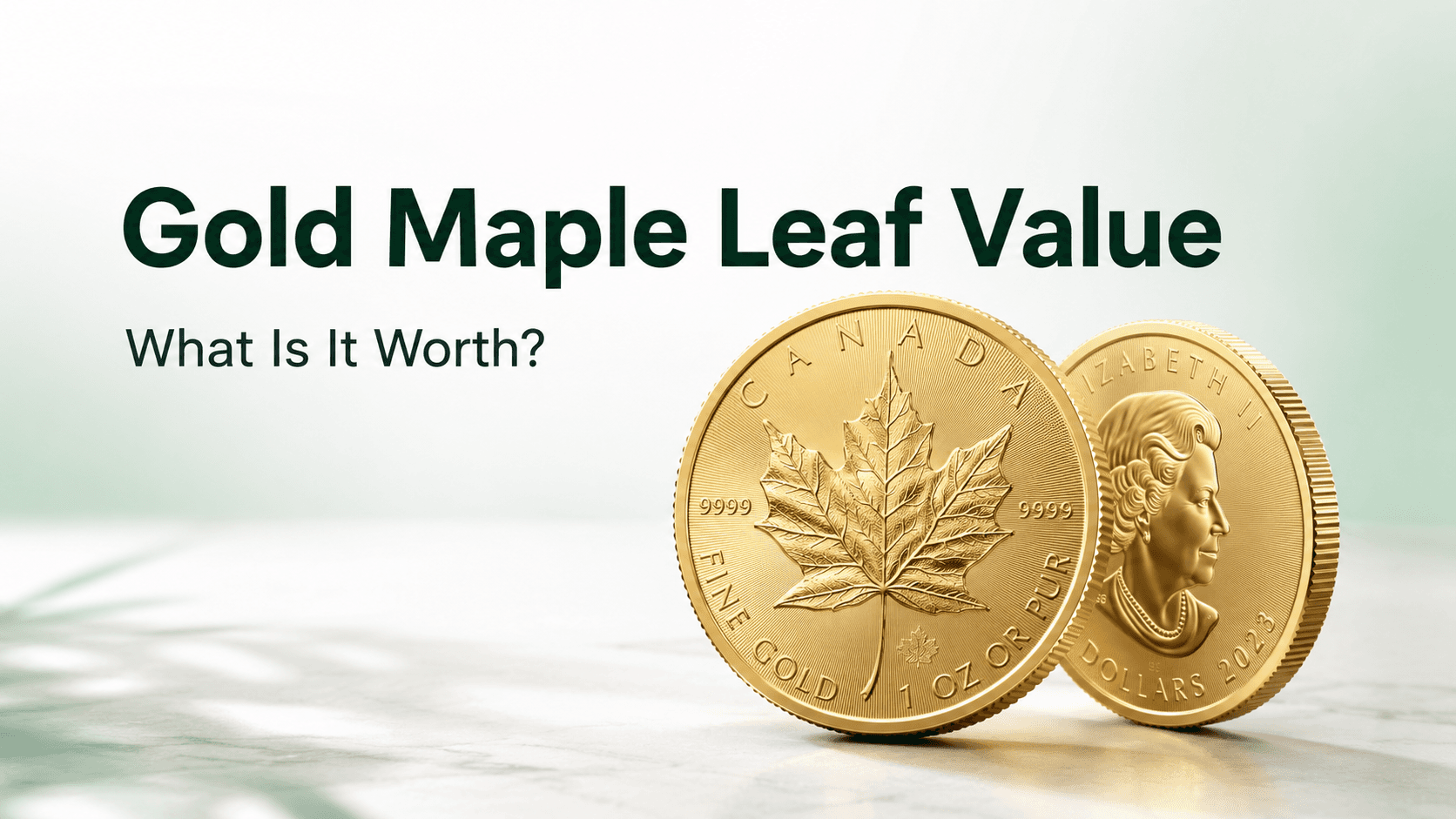

A 1 oz Canadian Gold Maple Leaf contains exactly one troy ounce of gold, so its base value is gold's spot price at that moment, times one. On top of that sits a premium: the extra a buyer pays for a minted, widely recognized coin instead of raw metal. Value equals god content at spot, plus premium.
Here's the worked version. On July 8, 2026, gold's spot price read $4,077.00 per troy ounce. At that reading, the metal inside one coin is worth exactly $4,077.00, full stop. What you'd actually pay to buy one today, and what you'd actually collect selling one, are two different numbers, and both sit a distance from spot. Most pages ranking for this question stop at "it's worth spot" and never show either. We'll show both.
One thing to clear away early: the coin says $50 on it. That's a legal-tender face value in Canada, and no one prices the coin off it. The gold decides the number.
What the premium covers on this coin
Turning gold into a Maple Leaf costs money. The Royal Canadian Mint strikes the bullion version in .9999 fine gold, refines the blanks, adds its anti-counterfeiting work (more on that below), and moves the coins through distributors before one ever reaches a listing. All of that lands in the premium.
The premium isn't fixed. It moves with demand for physical coins, which swings on its own schedule, separate from spot. It also varies by venue: the same coin can carry a very different markup depending on where it's listed and what that seller's cost structure looks like. Pure's premiums typically run about 3 to 5% over spot, against an industry range that commonly reaches 10 to 30% at retail.
And it varies by coin size, which gets its own section below, because the effect is bigger than most first-time buyers expect.
What you'd pay vs. what you'd get back
Every "Maple Leaf value" page quotes one number. A real market has two.
The ask is the lowest price any seller will currently take; the bid, the highest any buyer is offering right now. Buying, you'll pay at or near the ask. Selling pays out at whatever the best bid happens to be, and the gap between the two is the spread. On an order-book marketplace both numbers sit in the open on every listing. Reading one takes about two minutes.
On Pure's live 1 oz Gold Maple Leaf listing, the current picture looks like this:
That's from July 8, 2026, at 5:49 PM PST. The cheapest anyone would sell you the coin: $4,103.49, or 0.63% over spot. The most anyone was offering to pay: $4,086.88. Both sit above melt, and the $16.61 between them is the market's real answer to 'what is it worth': it depends which side of the trade you're on.
That's one coin, priced by a two-sided market at one moment, not a read on where gold goes next. The useful part is the piece a static price chart hides: the distance between the buying price and the selling price on the same physical coin, on the same afternoon.
How size changes the math
The Maple Leaf comes in fractional sizes, and gold content scales down in a straight line. Multiply the content column by the live spot price on Pure's gold chart and you have the metal value for any of them.
Size | Gold content | Metal value |
|---|---|---|
1 oz | 1 troy oz | spot x 1 |
1/2 oz | 0.5 troy oz | spot x 0.5 |
1/4 oz | 0.25 troy oz | spot x 0.25 |
1/10 oz | 0.10 troy oz | spot x 0.10 |
1 gram | 0.0322 troy oz | spot x 0.0322 |
Premiums don't scale down with them. Minting costs barely shrink with the coin, and a near-fixed cost spread over a tenth of the gold pushes the percentage markup up sharply. The smaller the coin, the more of your money goes to the premium instead of the metal. It's the annoying part of fractional gold, and there's no way around it, only the choice of which trade-off you want: a lower total price per coin, or more gold per dollar.
The extreme end of small is the Maplegram25, a sealed sheet of 25 individual 1 gram Maple Leafs, each carrying its own 50-cent CAD face value. Twenty-five grams of gold total, divided into the smallest coins the format allows.
Pure's catalog carries listings across these sizes, 1/2 oz included.
Year, condition, and the special issues
Most bullion Maple Leafs price off gold content regardless of the year on them. A 2016 coin and a 2024 coin hold the same ounce, and the market treats them that way. The 2024-dated coins carry the effigy of King Charles III, and the new portrait changes the look, not the value formula.
A few cases sit outside that:
The first Maple Leafs, from 1979, were struck at .999 fine before the Mint moved to .9999 in 1982. They show up in the market as vintage pieces and their fineness is noted in listings, but they trade on their gold content like every other year.
Since 2007 the Mint has also issued special 99.999% "five nines" Maple Leafs with a $200 face value. Those are separate limited issues, priced on their own terms rather than as standard bullion, and a value quote for a regular Maple Leaf doesn't apply to them.
Condition cuts the other way. A scratched, gouged, or mishandled Maple Leaf still holds its full ounce, but buyers paying a coin premium want a clean coin, so damaged pieces trade closer to melt, meaning the raw metal value with little or no premium on top. Pure .9999 gold is soft. It picks up marks from ordinary handling, which is why these coins tend to live in capsules and sealed sheets.
Fakes, and how a real one gets verified
Counterfeit Maple Leafs exist, and the Mint has spent the last decade making them harder to pass. A micro-engraved maple leaf privy mark, holding the coin's year in laser-engraved numerals visible under magnification, arrived in 2013. Radial lines across both faces followed in 2015. And every bullion Maple Leaf dated 2014 or later is registered under the Mint's Bullion DNA program, which lets participating dealers verify a coin against the Mint's own image database with a dedicated reader.
That covers coins in dealer hands. On a marketplace, verification has to happen somewhere too. Every item sold on Pure ships to its Los Angeles facility and runs through XRF and Sigma Metalytics testing, in about 24 hours, before the sale completes and the seller is paid. A coin that can't pass doesn't trade.
Checking the live number
Spot is on Pure's gold chart all day. For the coin itself, the Canadian Gold Maple Leaf page shows current listings across sizes with the full order book on each one, ask and bid side by side. That's the fastest way to turn "worth spot plus a premium" into an actual dollar figure for the coin in front of you.
FAQ
How much is a 1 oz gold Maple Leaf worth today?
Its gold content is worth exactly the current spot price, since the coin holds one troy ounce. On July 8, 2026, that meant $4,077.00. Buying one costs more than that once the premium is added; selling one pays the best bid on the order book, which sits below the ask. The live listing shows both numbers at any moment.
What is a 1/10 oz gold Maple Leaf worth?
One tenth of spot in metal, plus a premium that runs a noticeably higher percentage than the 1 oz coin carries, because minting costs barely shrink with the coin. Small coins cost the most per ounce of gold to own.
Do gold Maple Leafs lose value if scratched?
The gold content doesn't change, but the price usually does: damaged bullion coins trade closer to melt value because buyers paying a premium want clean coins. Since .9999 gold marks easily, most Maple Leafs stay in their capsules.
Is the $50 face value worth anything?
It makes the coin legal tender in Canada, and that's about the extent of it. The gold inside is worth many times the face value at any modern spot price, so the $50 functions as a designation, not a price. Nobody spends one.